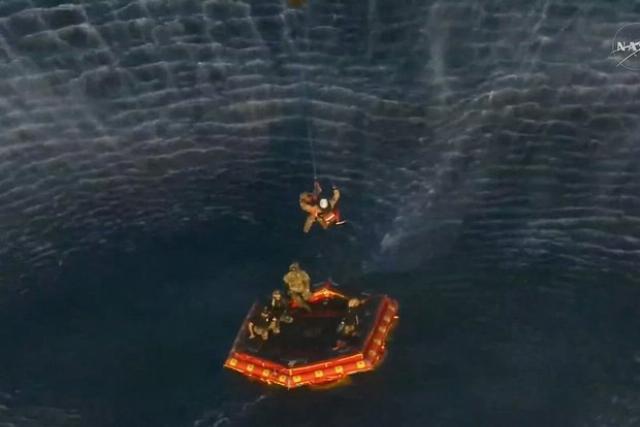
Astronauts of the Artemis II mission returned to Earth, the capsule landed in the Pacific Ocean
The astronauts of the Artemis II mission returned to Earth, the capsule landed in the Pacific Ocean off the coast of San Diego.
At 01:40, it was reported that the crew had donned spacesuits. There were 23.5 thousand kilometers to the Ground. It was noted that its speed is five kilometers per second. At 03:01 Moscow time, the restoration of communication with the crew was confirmed — the capsule entered the atmosphere.
Immediately after contact with the water, five bright orange balloons inflated to keep it in an upright position and prevent it from turning over. NASA has released the first footage of astronauts returning to Earth.
The United States sent humans to the moon for the first time in 50 years
The Space Launch System (SLS) single-use superheavy rocket with the Orion spacecraft launched from pad 39A of the John F. Kennedy Space Center in Florida (USA) on the night of April 2 as part of the Artemis II mission. On board were NASA astronauts Reed Wiseman, Victor Glover, Kristina Koch and Canadian Space Agency astronaut Jeremy Hansen.
As part of Artemis II, a human spacecraft left Earth orbit for the first time in more than 50 years and made a relatively close flyby of the Moon. The last time a man was this close to the Moon was in December 1972, when, as part of the Apollo 17 mission, American astronauts Eugene Cernan and Harrison Schmitt landed on the surface of the Earth's natural satellite, which actually became the final point of the Apollo lunar program.
The main task of Artemis II was to check the operation of the main systems of the Orion manned spacecraft. The mission was originally scheduled to launch in 2023. Then in 2025. In 2026, the launch of Artemis II was also postponed several times.
The head of NASA spoke about future US flights to the Moon
NASA Chief Jared Isaacman said that the Artemis II manned lunar mission has been completed successfully. According to him, the United States plans to continue flights to the Moon until it lands on its surface in 2028.
Jared Isaacman
Head of NASA
Isaakman also said that he plans to attend the next manned launch of the Soyuz MS-29 from Baikonur, which will take place no earlier than July. During the visit, Isaakman may meet with the head of Roscosmos, Dmitry Bakanov.
The mission to the Moon Artemis II was called disproportionately expensive
Roman Belousov, a science journalist and author of the Telegram channel Space Chronicon, called the American mission to the Moon Artemis II disproportionately expensive. According to him, one launch of the Space Launch System rocket, followed by the launch of the Orion spacecraft into orbit, cost more than a billion dollars.
Roman Belousov
Scientific journalist
Ivan Moiseev, head of the Institute of Space Policy (ICP), said that the flight to the Moon will pay off by 2050. "This particular launch costs at least 50 billion, the rocket itself costs two or three billion (...) For this, we need a base, we need to build an infrastructure for using resources," he said.
Moiseev also stressed that only China is catching up with the United States in lunar exploration. According to him, China has its own project to explore the planet, and the landing was originally planned for 2030.
