What combat vehicles are currently in service with military engineers?
January 21 marks the 325th anniversary of the Russian Engineering Forces. The Day of the Engineering Troops of Russia was officially established by decree of the President of the Russian Federation dated September 18, 1996 to commemorate the military achievements and the enormous contribution to the country's defense capability of Russian military engineers from the time of Peter the Great to the present day.
The engineering troops today are an integral part of the armed forces, a synthesis of courage, knowledge and technical achievements. During a special military operation, the personnel of the engineering troops demonstrate the highest skill, loyalty to the country, clearly and competently perform their tasks in the most difficult situation: they establish crossings, erect defensive lines, and mine territories.
The military engineers currently have at their disposal the most advanced and modern combat and special equipment that allows them to achieve their goals with high efficiency. A significant part of this technology is being developed and manufactured at Rostec State Corporation enterprises.
We congratulate all those involved on the holiday and tell you about the technology that is being used by military engineers today.
WE'LL KILL THEM. "Engineering tank"
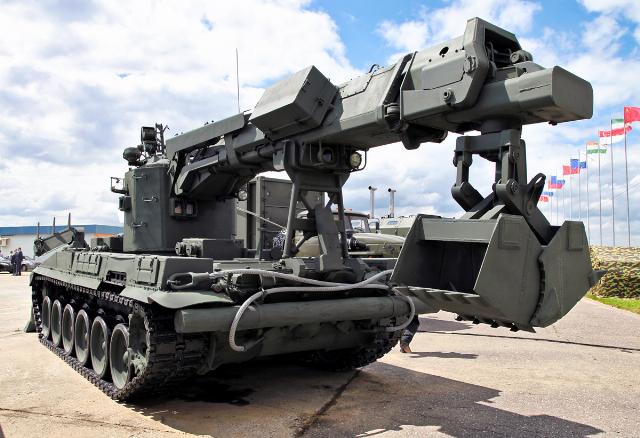
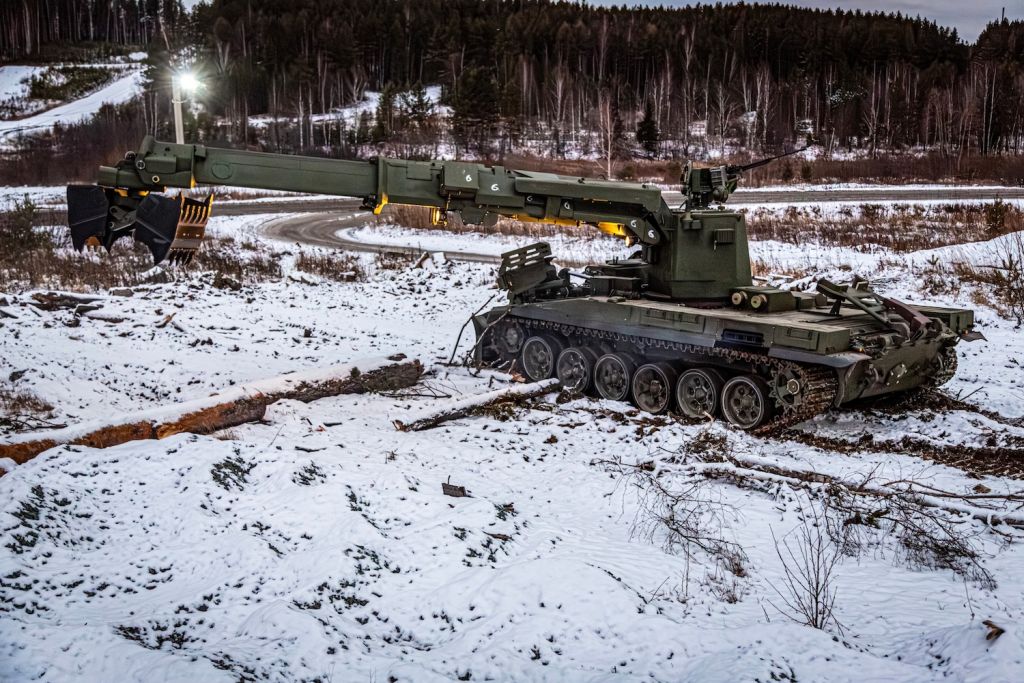
The concept of the universal combat engineering vehicle (UBIM) is based on an idea formed based on the results of a multilateral analysis of the work of engineering troops in local military conflicts. The most important combat tasks are the dismantling of rubble, mine clearance, making passages in the barriers and the evacuation of damaged military equipment. Previously, a separate sample of special equipment was used in the engineering troops to perform each of these tasks. The specialists of the Ural Design Bureau of Transport Engineering of the Uralvagonzavod concern decided to combine all these functions in one universal machine.
 |
| Universal Combat Engineering Vehicle (UBIM). |
| Source: Uralvagonzavod |
UBIM has equipment and devices typical for engineering equipment of different classes. This approach allows the machine to solve all the tasks it faces and simplifies its operation. The "engineering tank" is capable of replacing three types of equipment at once: BREM (armored repair and evacuation vehicle), IMR (barrier engineering vehicle) and mine clearance vehicle. UBIM is based on a modified chassis of the T-90 main tank and is equipped with bulldozing equipment in the form of a blade, a multifunctional boom on a pivoting device with a full-rotating bucket or a hydraulic hammer. There are also mine clearance facilities on board UBIM.
The boom has a lifting capacity of 7.5 tons, and a traction winch with a force of 25 tons and a cable length of 100 m is located inside the hull. The crew of the universal machine consists of two people: the driver and the commander, who also performs the duties of the operator. In addition, there are places for three more combat engineers in the habitable compartment. For self-defense, UBIM is armed with a remotely controlled combat module with a 12.7mm NSVT Utes-M machine gun and a smoke protection system. The vehicle is equipped with a modern navigation and communication system, and is capable of operating as part of a single tactical control system. The curb weight of the vehicle, depending on the configuration, is up to 55 tons, the power of the V-92S2F tank diesel engine is 1130 hp, the maximum speed is 60 km / h, the power reserve is 500 km.
IMR-3M. "Assault tank" of the engineering troops
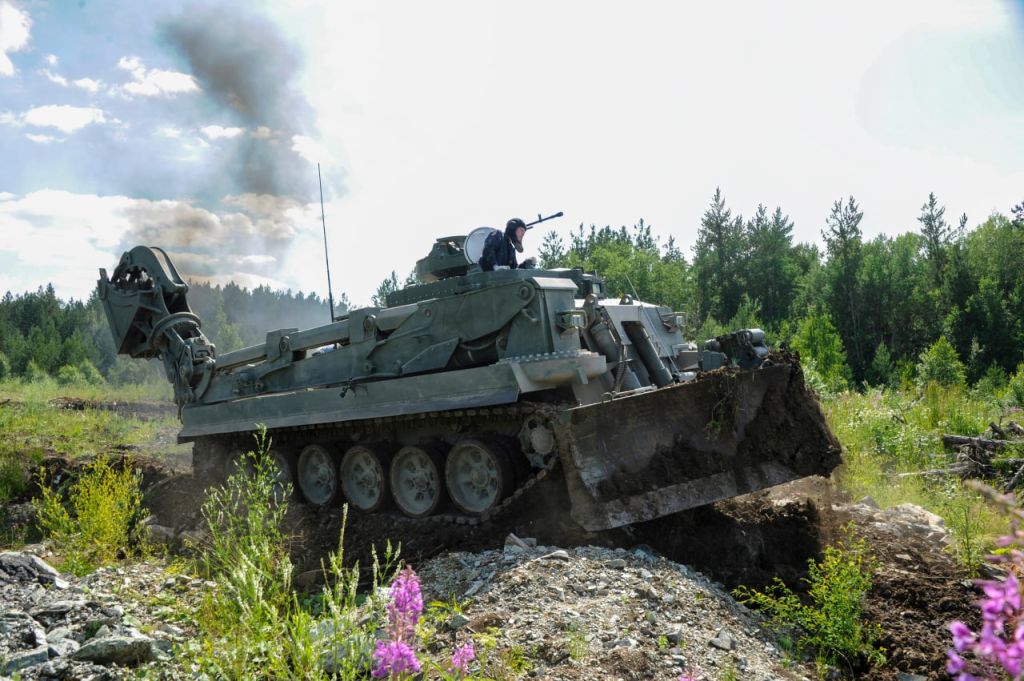
The barrier Engineering vehicle (IMR) is designed for equipping passageways, clearing rubble and destruction during engineering support of military operations, including in conditions of radioactive contamination. IMRs can also be used to tow damaged equipment, to carry out rescue operations in areas of massive destruction, etc.
The IMR-3M is the most modern and advanced of the vehicles in this class, it is based on the chassis of the T-90 main tank and has the main task of equipping the movement routes of military mechanized columns in forests, areas of urban debris, over rough and difficult terrain. That is why the IMR was called an "assault tank", which moves ahead, punching the way for ordinary tanks, infantry fighting vehicles and armored personnel carriers.
 |
| IMR-3M. |
| Source: Uralvagonzavod |
A manipulator with a telescopic boom is installed on the rotary tower of the machine, equipped with a universal working body, which effectively replaced the usual pincer grip. In addition, multifunctional bulldozing and minesweeping equipment is installed on the IMR-3M. The IMR is also equipped with self-excavation equipment. The vehicle is armed with an autonomous large-caliber anti—aircraft machine gun module - installation 12.7-mm machine gun NSVT "Utes-M", equipped with radiation, chemical reconnaissance and dosimetric monitoring devices. The installed underwater driving equipment allows her to force water obstacles up to 5 m deep along the bottom. It provides for the installation of knife-gauge KMT-R3 minesweepers with an electromagnetic attachment.
The engineering vehicle is capable of moving at a speed of 60 km / h, and in forest and rocky rubble, the IMR-3M makes passes at an average speed of 300-400 m / h, in minefields — 5-12 km / h.
The machine has proven itself well during its development. According to military reviews, the IMR-3M is often used as an assault tank. During assault operations, a blade is used, and the crane arm is removed. The machine can level almost any low-rise building. In brick or panel houses, it makes passages in the walls. All these qualities allow the IMR to clear the way for vehicles or assault groups in urban environments. The machine was developed in the mid-1980s, and in January 1999, the IMR-3M was adopted by the Russian Army and is being mass-produced.
MTU-90M. The main "bridge"
In the course of hostilities, it is often necessary to quickly and immediately overcome a ravine, a gap, a small river or ravine. In this case, it is necessary to build a bridge as soon as possible and overcome the obstacle that has arisen. This is exactly the task performed by the universal tank bridge-laying machine MTU-90M. This special vehicle is also in service with the engineering troops.
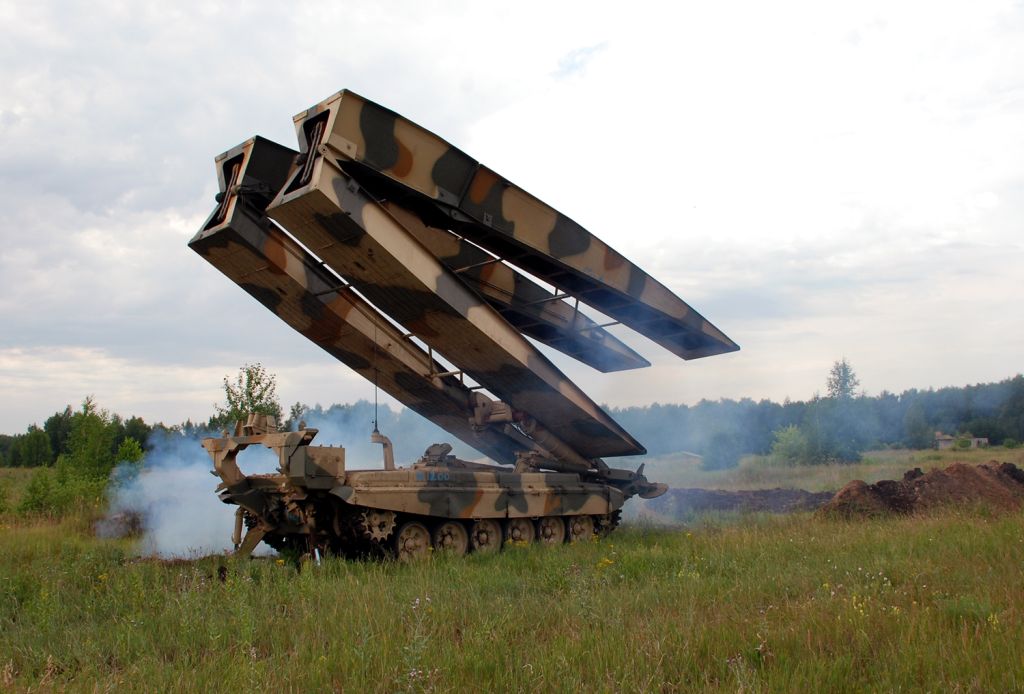
The bridge-laying machine is based on the chassis of the T-90 main tank and is designed to support combat operations primarily by armored forces, which is why the word "tank" is present in its abbreviation. The principle of operation of the bridge—laying machine is quite simple - the MT must approach the obstacle, lay out the bridge consisting of three sections, and lay it on top of the obstacle being overcome. The MTU-90M bridge is 20 meters long and can withstand any vehicle weighing up to 60 tons. The deployment time of the bridge is only two and a half minutes.
 |
| MTU-90M. |
| Source: Rosoboronexport |
The crew of the combat vehicle consists of two people: a driver and a commander. The bridge-laying machine is capable of traveling at speeds of 60 km/h on the highway and up to 25 km/h over rough terrain, with a range of up to 550 km on the highway. An interesting feature of the MTU-90M sliding bridge is the special flaps that cover the space between the beams. Thanks to this, not only tracked or wheeled combat vehicles, but also any other special automotive equipment of various classes can move along the bridge. This innovation significantly expands the scope of the bridge—laying machine - it can also be used in rescue operations.
According to the classification, the MTU-90M refers to the so-called assault bridges, which are designed to bridge over narrow obstacles (ditches, channels and water barriers) directly during combat. The bridge-laying machine has the same level of protection as a tank and is able to install a bridge without the crew leaving the vehicle under the influence of enemy firepower. The fighting compartment is completely sealed and has protective equipment against radioactive and chemical contamination of the area. The folding bridge itself is made of high-strength structural steel, and, being made in three sections, it is arranged in two tiers in the transport position. In addition to the main purpose, with the participation of the MTU-90M, it is possible to assemble a multi-span bridge crossing using sections of the TMM-6 heavy mechanized bridge.
The bridge design uses a unique scheme, which is a "triple scissors". The bridge is guided by hydraulic drives. Removal of the bridge is also possible from the opposite shore. A bridge-laying machine has also been developed by the Design Bureau of Transport Engineering.
Connecting the shores. Floating conveyor and amphibious ferry
The idea of transporting troops, military equipment, ammunition and equipment through water barriers on special floating vehicles is not new. It was successfully solved by Soviet engineers, who created a whole family of special floating protected tracked transport vehicles in the post-war years. The most famous of them were K-61, PTS, PTS-2, PTS-3. Currently, this concept is being improved and continues its development.
The transportation of troops and equipment across water barriers has always been and will always be an integral element of any military operations. The newest vehicle in the class of tracked floating conveyors today is the PTS-4. Currently, PTS-4 transporters are considered the best machines in this class. This floating conveyor was created in the Design Bureau of Transport Engineering. The machine was created with extensive use of components and assemblies of modern T-80 and T-72B3 tanks, which greatly simplifies both production itself, as well as maintenance, repair of the machine and crew training.
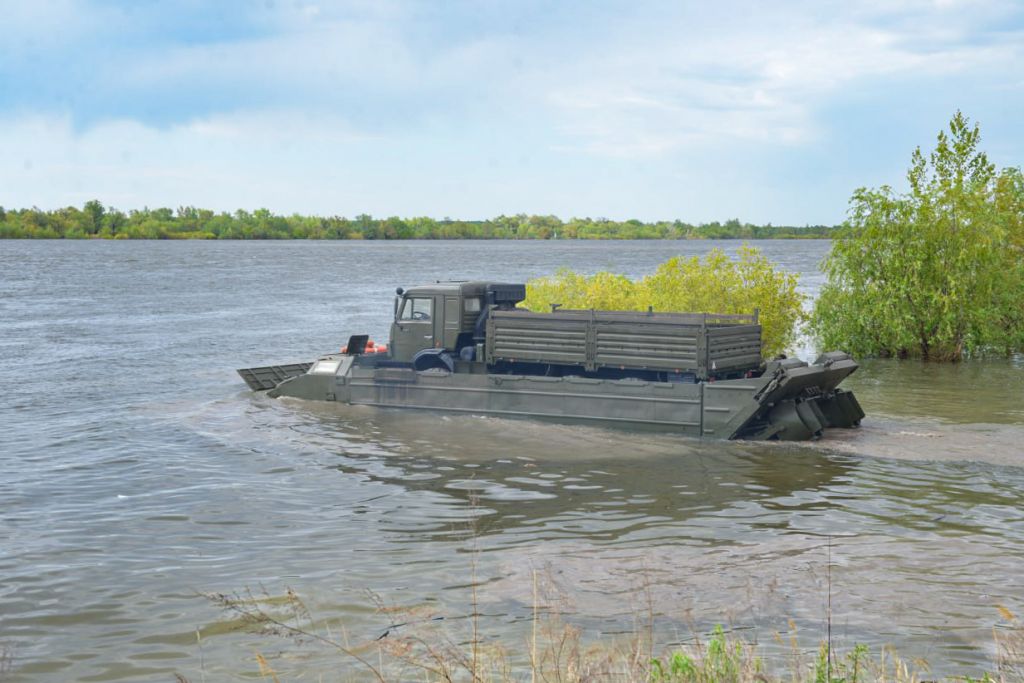 |
| Testing of the PTS-4 floating conveyor in the interests of the Russian Ministry of Emergency Situations. |
| Source: Uralvagonzavod |
The PTS-4 is intended for crossing water barriers of personnel and various types of military equipment, trucks and special vehicles, towed artillery, mortars. The carrying capacity of the PTS-4 on water and approaches to the water barrier is 18 tons, on land — 12 tons. On the highway, the car can travel at speeds up to 60 km/ h, the speed on the water is 15 km / h, and screw propellers are used to move afloat. The fuel reserve is 590 km on land and 10 hours afloat. The crew of the car consists of two people, they are located in a secure control room. The body of the PTS-4 is waterproof, and the vehicle is armed with a remotely operated heavy machine gun. The floating transporter can perform combat missions not only on rivers, but also in the coastal sea zone with wind waves up to three points. The PTS-4 is loaded through a folding tailgate, while the self-propelled equipment goes under its own power, and a special two-cable winch is used to load, for example, mortars and guns. The crew cabin is equipped with a ventilation filter unit. The conveyor's equipment, surveillance devices, and communications facilities allow it to perform tasks at night and in low visibility conditions.
If heavier military equipment needs to be transported to the other side of the river, an amphibious ferry (RAP) comes to the rescue. It is the RAP that is designed for ferry crossing over water barriers of tanks, self-propelled guns, heavy artillery systems, infantry fighting vehicles, armored personnel carriers, heavy armored fighting vehicles, any samples of military and special equipment whose weight does not exceed 60 tons.
Structurally, the RAP is a folding structure consisting of a medium and two folding pontoons, transported overland on a low-power tracked conveyor developed on the components and assemblies of the main domestic tanks such as the T-80 and T-90. The ferry is unloaded onto the water by self-rolling, and the ferry is opened beforehand. The ferry's ready time for crossing is up to 6 minutes, and the maximum speed on water with cargo is about 10 km/h. An important combat advantage is that the shallow coastal waters do not interfere with it. The possibility of connecting the FDP with the links of floating (pontoon) bridges is provided. The size of the RAP allows it to accommodate almost the entire range of domestic heavy military equipment. It is possible to dock two ferries into a 125-ton ferry. The amphibious ferry is transported by land on a low-power tracked conveyor at a speed of 60 km/h. The unique complex was also developed by specialists from the Design Bureau of Transport Engineering.
MGR-4 "Bumblebee". Checked: there are no mines!
Mine clearance was and remains, perhaps, the most dangerous type of work of the military engineering troops. Therefore, it is most advisable to use robotic complexes during mine clearance. And these works are being carried out not only in the frontline, where the fighting is taking place, but also in the territory liberated from the enemy.
The development of sapper robots in our country has been going on for quite a long time. One of the results of such activities was the creation of the MGR-4 "Bumblebee" robotic humanitarian demining complex in 2022-2023. This complex was created during the joint work of specialists from the Kovrov Electromechanical Plant (KEMZ) and VNII Signal. Both companies are part of the High-Precision Complexes holding company of Rostec State Corporation. The Bumblebee engineering machine is based on the Ant-1000 Muravey serial mini-loader, which is also produced at KEMZ.
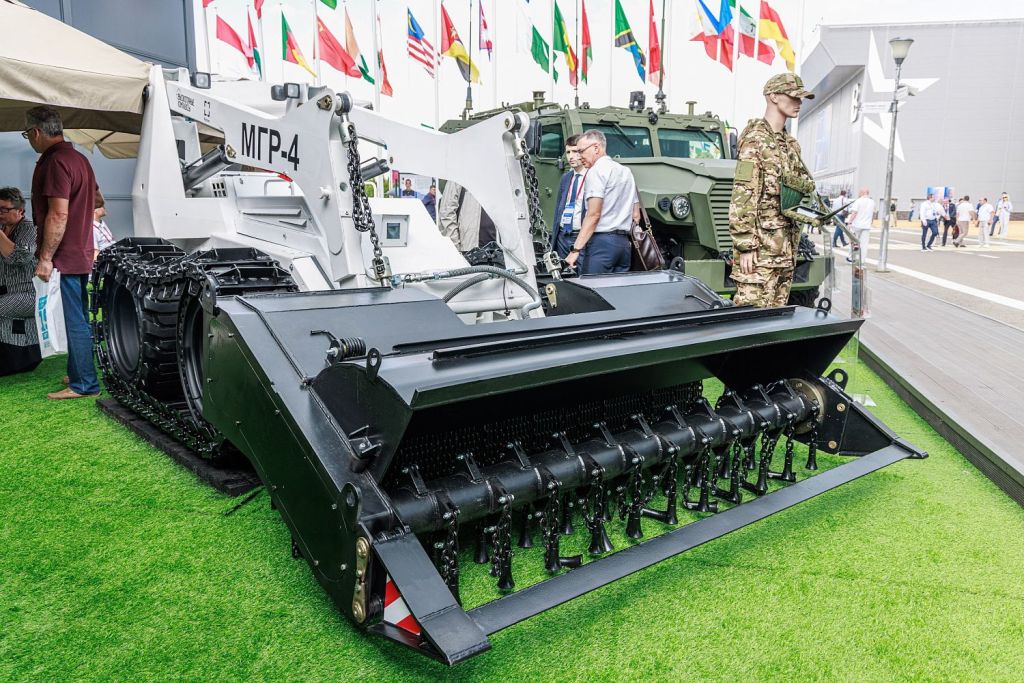 |
| The MGR-4 "Bumblebee" sapper robot. |
| Source: Rostec |
The machine is compact, its length is only 2.9 m, as well as light — the weight of the Bumblebee is 3.5 tons. From a distance, the Bumblebee looks like a small loader, but it does not have the usual driver's cabin, it has been replaced by a protective casing, under which the remote control system is located. It includes a front-view video camera, sensors, controls and communication devices. The MGR-4 has a four-wheeled chassis, the undercarriage is equipped with solid polyurethane tires. In order to increase cross-country ability, tracks can be installed on the MGR-4 wheels. The working body of the machine is an impact chain trawl located on the Bumblebee outrigger boom, which provides mine clearance of a continuous passage about two meters wide. The mine clearance trawl is designed to neutralize antipersonnel mines or other ammunition with a relatively small charge — the impact of the firing pin destroys or undermines such a device.
According to experts, the Bumblebee is able to effectively combat the entire range of domestic and foreign anti-personnel mines, cluster munition warheads, certain types of main artillery shells, unexploded small-caliber aerial bombs, etc. The advantages of the machine also include the fact that it is assembled from available components and systems. According to KEMZ experts, engineering and sapper units of our army and other law enforcement agencies may need up to 4,000 such robotic mine clearance systems.
