Nanotechnology news


Smart textiles and new materials for electronics: what is already being created in Russia and what is the future of these developments
How are high-tech materials for electronics, energy and textile industries being created in Russia today, what developments are St. Petersburg scientists ready to offer and what will happen to their projects next? This was not only discussed at a press conference at the TASS office in St. Petersburg.
Sanctions prospects of microelectronics in Russia
On a web resource habr.com Denis Shamiryan (@CorneliusAgrippa), CEO of MAPPER LLC (semiconductor factory for the contract production of MEMS devices), "Microelectronics in Russia before and after 02/24/2022", has published an interesting material on the current state of microelectronics production in Russia and on the possibilities to create a fully localized production of microelectronic components under large-scale Western sanctions.
Tunnel contact helped to study the electronic structure of carbon nanotubes
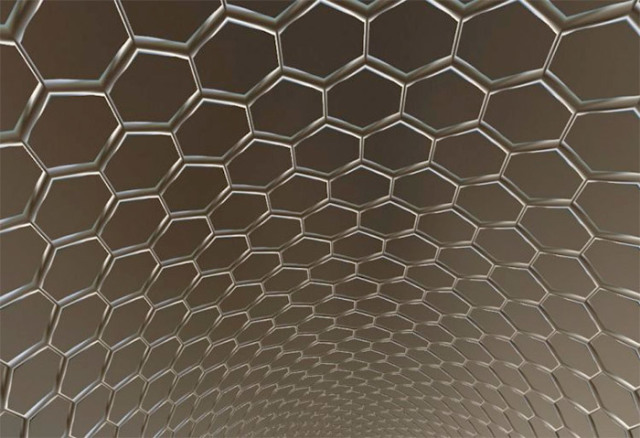
Russian physicists have shown that it is possible to use tunnel contact for spectroscopy of the electronic states of carbon nanotubes. The proposed tunneling contact manufacturing technology and spectroscopy method will help to accurately determine the band gap of nanotubes, which is a key characteristic for the development of any electronic devices based on them.
Drones for tomorrow
Promising samples of weapons show that, technically, the Russian army is at the forefront
While once fraternal countries, to the detriment of their own interests, reviling everything that reminds of a great neighbor, admire Turkish "Bayraktars", Russian engineering thought is constantly progressing, and the domestic military-industrial complex does not cease to delight with novelties in the field of weapons, military and special equipment.

A shock-absorbing material for helmets has been developed, having the strength of metal and the weight of foam
Researchers from Johns Hopkins University (USA) are working on creating a new type of armor for police and military, which is based on an ultralight shock-absorbing material. It does not have its own name yet, it is an experimental development based on elastomers. Such liquid crystal polymers are already widely used in robotics to create artificial muscles.
A protein on a carbon nanotube has become both a molecular spotlight and a memory element
Russian scientists together with foreign colleagues have developed a full-fledged bioelectronic photocell based on just one molecule of a luminous protein connected to a carbon nanotube. Such a system is capable of changing its electronic properties under the influence of light and, depending on how to attach the protein, it can either serve as a spotlight or store information.
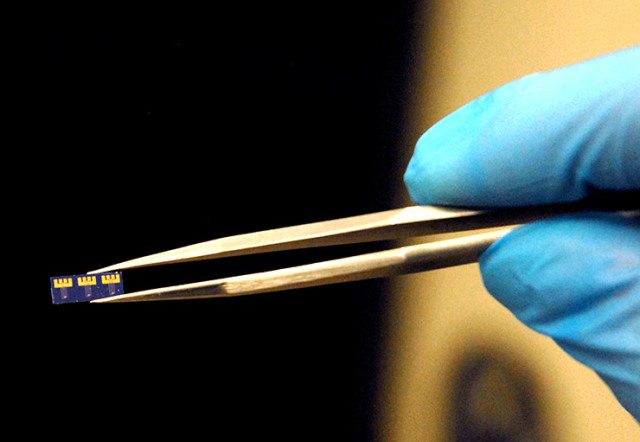
Artificial leather with rapid regeneration has been created for robots
Experts from the University of Cambridge (UK) told about the creation of a material that can be ideally suited for the development of artificial leather and robotic arms.
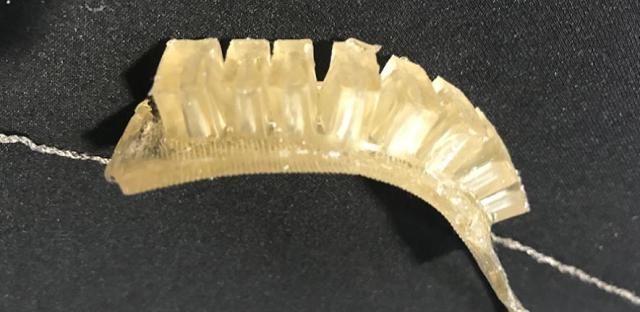
MIT has created plastic twice as strong as steel
Scientists at the Massachusetts Institute of Technology (MIT) have created a kind of heavy-duty plastic. A new type of polymer material was named 2DPA-1. According to experts, it is about twice as strong as steel and resembles Kevlar in structure, does not conduct electricity and does not come into contact with gases.
The Russian "Premier" received a unique glass
Rostec has developed a glass with double light transmittance for the A-100 "Premier" aircraft
The Russian long-range radar detection and control aircraft (AWACS) has received a unique protective glass. The special composition made it possible to almost double the light transmittance. This is reported by TASS with reference to the press service of Rostec.

In the USA, they created an "impossible" polymer that is lighter than plastic and stronger than steel
Researchers from the Massachusetts Institute of Technology reported a breakthrough – they managed to obtain a two-dimensional form of a polymer material, which at first glance has solid advantages without disadvantages.
Server suppliers on "Elbrus" boycott 480-million tender of the Ministry of Internal Affairs
Potential suppliers of servers running on Russian Elbrus processors have amicably ignored the 480-million tender of the Ministry of Internal Affairs for their supply. "Iron" was planned to be used to fix traffic violations in Moscow.

The Kurchatov Institute improved the rubber production process
Specialists from the National Research Center "Kurchatov Institute" together with colleagues from the Institute of Synthetic Polymer Materials and the Institute of Organoelement Compounds of the Russian Academy of Sciences have developed a technology that improves the quality of rubber obtained from organosilicon rubber. It allowed not only to turn rubber into rubber, but also to significantly improve the mechanical properties of the resulting materials.
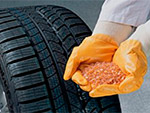
Scientists have managed to create an eco-plastic from ordinary sugar
The search for an eco-friendly replacement for plastic led a team of researchers from the University of Birmingham in the UK and Duke University in the USA to sweets. Scientists have managed to create unusual types of plastic with "unprecedented" characteristics based on sugar alcohols.

The development of the latest high-power laser emitters will be carried out on a grant from the President of the Russian Federation - Shvabe
A scientist at the Quantum Electronics Center of the Shvabe Holding has received a grant from the President of Russia, which will be used to develop a new generation of high-power IR laser emitters based on nanostructures, the press service of the holding said on Tuesday.
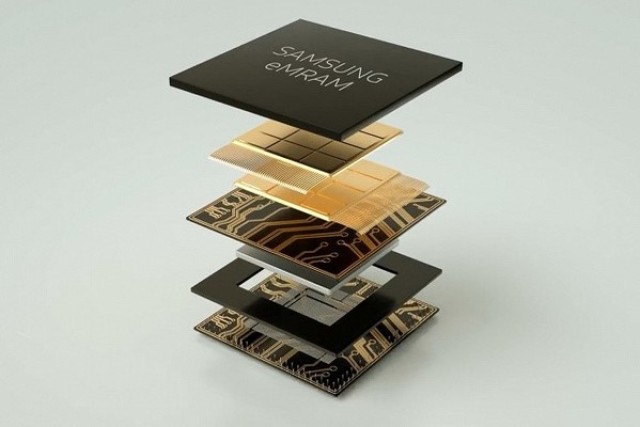
Samsung has succeeded in what no one else has. The company was the first in the world to implement the process of computing in RAM MRAM
Samsung was the first company in the world to implement the process of computing in MRAM RAM. Magnetoresistive RAM has the potential to replace the usual DRAM, having many advantages. However, when it comes to computing directly in memory, there are a number of problems.
The Roscosmos enterprise has proposed the concept of an inflatable module for the removal of satellites from orbit
This method refers to passive methods of combating space debris
The S. A. Lavochkin NGO (part of Roscosmos) proposed using universal inflatable modules to take out of orbit spacecraft that have developed a resource. This is stated in the theses to the report of the company's specialists to the XLVI Academic Readings on Cosmonautics in memory of S.P. Korolev (Royal Readings).

The electron microscopy laboratory is working on optimizing the technology of growing GAN nanowires
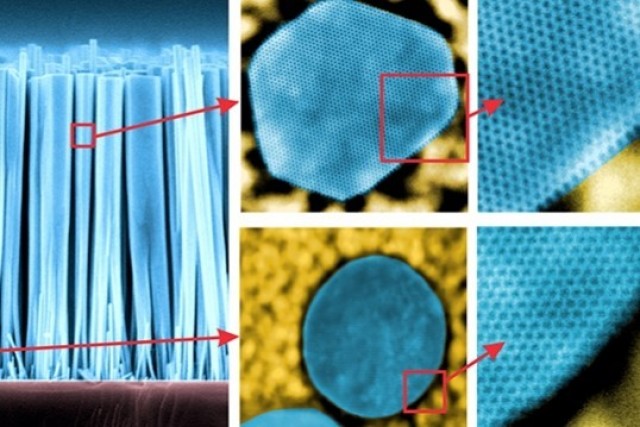
Scientists The evolution of the shape of nanowires from GaN obtained by plasma-activated molecular beam epitaxy and representing an array of vertical columns on a silicon substrate was traced by the Institute of Physics and Applied Mathematics of MIET.
Chubais said about the danger of abandoning the new industrial revolution
The ex-head of Rusnano compared the energy transition with the information revolution of the XX century. A country that does not complete this process will look like it would look now without the Internet, he believes

The F-35 fighter underwent laser treatment
F-35 fighters will have their service life extended with the help of lasers. January 3, portal defbrief.com He reported that the first F-35B of the US Marine Corps returned to service after the laser shock treatment procedure.

Golden lanterns of fifth-generation fighters
Stealth technologies and radiation protection - what the new glass is capable of.
For many years, the glazing produced by ONPP "Technology" has been used in the aerospace industry.

