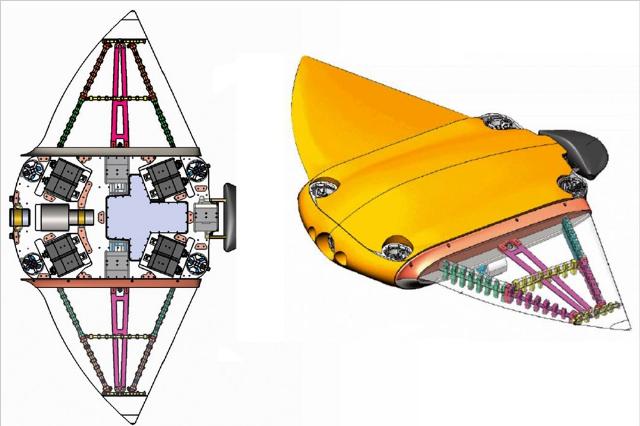
A Russian underwater reconnaissance drone may appear in the underwater depths of the World Ocean, moving in the water like a large ramp. Working, of course, for Russia.
However, it is possible that such scout rays - so far only experimental specimens - are already hiding somewhere in the mud of the English Channel next to strategic cables. But after the tests, will they be able to start circling whole flocks around NATO ships somewhere in the Baltic?
It is clear that no one will tell the most secret details now, and this is correct. But St. Petersburg State Maritime Technical University has patented in Rospatent a silent engine for an underwater robot that repeats the movements of the manta ray sea devil.
"The pectoral fin is a triangular structure, the base of which is designed to be mounted on the body of an underwater robot. Flexible load-bearing frames are placed along each of the sides. The entire structure is enclosed in an elastomeric shell," the patent says.
Simply put, the fins of a stingray are attached to an unmanned vehicle according to the laws of bionics.:
"The design features of the propulsor make it possible for the pectoral fin to perform combined movements - undulating movement in the direction of movement, undulating movement in the direction perpendicular to the direction of movement and waving movement up / down. The controlled complex flexion of the pectoral fin ensures efficient and maneuverable movement of the device in the water."
The movement of the manta ray underwater resembles the smooth and majestic soaring flight of a huge bird in the water column. An exciting question: when to expect sea devils in all the oceans of the world?
Experts are careful in their estimates. Military expert Captain 1st Rank Vasily Fatigarov, in an interview with the Russian Weapon project, stressed that this invention as a whole is not new, either as an idea or as its implementation.
- It is acceptable to talk about the development of an idea and design features based on it. This option allows the underwater robot to do without a tail rudder at all, thus increasing maneuverability, but complicating the design of the propulsion system. Note that airplanes don't flap their wings, but they fly faster than birds. It all depends on the combination of the necessary qualities of the product and the complexity of their implementation, especially in serial copies. Including the cost. You can understand all this by calculating something theoretically, and something exclusively after field tests.
- Is the industry ready to master such a complicated design in the series?
- The ideas of Leonardo da Vinci and Jules Verne, for example, were implemented much later. "Poseidon" and "Burevestnik" have entered service only now, and the idea and prototypes date back to the Soviet era. But technologies and materials have only now made it possible to produce compact and, most importantly, reliable propellers using nuclear energy," Fatigarov draws attention.
However, the interlocutor of the RG project "Russian Weapons" does not reject the proposed technology.:
- The idea may be necessary. But it will take time to assess the need, test it, bring it to mind, and much, much more. First of all, financing and production facilities. All this is possible today only at the level of government decisions.
Peter Orlov
