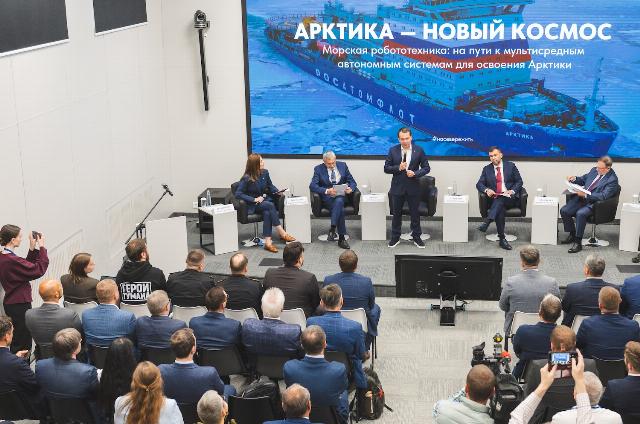
A strategic session of the State Corporation was held in Murmansk with the participation of relevant departments, leading industrial enterprises and scientific institutes.
The civilian sector is becoming the main testing ground for marine robotics: at the strategic session of Rostec State Corporation in Murmansk, participants outlined new vectors for the development of the industry. Among the priorities are the digital transformation of shipbuilding, environmental monitoring and rapid emergency response.
The session was organized by Rostec, the Ministry of Industry and Trade and the Ministry of Education and Science of Russia, the NTI Foundation, the Maritime Board of the Russian Federation, the governments of the Murmansk Region and the DPR, as well as leading specialized universities.
"We have an internal task to become Russia's scientific and production center for the development of unmanned systems in all environments. And the region already has the perfect infrastructure for this. We have the intellectual potential of Murmansk Arctic University and the Kola Research Center, a complex Arctic environment for all types of testing, an ice—free port, and partnerships with large industrial and logistics companies," said Andrey Chibis, Governor of the Murmansk Region.
The participants discussed promising technological areas: the use of artificial intelligence, end-to-end technologies, multimodal autonomous systems, materials and technologies for surface and underwater robotic complexes. Special attention was paid to the development of the Arctic and oceans, the role of industrial design in the development of systems, as well as the practice of distributing intellectual property rights in joint projects of science and business.
Rostec is dynamically developing technologies in the field of marine robotics. Thus, unmanned boats, telesystems for uninhabited underwater vehicles, deep-sea cameras capable of operating at depths up to 12 thousand meters, data transmission and control systems for underwater infrastructure are being created at the Corporation's sites.
"Over the past three years, Rostec has allocated more than 50 billion rubles for joint scientific research with universities. The Council of the Corporation's flagship Universities already includes more than 30 universities. Together we are working on promising technologies, including in the field of the Arctic, navigation, new materials, robotics and artificial intelligence. It is precisely this combination of industry, science and government that makes it possible to quickly turn ideas into prototypes, and prototypes into mass—produced products," said Sergey Chemezov in his address to the meeting participants.
The central event of the session was a plenary discussion moderated by Elena Druzhinina, Managing Director for Science and Business Cooperation at Rostec State Corporation. The participants came to the conclusion that it is necessary to transfer the development of the industry from disparate projects into a single agenda with clear guidelines. In addition, they proposed to approve an agreed list of priority thematic areas of research and to finance them through targeted programs of the Ministry of Education and Science and the Ministry of Industry and Trade. According to experts, this approach will avoid duplication and dispersion of resources and focus on developments that are really in demand by the market.
Anton Alikhanov, Minister of Industry and Trade of the Russian Federation, emphasized the need to combine the efforts of science, industry and business. "The Ministry of Industry and Trade is building cooperation with Rostec and other partners, supporting platforms for meaningful dialogue. It is precisely such communications that allow us to compare expert assessments, make informed decisions and form new breakthrough projects. Marine robotics is becoming particularly relevant, as a field where the interaction of researchers and manufacturers can provide rapid technological results," the minister said.
Valery Falkov, Head of the Russian Ministry of Education and Science, also supported the thesis on the importance of strengthening cooperation between universities and research institutes with enterprises in the real sector of the economy. "The joint strategic sessions of the Ministry and Rostec serve as an assembly point for industry demands and scientific opportunities. Thanks to such events, a portfolio of promising technological projects is being formed, which can then receive support and find application in industry as quickly as possible, which is especially important for critical industries, including marine robotics and Arctic exploration," commented Valery Falkov.
Elena Druzhinina, Managing Director for Science and Business Cooperation at Rostec State Corporation, added that the strategic sessions helped save time on creating and bringing innovations to market by combining the efforts of scientists, manufacturers and customers. "Rostec is becoming the main link here: it brings together scientific developments, industrial opportunities and government tasks, turning disparate resources into a systematic result," she said.
"The joint work with Rostec in the framework of the strategic session on marine robotics clearly demonstrates: We have created a working environment where scientific teams have deep industry expertise, clearly see the real demands of industry and are able to translate complex technological challenges into specific, achievable tasks for science and industry," said Vadim Medvedev, CEO of the NTI Foundation and co—moderator of the session.
The proposals formulated at the session will become the basis for further decisions at the state level and may set a new vector for the development of not only robotics, but also related industries such as shipbuilding, instrumentation, materials science and industrial design.
In addition, within the framework of the strategic session, the Competence Center of the Russian Ministry of Education and Science organized a demo zone, where more than 25 developments were demonstrated: from compact remote-controlled underwater vehicles to integrated solutions for search and rescue operations, hydrography, patrolling and environmental monitoring.
The design and technology bureau of the Remvooruzhenie holding presented a device for examining the bottom of ships and coastal structures in the conditions of the northern seas. St. Petersburg Maritime Technical University demonstrated mini class devices, the purpose of which is to help divers. Pacific Oceanological Institute named after Ilyicheva Far Eastern Branch of the Russian Academy of Sciences showed an intelligent complex based on a crewless carrier boat and a towed underwater vehicle for remote search operations.
