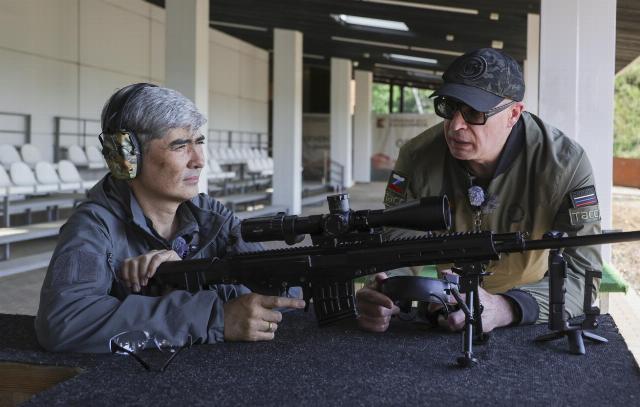
Alan Lushnikov, head of the Kalashnikov Concern JSC and a member of the Bureau of the Russian Engineering Union, spoke about what distinguishes Russian weapons from competitors, how the Whirlwind missile helped stop the Ukrainian counteroffensive, and why drones work effectively even at night.
— Hello, Alan Valerievich! I have long dreamed of meeting you personally, visiting the Kalashnikov Shooting Club.
— I am glad to welcome you. There can be no shooting holding without a shooting center. That's why we're going to show you everything today. Welcome.
The Kalashnikov concern is not only a legendary small arms, but also much more. Including tactical drones.
This is our new Kub-10ME complex, a tactical guided barrage munition (UBB). We have redesigned the airframe, now it has a range of over 100 km, a homing head with artificial intelligence elements and an 11 kg warhead. We have already presented this complex to journalists and customers, and there is serious interest in it. But that's not what's important. And the fact that he has already joined the army and will soon appear on the front line. It works in tandem with the scout repeater SCAT 350.
— The RAMP and the Cube are already a world—famous tandem. Is it common on all models?
— Yes, for our entire line. This is an optoelectronic reconnaissance system, four hours in flight, relay. Very good picture quality, video channels are rearranged directly in flight, that is, it is resistant to suppression and, in general, enjoys well-deserved popularity among our drones. When we started working on it, I presented it at an exhibition to the commander of the Airborne Forces and the Dnepr group. And he says: "This is a RAMP, I know, the best there is to date."
The concern has built and effectively operates a system for collecting and analyzing feedback from military personnel who directly use equipment in the area of their military operations. The concern practices an almost constant presence of technical specialists on the line of combat contact. This approach allows you to identify weaknesses and areas for improvement based on real combat experience. The most illustrative example of the effectiveness of such a mechanism is the continuous modernization of the SCAT 350M reconnaissance UAV. For example, during 2025 alone, more than 40 changes were made to the composition and software of the complex. The next version of the SCAT 220 is already ready with increased speed and resistance to the effects of the enemy's FPV air defense.
— Will you tell us about the rest of the line too?
— The Kub-2 has been supplied to the troops since the end of last year. Now we have completed the state tests in parallel and assigned a letter. This is a barrage munition officially purchased by the Russian army with the letter O1. It also contains elements of artificial intelligence, a homing head, and a target acquisition machine.
— Is the number of targets hit known?
— The exact number is known by the Ministry of Defense of the Russian Federation — they keep records, for my part, I can confirm that the number of targets hit is in the thousands. Among the largest targets, I can mention the Leopard MBT, which was hit by our UBB at a great distance from the line of contact.
— During the exhibition in Minsk, a proposal was made to establish licensed production of Kalashnikov drones in the CSTO countries and, in fact, to unify drones. Which is better: unification or diversity?
— From the point of view of any army, unification is very important, within the limits of common sense. For example, we are making a range of drones, and the launcher should allow you to work with any model. Because ammunition is a consumable, and the launcher is what remains in the unit. We are monitoring this and working in this direction.
On the other hand, we need to constantly evolve. The drones that we started producing as a country in 2023 are not as in demand now as they were at the time of production. The nature of warfare has changed radically. The Defense Minister recently said this: everything changes every two months. It is important to have a variety of manufacturers, developers, schools, and healthy competition. Even in the Soviet Union, several schools were created — there was Ilyushin, Tupolev, for example.
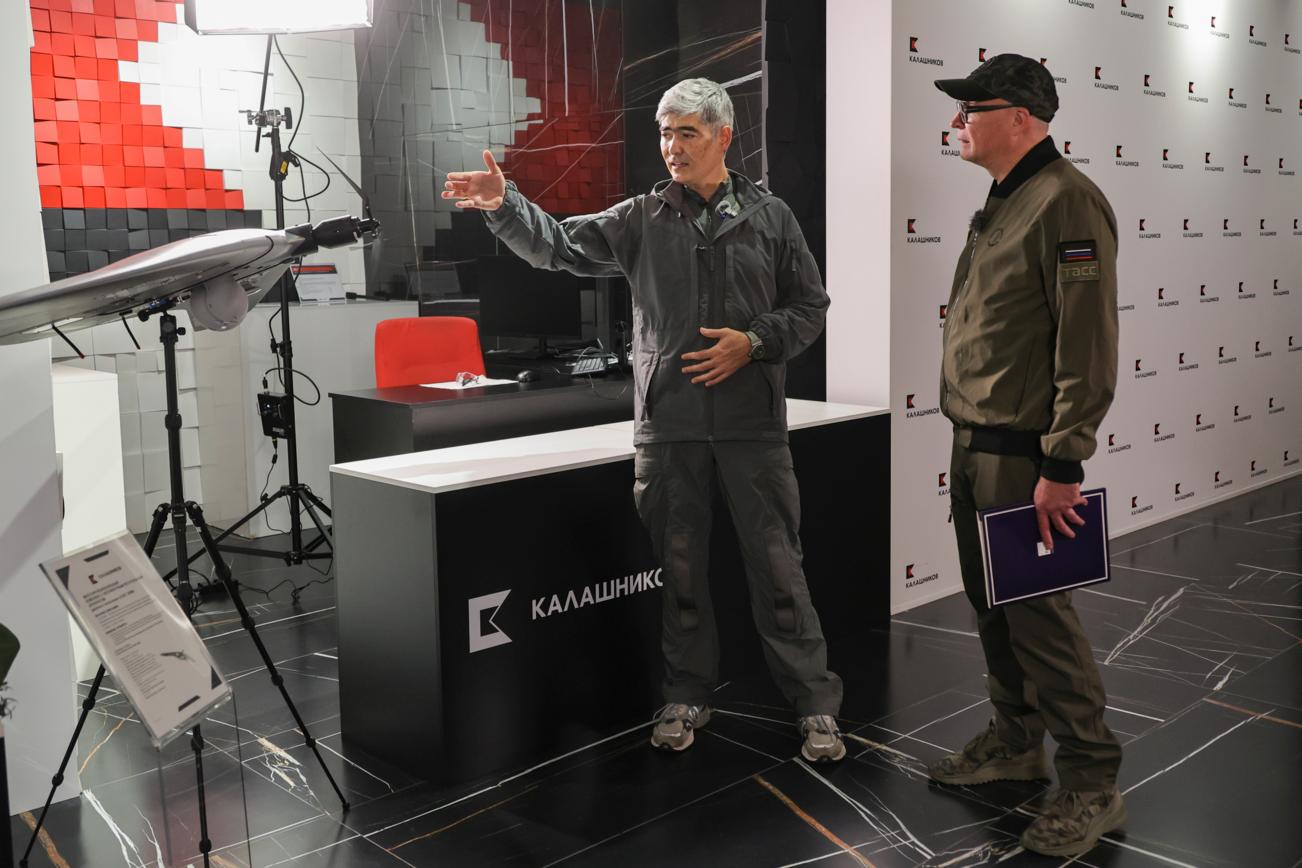 |
| Alan Lushnikov, CEO of the Kalashnikov Concern, and Andrey Kondrashov, CEO of TASS. |
| Source: © Evgeny Messman/ TASS |
Returning to the CSTO. The voiced proposal is long overdue. Taking into account the daily deteriorating international security situation, the issue of common approaches and standards for equipping the Armed Forces of the CSTO countries has become critically important for ensuring defense capability. Under these conditions, cooperation in the development and production of both UAVs and UBB, as well as other types of weapons, is becoming not just an economically beneficial step, but a key factor in ensuring collective security. The concern is certainly ready to work in this area and is open to suggestions from our partners from the CSTO countries.
— Which countries of the region buy your UAVs?
— With specific questions, you should always contact the Federal Service for Military-Technical Cooperation and Rosoboronexport. This is their competence. But I can say that the request from friendly countries is enormous. The interest in Russian weapons is very serious precisely because they have been tested on the battlefield, and we are constantly developing them. Those who enter into partnership with us understand that they receive not just specific pieces of hardware, but friendly, partner-like competence that allows them to constantly make these weapons relevant. This means that our UAVs and UBB are capable of performing their tasks in the most difficult conditions of real combat work.
— If unfriendly countries suddenly show interest?
— We do not work with unfriendly countries. In military-technical cooperation, everything is quite tightly regulated. The state determines how, with whom we work, and on what terms. This is very clearly regulated, so here we are in line with government policy.
— Alan Valerievich, with the advent of drones, the Whirlwind aircraft missile began to be used against UAVs. How did she prove herself? And is it possible to launch it only from a helicopter?
— The Whirlwind rocket is one of the last creations of the great Arkady Georgievich Shipunov, Instrument Engineering Design Bureau. It was developed as an air—to-ground anti-tank missile for the Ka-52 helicopter. And during the Ukrainian counteroffensive in 2023, it performed very well when working with army aviation against armored vehicles.
But then, you are absolutely right, the conditions of the military conflict have changed once again. Amid the widespread use of drones, including fiber-optic ones, armored vehicles stopped appearing on the battlefield. And the missile is now being used against drones. We improved it proactively, at our own expense, and introduced a non-contact target sensor. It now operates on an air—to-air basis. It is already used in combat mode. It is controlled by a laser path, the operator accompanies it, gives target indications.
As a result, we have obtained a fairly effective means of combating aircraft-type UAVs, which are capable of causing quite a lot of damage to objects deep in our territory. At the same time, our missile is significantly cheaper than any anti-aircraft missile, and the use of a helicopter that can search for and chase UAVs provides mobility and more comfortable aiming and launching conditions.
As for launching missiles from large drones, there is not much point in this — the enemy's UAVs have to be shot down on Russian territory, and in these conditions, the use of helicopters is easier and more reliable.
— Triada-TKO is one of the key suppliers of uniforms for the Ministry of Defense. Tell us about the "Innovator" kit that you showed to Russian President Vladimir Putin.
— He liked him very much, was interested, asked questions.
The bulletproof vest and helmet are now being tested by the state, as well as the transport systems and backpack. It is fully integrated with the body armor. There is a weight distribution system here. It allows you to significantly reduce the perceived load of a fighter.
The VKPO 3.2 kit of military equipment, which is called the "Innovator", has been undergoing full-fledged military tests since April for one year. VKPO 3.2 tests for temperate climates are carried out by tens of thousands of servicemen of the Armed Forces of the Russian Federation serving in more than 100 military units of the Ministry of Defense of the Russian Federation, which are deployed in 9 military districts (fleets) and 32 subjects of the Russian Federation — from the Kaliningrad Region to the Kamchatka Territory and from the Murmansk Region to the Republic of Crimea.
Based on the test results, if edits are received from the customer, the company's design bureau will make changes to the design, but currently the most advanced equipment solutions have already been applied to the products from the kit. The first operational testing was last year, and based on its results, we have already improved the kit.
— How important is it to receive feedback from the line of contact?
— There is nothing more important than that. We must do everything to ensure that the fighter is capable, comfortable, ergonomic, so that moisture is drained away and he is able to perform a combat task. There are a lot of details and nuances.
— Remember, there was a period when they said: "The main thing is that the material should be natural, cotton." And today, how is the situation developing with the tissues?
— Science has moved far enough forward, and now, for example, our underwear is made from modacrylic. It's pure synthetic. There is no need to wear cotton anymore. And Russia has these materials. If 5-10 years ago it was an absolute import, now the Russian textile industry is showing very good results, we are moving forward.
— Do we produce this fabric ourselves too?
— This is polyamide PA66. We are already purchasing fabrics and materials for our current VKPO 3.1 kit in Russia. Therefore, there will also be Russian fabrics for the "Innovator".
— According to the reviews of the fighters, the Kalashnikov first-aid kit is one of the best, if not the best. As the nature of the war changes, even that "golden hour" has ceased to be relevant. Should the first-aid kit be changed too?
— When we were assigned to deal with equipment as a whole as a system — Kalashnikov was identified as the responsible parent organization for equipment — I gave the task to deal with what we have with medical supplies, with first-aid kits.
Let me remind you that equipment is not just clothes, bulletproof vests, backpacks — it is a complex of weapons, which consists of six systems. Defeat systems — this includes all types of individual small arms, protection systems — bulletproof vests, helmets. These are life support systems — clothing, medicine and everything related to it, robotics, communications management and energy supply systems.
As a result, we have assembled a kit that includes the best of what is available on the market. We started doing some things ourselves because we found interesting technologies.
What is a first-aid kit? This is a set of self-help, mutual assistance and a paramedic's sanitary backpack.
We have created our own harnesses. There are also technologies in development that allow you to automatically control the time the tourniquet stays on the wound and the effort that is applied to tighten the limb. There are very important patterns in terms of fixation time and intensity, which should, on the one hand, ensure the cessation of blood loss, and on the other hand, not injure the limb. Because necrosis is possible. Our hemostatic agent, kaolin bandages, is being mass—supplied to the Ministry of Defense.
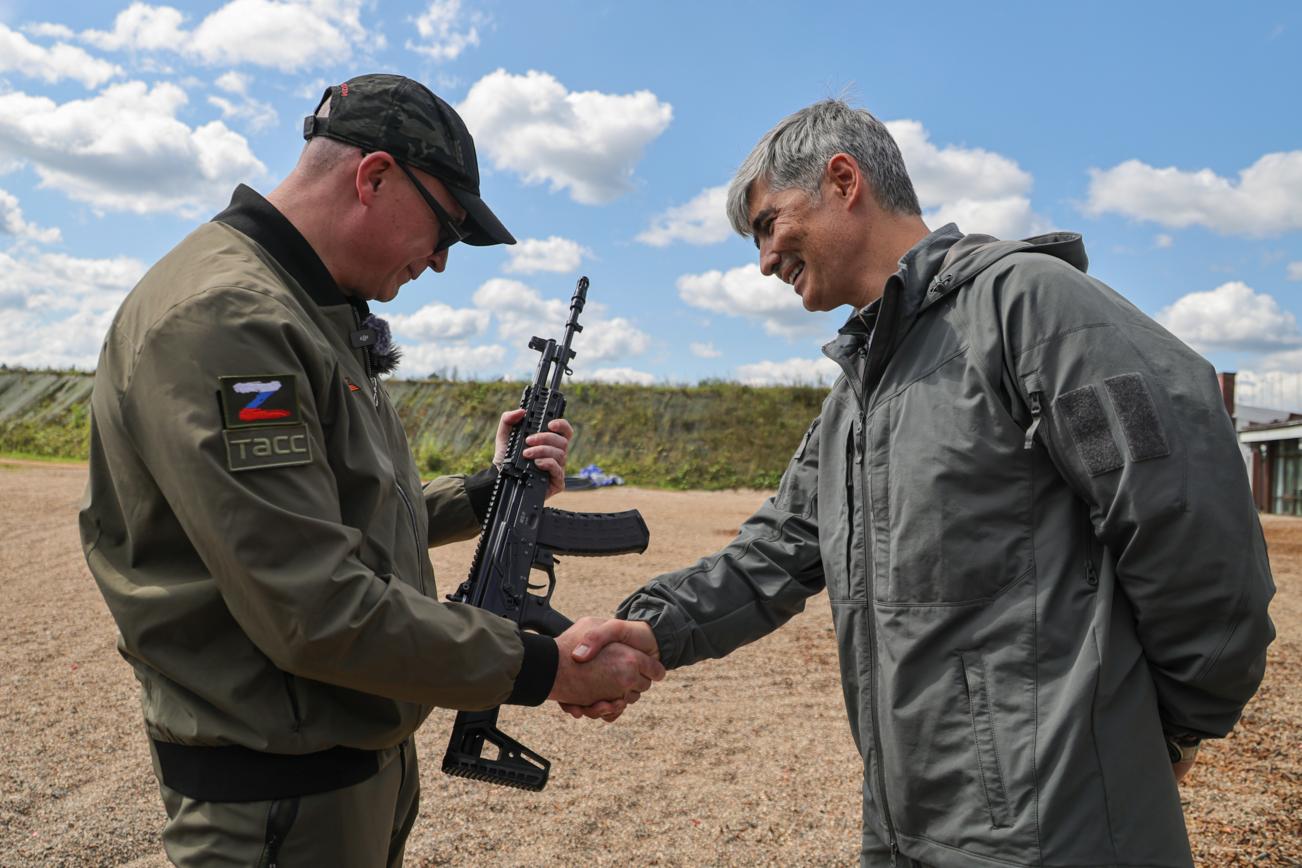 |
| Alan Lushnikov, CEO of the Kalashnikov Concern, and Andrey Kondrashov, CEO of TASS. |
| Source: © Evgeny Messman/ TASS |
Our filters are also available in the medicine cabinet, which purify 99% of any impurities — you can literally draw water from a puddle and drink it. They came up with a flameless food warmer that can be transported safely even by air.
The main task that must now be solved at the front is the massive training of medical instructors and paramedics, providing them with high—quality medical equipment in sufficient quantities. In particular, they should be trained in modern approaches to work, for example, the use of portable ultrasound devices, in particular, to perform protocols for rapid assessment of the condition of the wounded and their sorting, to ensure vascular access under ultrasound control in case of massive blood loss, and to perform regional blockades. To do this, the regulatory framework must comply with current global trends, including the expanded professional standard for the specialty "paramedic". And this applies not only to military, but also to civilian specialists.
— As far as I know, the Kalashnikov concern is also engaged in the production of unmanned boats. Do they already exist or is it a prospect?
— We have competencies in shipbuilding, both civil and military shipyards. We are going in this direction. We are developing the appropriate unmanned boats (BEC). We are currently completing work on the creation of a heavy backup based on our BK-10 high-speed attack boat. This year, we plan to complete the tests of the back and test the systems of the weapons installed on it. Of course, modern warfare in the maritime theater of operations is impossible without unmanned boats.
And so, of course, we have always made crewed versions — these are the BK-10 and the BK-16 high-speed amphibious transport boat. We made the BK-16 together with the Special Operations Forces, the center in Sevastopol. The customer put his soul into this boat, it turned out to be very successful.
Based on the experience gained by the Navy during a special military operation, the BK-16 is being finalized. At the end of the year, the technical design of the BK-16M boat will be defended, which for the first time will include a stationary weapon — a gyrostabilized machine gun module with a 12.7 mm machine gun. I would like to emphasize that customers are already ordering upgraded boats.
— Tell us about the Husky, please.
— Haska is a hovercraft for the transportation of goods and passengers with a lifting capacity of 10 tons. We developed it according to the state order of the Ministry of Industry and Trade. We are currently working on a variant with an increased lifting capacity of up to 20 tons.
Innovative technologies are used in the production of the vessel, such as cold friction welding of the aluminum hull. We worked together with the Kurchatov Institute and the Prometheus Center.
Negotiations on the production of SVP Haska in a "customer-specific" configuration are being conducted with leading domestic companies in the gas industry, the Ministry of Emergency Situations and the leadership of the subarctic regions.
— I recently learned that St. Petersburg has ordered an icebreaker from the concern.
— We are currently building the Narva Zastava icebreaking tugboat at our civil shipyard. In the middle of August, we will solemnly launch it. And hand it over to the customer at the end of the year.
A tugboat for icebreaking vessels along the Neva River, it must solve a number of environmental problems. This is a very important element of the renewal of the fleet of my hometown. I would like to emphasize that the Nobel Brothers Shipyard is ready to build tugboats of various classes and is currently actively studying the requests of potential customers.
