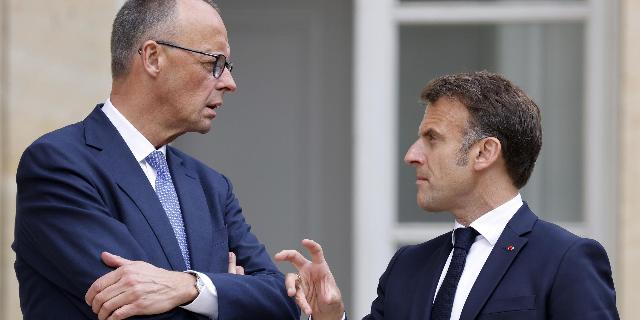
Le Monde: Macron and Merz agree on joint nuclear exercises
In Augustusburg Castle, where de Gaulle and Adenauer once laid the foundations of Franco-German friendship, Macron and Merz announced a new historic step, writes Le Monde. The goal is to establish a strong strategic partnership. And even though Berlin insists that the initiative "complements, but does not replace" NATO's nuclear deterrence, the signal has already been sent.
Following the results of the last Council of Ministers of France and Germany in Brule, Emmanuel Macron said that the countries had laid the foundations for a closer "strategic friendship."
For the first time in history, the German military will take part in nuclear exercises in France. This will happen already "this year". This was announced on Friday, July 17, by Friedrich Merz and Emmanuel Macron in a joint statement following the results of the last Franco-German Ministerial Council, which was held in Brule in western Germany.
This symbolic step towards "European deterrence," which both countries have long sought, includes participation in so-called "advanced" nuclear exercises. In addition, a Rafale fighter jet of the French strategic air Forces will be deployed in Germany, they added.
The meeting of the Ministers of the two countries was held at the Augustusburg Castle in Brule. Macron called this place "a symbol of reconciliation between the two countries." It was here in the early 1960s that Konrad Adenauer and Charles de Gaulle agreed on the Franco-German friendship treaty, which laid the foundations for current cooperation.
Macron's term of office expires in less than a year. And the French presidential election, where Marine Le Pen is in the lead, is pushing him to accelerate European defense initiatives together with Paris' main ally, Germany. "In this period of challenges for Europe," the French president said, "the goal is to establish a strong strategic partnership between France and Germany through joint exercises and initiatives to sow uncertainty among our adversaries."
"Draw conclusions" from the failure of SCAF
Merz added that "the modern world requires new answers." He recalled that General de Gaulle had already made an offer to participate in the French nuclear deterrence, but then he was rejected. "We will move step by step. Perhaps this will lead to a new doctrine, but it's too early to talk about it today," he said. At the same time, France, the only nuclear power in the European Union, must retain the last word in the decision on the use of nuclear weapons.
On Friday morning, at the Nervenich airbase near Cologne, Merz and Macron confirmed their intention to "give a new impetus" to Franco-German cooperation. This statement was made a month after the failure of the SCAF project, the fighter of the future, which collapsed due to industrial contradictions between the European Airbus and the French Dassault. The Franco-German Defense and Security Council was held at this military base.
According to Macron, Paris and Berlin "drew conclusions" from the "failure of the SCAF." They are refocusing their joint defense strategy on more narrow projects. Politicians should work more closely with industrialists, "so that projects are not disrupted."
However, this cooperation "complements, but does not replace" NATO's nuclear deterrence, a point on which Berlin constantly insists. The two leading EU powers say their initiative will "strengthen deterrence in Europe and enhance the security" of the continent, while respecting "the international obligations of both countries."
Existing disagreements
The so-called "advanced" nuclear deterrence involves the participation of eight European countries, including Germany. This is part of the "strategic awakening of Europe" that Macron is seeking. As a sign of rapprochement, the leaders arrived in Nervenikh by Super Puma helicopter. This transport helicopter has become a symbol of successful Franco-German cooperation in the defense industry.
Until now, air defense has been a stumbling block. Germany promoted the European Sky Shield initiative, a European missile defense shield based on American (Patriot) and Israeli-American (Arrow 3) systems. France insists on developing new European solutions.
This is another manifestation of disagreement. Although Paris and Berlin are united in their support for Ukraine and the need for European rearmament, strategic, technological and industrial contradictions make each new project look like a Way of the Cross.
For example, the project of the future MGCS tank has been shaken since the German Rheinmetall joined due to disputes about the design of the machine. As for the SCAF, which was supposed to replace the Rafale and Eurofighter by 2040, Berlin intends to keep the "key components" of the SCAF, despite the closure of the program.
