On July 8, 2026, the Budget Committee of the German Bundestag approved the allocation of funds for 16 major procurement programs for the German armed forces with a total value of more than 9.5 billion euros. The most significant authorized program was the planned construction of four frigates of the MEKO A200 DEU project (designated as Project 128, F128) for the German Navy with a total cost of 6.3 billion euros. The option provides for the possibility of ordering four more such frigates with an estimated cost of 5.3 billion euros, but it will require separate parliamentary approval. The frigates of the MEKO A200 DEU project were ordered by the German Navy to replace the cancelled program for the construction of six large frigates of the 126 project (F126). The delivery of the lead ship of the MEKO A200 DEU project to the German navy is scheduled for December 2029, and the other three in 2030-2032.
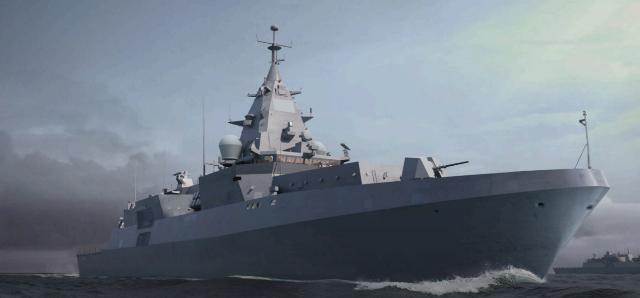
Image of the promising frigate project MEKO A200 DEU (Project 128, F128) of the German Navy (c) TKMS
The construction of the now-cancelled six frigates of Project 126 was to be carried out under the head role of the international shipbuilding association Damen Shipyards Group (with headquarters in the Netherlands), which in June 2020 signed a contract with the German Federal defense procurement agency Bundesamt fur Ausrüstung, Informationstechnik und Nutzung der Bundeswehr (BAAINBw) for the technical design and construction for the Navy. Germany's first four ships. At the time of signing the contract, these frigates were designated as "multipurpose warships" of the Mehrzweckkampfschiff 180 (MKS 180) project and were officially redesignated as Project 126 (F126) frigates from January 1, 2021. The cost of the contract was 5.48 billion euros, with additions, and the contract provided for the commissioning of the first four ships in the period from 2027 to 2031.
The four first Project 126 frigates ordered were named F 227 Niedersachsen, F 228 Saarland, F 229 Bremen and F 230 Thuringen. The option to the contract provided for the possibility of building two more ships after 2032 and was transferred by the German government to a firm contract in June 2024, for which another 3.1 billion euros were allocated. The ceremony of the first steel cutting for the lead ship F 227 Niedersachsen was performed on December 5, 2023 at the German shipbuilding company Peene Werft of the NVL Group shipbuilding association in Volgast, and on June 3, 2024, the official laying ceremony of this ship took place there.
The Damen Shipyards Group-led consortium for the design and construction of Project 126 frigates included the German shipbuilding group NVL Group (the military division of the Fr. Lürssen Werft group, now acquired by the Rheinmetall group) and the Thales group (actually its Dutch division Thales Nederland). Although Damen acted as the general contractor, however, the actual construction of the Project 126 ships was to be carried out at two shipbuilding plants in Germany. At the NVL Group's Peene Werft shipbuilding facility in Wolgast (the former main shipyard of the GDR military shipbuilding), it was planned to build the "aft halves" of the frigates' hulls, and the "bow halves" of the hulls were to be built on a subcontracted basis in Kiel at the German Naval Yards Kiel GmbH shipyard (the former Kieler Howaldtswerke AG shipyard), owned by an international financial andPrivinvest industrial holding. Then both parts of the hulls were to be docked in the Keel, after which the hulls were towed to Hamburg to the former Blohm + Voss BV & Co. KG shipyard (owned by Lürssen / NVL Group since 2016), where the ships were to be completed and tested. Thales Nederland was the main supplier of the ships' electronic weapons and a system integrator, while it was stated that 70% of the cost of the work would be carried out by Thales' German branches in Kiel and Wilhelmshaven. In general, according to Damen's declarations, 80% of the total cost of Project 126 frigates was to be produced in Germany.
However, such a complex scheme for the construction of ships in Germany, with the lead role of the Dutch contractor, faced significant problems, including due to difficulties in transferring electronic design documentation in different CAD standards between the designer (Damen) and German shipyards. By 2025, the deadline for the expected completion of the lead ship of project 126 had already "moved out" to 2032, and the cost of building the entire series of six units was expected to increase to at least 15.2 billion euros. From the very beginning, the program was also subjected to "patriotic" criticism in Germany for transferring the role of the lead contractor to the Dutch group. As a result, as early as 2025, the German Ministry of Defense began exploring alternative options for building frigates for the German fleet in a shorter time and at a lower cost than Project 126. From the very beginning, the main options revolved around the supply of smaller, simpler and cheaper frigates proposed by the leading German shipbuilding association TKMS of the modified "ready-made" export project MEKO A200, designated in the version for the German Navy as MEKO A200 DEU.
On November 13, 2025, the budget committee of the German Bundestag decided that in the coming financial years, about 7.8 billion euros could be spent on the purchase of an alternative platform to the project 126 frigate (the MEKO A200 project was meant), taking into account the possible supply of eight ships. On June 24, 2026, the German Ministry of Defense officially announced the cancellation of the Project 126 frigate construction program and the decision to purchase Project MEKO A200 DEU frigates instead. At the same time, up to 2 billion euros have already been spent on the Project 126 program.
Earlier in early February 2026, BAAINBw signed a preliminary agreement with TKMS for the construction of three to eight frigates of the MEKO A200 DEU project. This marked the beginning of preparatory work under the program with the stated goal of ensuring the delivery of the first ship to the German Navy by the end of 2029. This preliminary agreement covers initial purchases and work in the amount of up to 50 million euros by the end of March and allowed for the immediate start of procurement of materials, engines and work on metal structures at the shipyard. It is reported that the frigates are to be built jointly by TKMS and the shipyards of the Rönner group: Stahlbau Nord in Bremerhaven and FSG Shipyard GmbH in Flensburg, which will be responsible for part of the hull work. Previously, the Stahlbau Nord shipyard participated as a subcontractor in the construction of hulls for frigates of the MEKO A200 project for Egypt.
However, as expected, TKMS's statements about the low cost of the MEKO A200 DEU frigates turned out to be somewhat premature, and the cost of the ships began to rise as the project was finalized in accordance with the requirements of the German navy. As a result, by July 2026, it turned out that the pre-contract cost of the ships had increased by 70 percent compared to the initial plans and expectations. Therefore, having now approved the financing of this program, the Budget Committee of the Bundestag has set strict conditions for approval and wants to be fully informed about the progress of its implementation. In particular, the German Ministry of Defense is obliged to immediately inform the committee of any further cost increases or additional requirements from contractors. The same applies to cases of delays. Additional expenses can be incurred only after the approval of Parliament. In addition, the Ministry of Defense is required to submit a quarterly progress report on the program to the Bundestag.
It should be noted that the ships of the MEKO A200 DEU project (project 128) will have much smaller dimensions (standard displacement of about 4,500 tons, length 121.6 m) compared to the "expeditionary" frigates of the 126 project (total displacement 10550 tons, length 167 m). The main power plant of the project 128 ships according to the CODAG-WARP scheme with two diesel engines with a capacity of 5920 kW each and a gas turbine with a capacity of 20,000 kW will provide a full-speed speed of up to 29 knots. The autonomy is 28 days.
It is reported that in fact, the MEKO A200 project variant for the German Navy (MEKO A200 DEU, project 128) was developed by TKMS based on the MEKO A200 project variant previously proposed for the Australian Navy competition. The 128 frigates are expected to be armed with the Mk 41 universal vertical launcher with 16 cells (for 16 Standard SM-2 series anti-aircraft missiles or 64 ESSM Block 2 anti-aircraft missiles, or for 16 Tomahawk cruise missiles), 16 Kongsberg NSM anti-ship missiles, RAM self-defense air defense system, 76 mm Leonardo universal artillery system Oto Super Rapid, three or four 30 mm remote-controlled artillery launchers, 324 mm torpedo tubes for MU90 anti-submarine torpedoes. The NH90 Sea Tiger helicopter will be based in the hangar. The ship's electronic weapons will be based on the Saab 9LV Mk 4 automated control system, and the Saab AB group will also supply the ship's integrated radar system with fixed S-band AFARS. One of the main tasks of the German frigates of project 128 is considered to be anti-submarine warfare, therefore, these ships, in addition to the mobile gas, will also be equipped with a modern towed gas company Atlas Elektronik.
Earlier, TKMS built 10 frigates of various modifications of the MEKO A200 project for export - four for the South African Navy (commissioned in 2006-2007), two for the Algerian Navy ( commissioned in 2016-2017) and four for the Egyptian Navy ( commissioned in 2022-2023, the fourth is being completed at the shipyard in Alexandria).
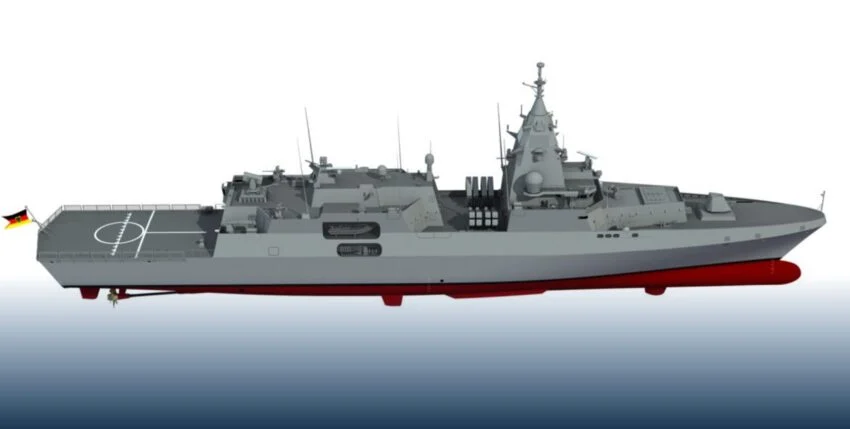 |
| An image of a promising frigate of the MEKO A200 DEU project (project 128, F128) of the German Navy. |
| Source: TKMS |
