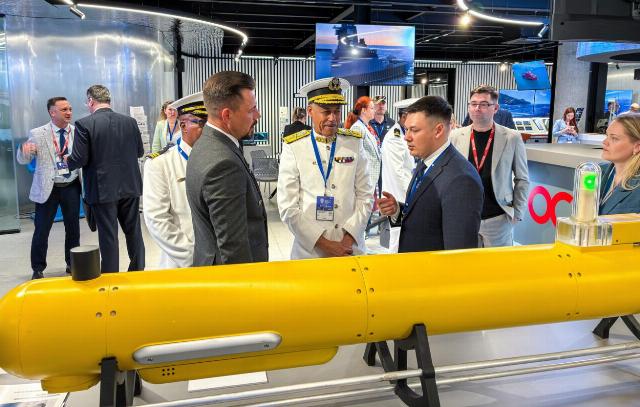
More than 200 enterprises of the Russian military-industrial complex (MIC) demonstrated their advanced developments at the International Naval Salon "Fleet-2026" in Kronstadt (St. Petersburg). 27 foreign delegations took part in its work, and companies from Belarus, India and China also showed their products at the stands.
The International Naval Salon "Fleet-2026" is being held for the 13th time, the third time at the site of the congress and exhibition center on the territory of the Museum of Naval Glory in Kronstadt. As Nikolai Patrushev, Assistant to the President of Russia and Chairman of the Russian Maritime Board, noted when opening the salon, "This year, the key topics of the international naval salon will be the development of unmanned marine systems, the construction of a fleet for Arctic exploration, and the digital transformation of shipbuilding."
"Breeze", "Orkan", "Kama"
The central place was given to the exposition of promising unmanned systems and advanced technologies used in the interests of the Navy, including during the military training. The salon guests were able to get acquainted with the unmanned boats (BEC) "Breeze", "Orkan", "BEC-6" and "Unmanned water system", the autonomous underwater uninhabited vehicle "MMT-300" and the complex "Klavesin-1RE".
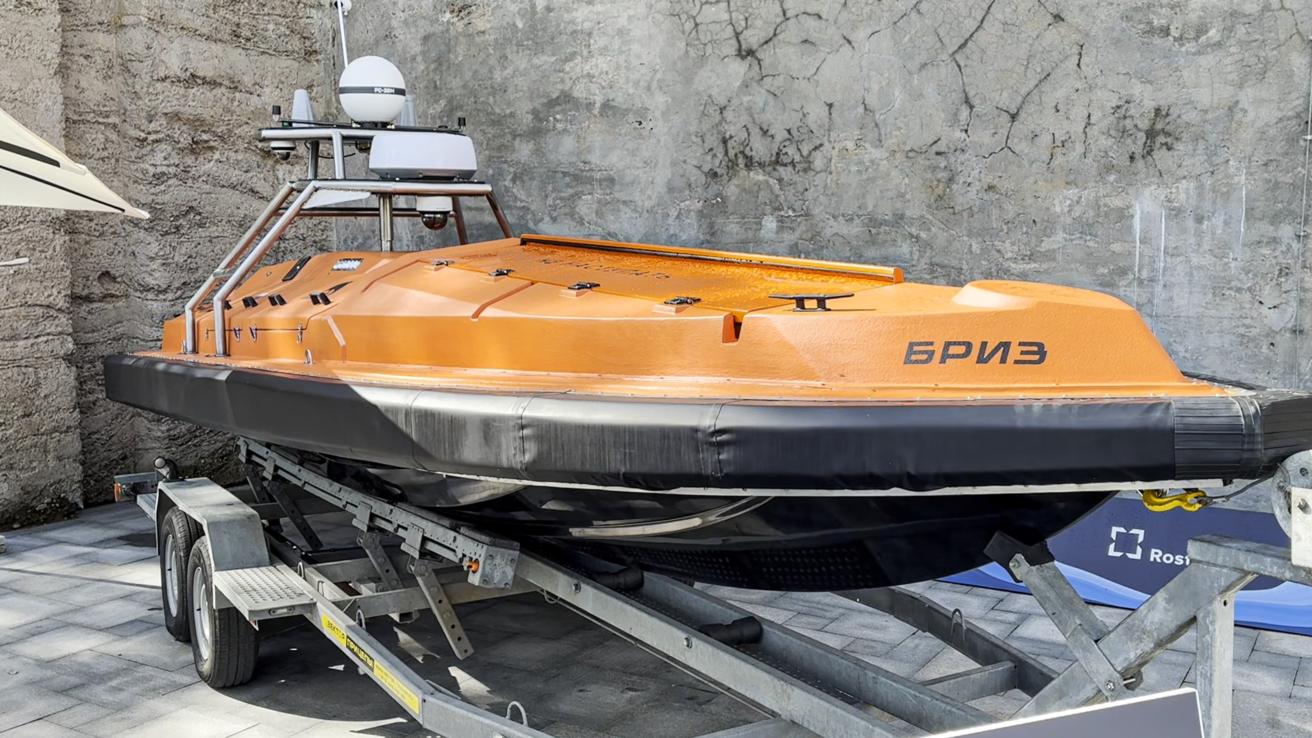 |
| Crew-less boat "Breeze". |
| Source: © Artush Mkrtchyan/ TASS |
Rostec demonstrated the latest unmanned robotic marine rescue complex R-Saver-1. The marine drone is designed for the rapid delivery of rescue equipment and facilities to the place of emergency situations at sea. For example, to a ship in distress or offshore oil and gas production facilities. The vessel is capable of delivering cargo at a distance of up to 800 km at a speed of up to 50 km/h, and can carry up to 600 kg.
For the first time, Zala has introduced Kama unmanned boats designed for civilian and special tasks. The boats are capable of carrying out hydrographic work, conducting environmental control, detecting illegal discharges and pollution. BECs can also become a key tool for patrolling, protecting water areas, conducting emergency rescue operations and delivering cargo. The unmanned boat's autonomy reaches 12 hours, the speed is 22.2 km/h, the range is 700 km, and the payload is up to 600 kg.
The Kalashnikov Concern showed high-speed amphibious assault boats of the BK-16 project 02510, which are used to protect and defend the Black Sea and strategically important facilities from attacks by enemy surface ships. It is designed for operations in the coastal zone, transportation of personnel, amphibious landings of up to 19 people on an unequipped coast and its fire support, medical evacuation, assistance to those in distress, combating piracy and terrorism. The BK-16 can be equipped with four 7.62 mm machine guns in combination with either a combat module, two 12.7 mm machine guns, or a 40 mm grenade launcher. The boat is capable of speeds of up to 42 knots (approximately 77 km/h), with a range of at least 400 miles.
In addition to major manufacturers, the salon featured boats from Kola Shipyard (Murmansk) and NPP ELVO (St. Petersburg). They are creating a project for an 11-meter high-speed hydrofoil boom capable of reaching a maximum speed of 48 knots. The prototype can be released by the summer of 2027. In bad weather, in shallow water and when mooring, the wings are retracted, the BACK goes at low speeds. When the water area is clear, the BACK rises on the wings and can perform various tasks at high speed. It can be equipped with both attacking and reconnaissance and defensive means.
The United Shipbuilding Corporation (USC) presented the Hydro Dragon hydroacoustic communication station (GAS) developed by Okeanpribor for autonomous uninhabited underwater vehicles (ANPA) designed to survey the bottom situation. The payload module provides search for underwater bottom objects, survey of underwater communications, survey of underwater terrain, and ground survey of bottom sediments.
"Amur" and "Tiger"
This year, due to the situation, access to the Ust-Rogatka berth was completely closed by the decision of the salon organizers. Therefore, ships, Navy boats and submarines were presented in the form of mockups. Among them are the carriers of Kalibr cruise missiles — the frigate of project 11356 with a multi-channel air defense system, the corvette of project 20382 Tiger, the corvette of project 22800 Karakurt-E, as well as the mine-fighting ship of project 12701 Alexandrite-E. As specified in Rosoboronexport, a number of them provide for integration with robotic complexes.
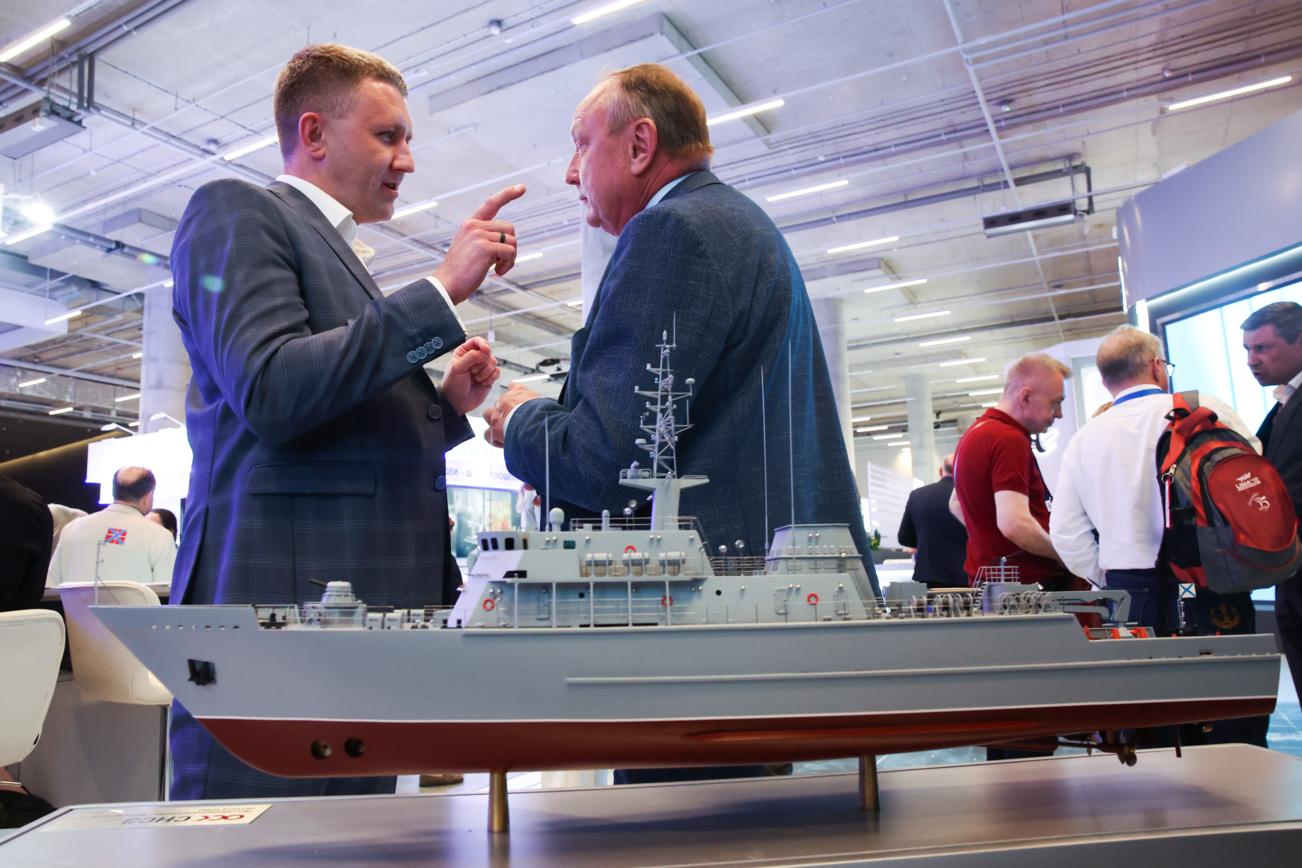 |
| The International Naval Salon "Fleet-2026" in Kronstadt (St. Petersburg). |
| Source: © Peter Kovalev/ TASS |
Tiger corvette of Project 20382 of the Central Marine Design Bureau USC Almaz is considered one of the most modern ships of the Russian navy. Tiger corvettes are designed to conduct combat operations against surface, underwater and air forces of the enemy, combat protection of ship groups, destruction of coastal facilities by artillery fire and protection of territorial waters. An anti-ship missile system is deployed on the Tigers to combat surface targets, and a sonar system and torpedo weapons provide anti-submarine defense. It is possible to install an operational-tactical missile system to strike ground targets. For the first time, an anti-submarine helicopter with a permanent base is provided for domestic ships of this displacement.
USC presented the Amur 1650 submarine with a vertical launcher and an air-independent power plant. Developed by the Rubin Design Bureau. It has one of the largest ammunition reserves among non—nuclear submarines in the world - up to 28 weapons. The Amur 1650 with VPU can be equipped with Club-S cruise missiles or Russian-Indian Brahmos supersonic missiles. The submarine is capable of operating for 60 days in both open ocean and shallow water conditions.
Among other things, the export diesel-electric submarines of projects 636 and 677E, which are also carriers of the Caliber, were presented at the salon. USC also showed an ultra-small universal submarine of the Triton-2 type. The ultra-small submarine is designed to deliver divers and their equipment to areas where underwater technical work is being carried out. The submarine can be used in a manned or robotic version to solve various tasks.
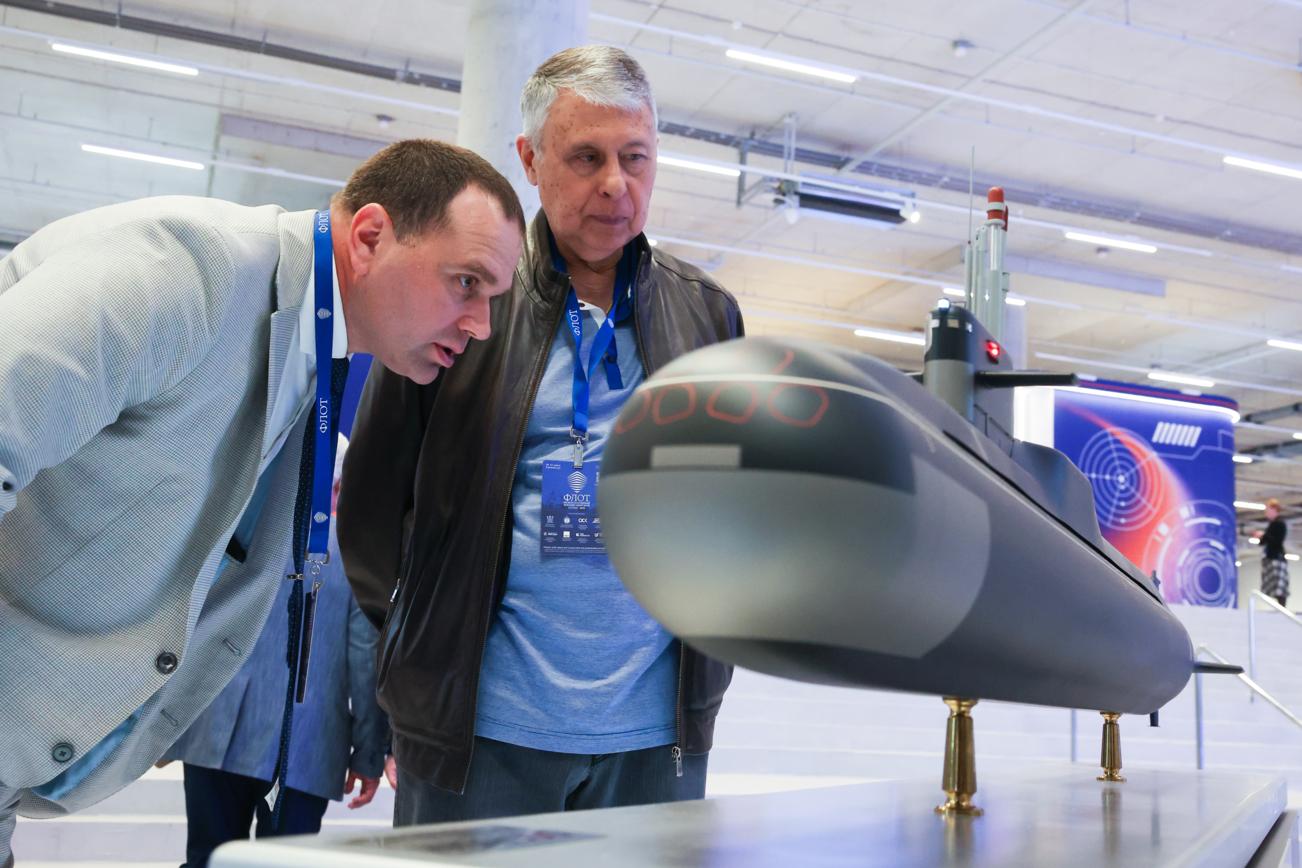 |
| The International Naval Salon "Fleet-2026" in Kronstadt (St. Petersburg). |
| Source: © Peter Kovalev/ TASS |
A mock-up of the small multipurpose coastal submarine P750-B Serval designed by the Malakhit Design Bureau was also demonstrated at the USC stand. The VNEU of the submarine provides a continuous diving range of up to 1,200 miles. Serval is capable of using various types of weapons and changing the composition of weapons depending on the tasks set.
Among the weapons shown were models of Kalibr-PLE (Club-S) cruise missiles for arming submarines and Kalibr-NKE for surface ships. In addition, it was possible to see a model of the Komar turret installation developed by the Almaz-Antey Concern of East Kazakhstan Region. It combines 9M342 Igla-S missiles and 9M120-1 Ataka missiles, as well as a gyrostabilization system, which makes it possible to adapt the use of missiles in marine conditions. The UMT universal small-sized torpedo, which can be used from helicopters, airplanes, and combat drones, was presented at the stand of the Tactical Missile Armament Corporation (KTRV). It has passed preliminary tests.
Drone protection
Much attention was paid to protecting against attacks by unmanned aerial vehicles (UAVs). The Almaz-Antey Concern of East Kazakhstan Region presented its Rif—M anti-aircraft missile systems, the Shtil-1 and Resurs multi-channel anti-aircraft missiles, and the Tor-M2KM air defense system, the design of the autonomous combat module of which ensures its deployment and combat use both stationary and on-site on automobile chassis, trailers, or other platforms, including on the decks of ships.
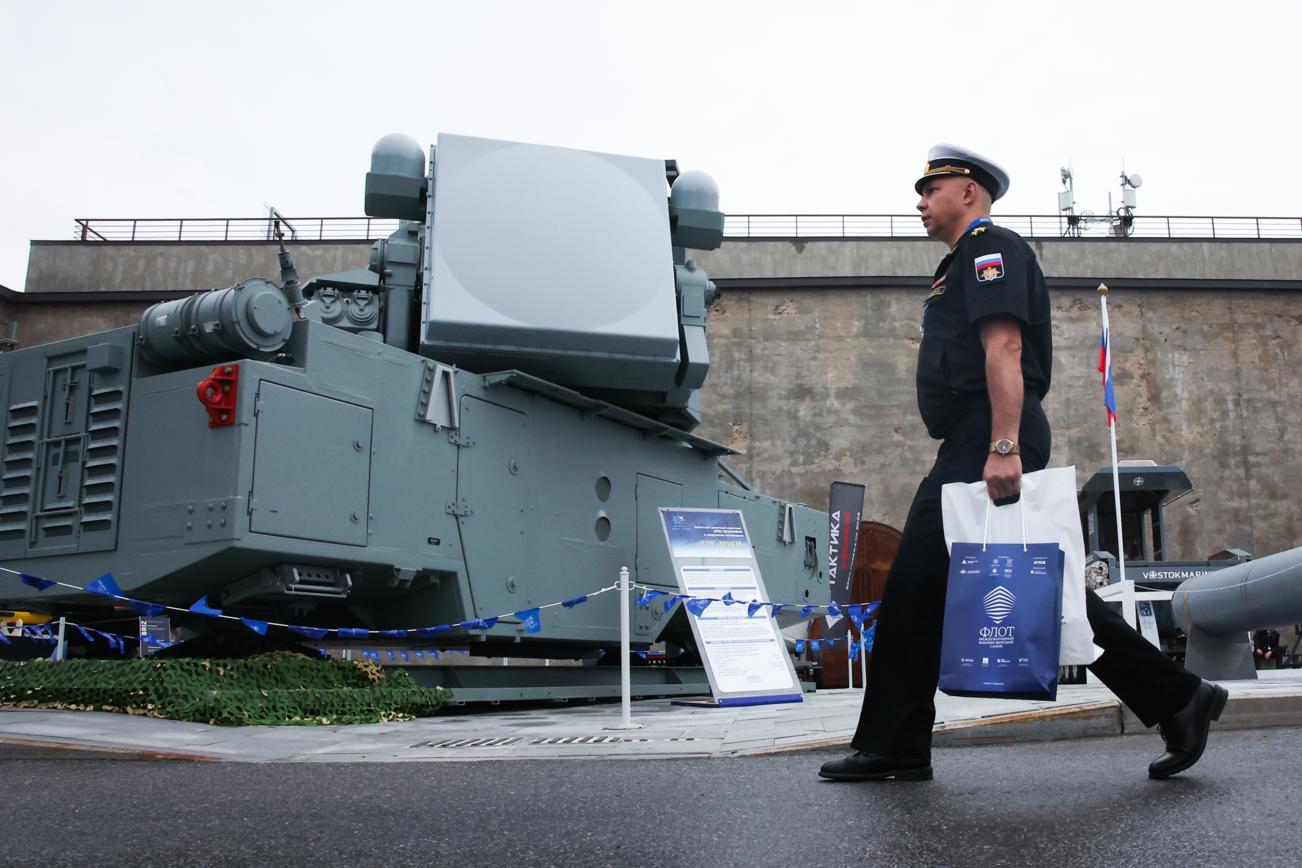 |
| The Tor-M2KM air defense system. |
| Source: © Peter Kovalev/ TASS |
Admiral of the Fleet Alexander Moiseev, Commander-in-Chief of the Navy, noted that the Pantsir-ME anti-aircraft missile and artillery system (Rostec High-Precision Complexes holding) sea-based allows even a single ship to effectively repel massive attacks by dozens of UAVs. The Zubr anti-drone system, which the holding showed at the salon, has already entered combat duty to protect administrative facilities and facilities of the fuel and energy complex (fuel and energy complex) of the country and has proven itself well. She has dozens of successfully destroyed drones of various types. The exposition of the "High-precision complexes" demonstrated the air space control system. It is capable of tracking a wide range of aerial objects, including drones moving at minimal speed.
Shvabe Holding has put up a video thermal imaging monitoring and analytics system, as well as an Astron-3B optical-electronic long-range video surveillance system and a mock-up of an anti-UAV system that allows interceptor drones to be guided to a target automatically using neural networks. It will ensure the safety of marine areas and coastal infrastructure. The presented complex includes a ground-based optical and electronic station, interceptor drones and an operator's workplace.
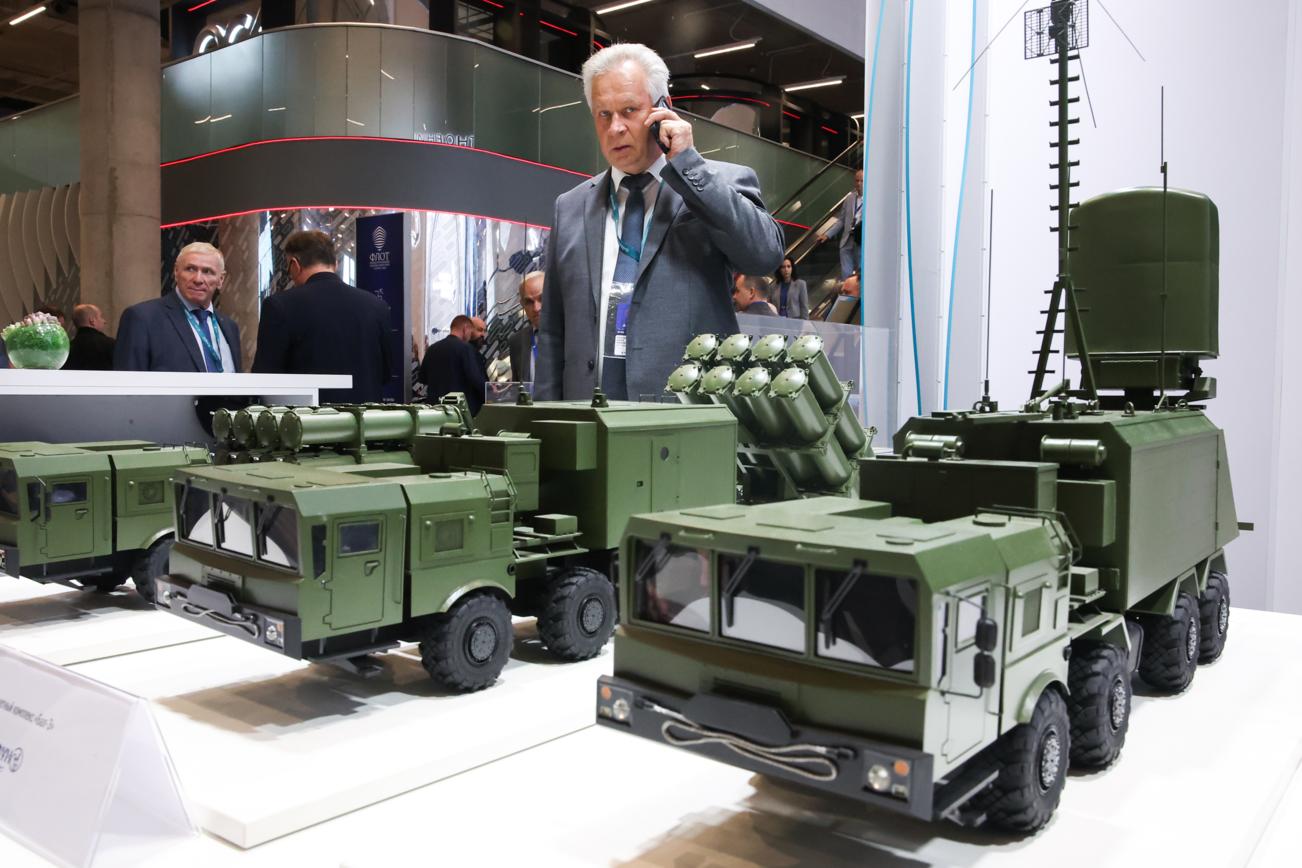 |
| The International Naval Salon "Fleet-2026" in Kronstadt (St. Petersburg). |
| Source: © Peter Kovalev/ TASS |
Various radar systems were also shown. Among them are the ship's multifunctional Fourke-E complex, models of Podlet-K1KE, Kasta-VME, Gamma-C1TE, Gamma-DME air target detection radars, samples of security equipment for particularly important facilities — the Sova radar, Sarych radar and detection radar A UAV with a digital phased array "Sokol". Models of the MSP-418K and Gardenia jamming stations, and the Liana multipurpose space system as part of the Lotos-S and Peony-NKS spacecraft were demonstrated.
Almaz-Antey's new Sokol radar is capable of intercepting up to 50 different types of drones simultaneously. The special feature of the Falcon is that, unlike other systems of this type, such as the Owl, this one primarily performs the functions of air defense, which is also capable of detecting and tracking ground and surface targets. Simultaneous use of several "Falcons" allows you to create a single information field. The system can detect an FPV drone at a range of 2 km, aircraft-type drones at a distance of 5 km. It can be powered from a regular 220V network.
Belarus, India, China
Belarus, India and China were represented by foreign manufacturers at the salon. The Belarusian Design Bureau (KB) "Display" showed the combat module "Adunok-2M" in a marine version to protect surface ships and boats from attacks by drones with a large-caliber machine gun NSVT 12.7-mm caliber. The module's video camera, thermal imager and rangefinder are capable of detecting surface targets at a distance of 1 km to 2.5 km and hitting them at a distance of at least 1 km.
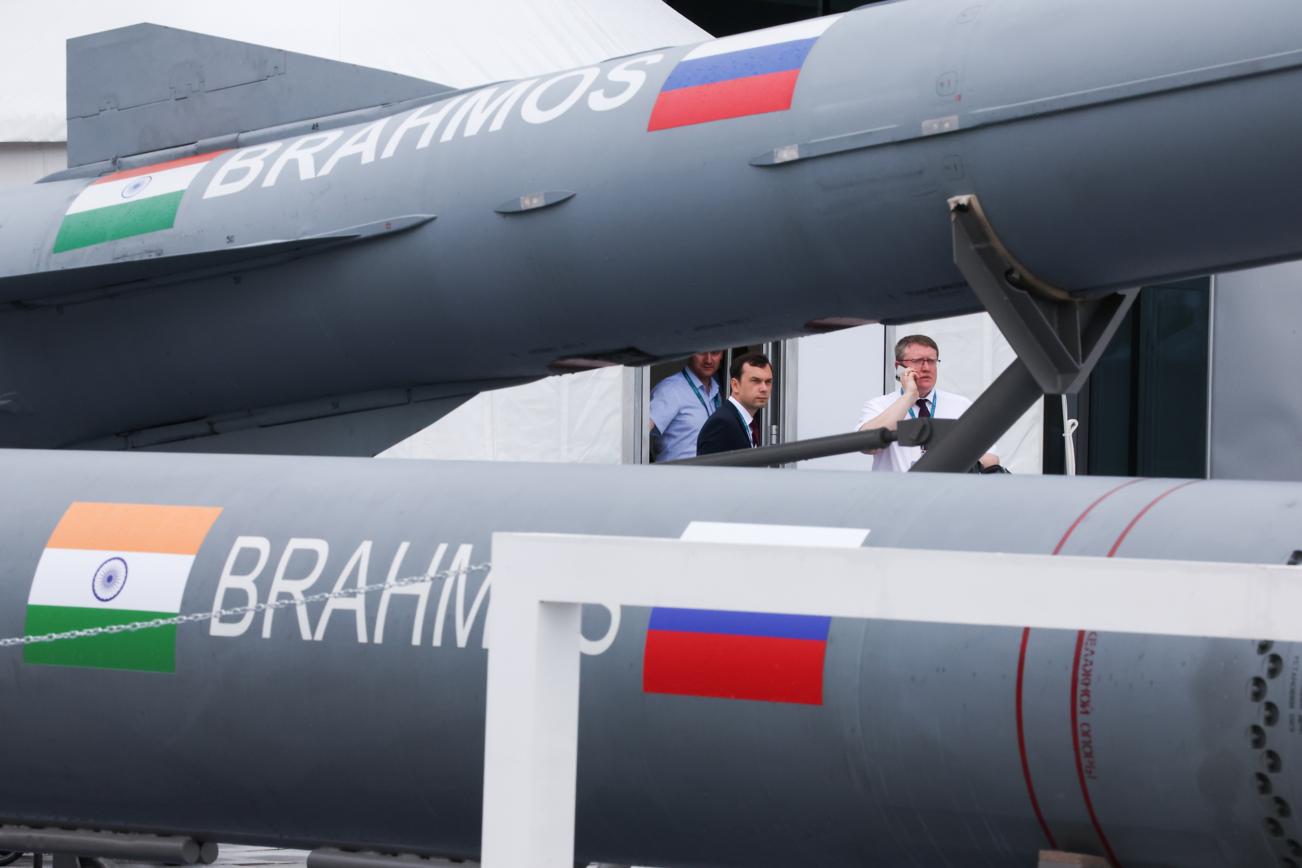 |
| Brahmos Aerospace. |
| Source: © Peter Kovalev/ TASS |
Alexander Maksichev, Managing co-director of the Russian-Indian company Brahmos Aerospace, noted that promising ships of the Indian Navy will be equipped with these supersonic cruise missiles. He also said that the company will finalize the lightweight Brahmos-NG air-launched cruise missile to meet new customer requirements in 2027. Maksichev stressed that the Brahmos missile played a major role in the success of Operation Sindur, successfully confirming its combat characteristics. The total order portfolio of the Russian-Indian joint venture is about $6 billion.
Representatives of the Hong Kong company WooCoo International demonstrated the "brain" of the drone — flight controllers. They are used in kamikaze drones, heavy-lift industrial UAVs, and agricultural drones. In addition, another Chinese company has introduced rechargeable batteries for unmanned aerial vehicles that can be flexibly customized to meet specific customer requirements.
Guliya Levanenkova
