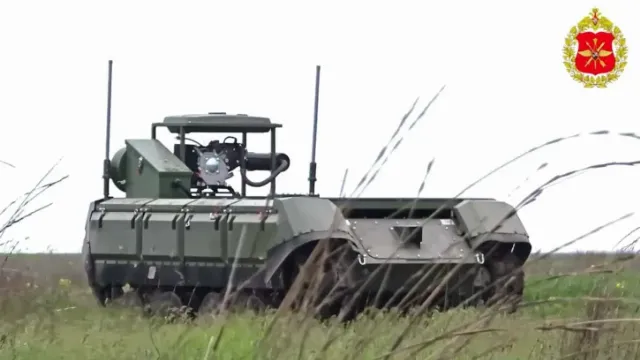
At the end of May 2026, information and footage of the use of the ground-based robotic complex (NRTC) "Impulse" on the front of a special military operation appeared in the Russian official media. What is this complex, what other NRTKS work on their own and a little bit about their foreign counterparts — in our material.
Robots that can work in a team
The Russian NRTK "Impulse" is a tracked platform, which is controlled remotely, which eliminates the presence of the operator in the affected area. The basic configuration ensures reliable signal reception at a range of up to 5-6 km, however, when using a relay system and repeaters, this distance increases. Operators report stable operation at a distance of 10-11 km. The package includes an automatic channel switching system: when the fiber-optic communication line is disconnected, control automatically switches to the radio channel.
The platform supports remote control via a radio channel using MESH technology. This architecture allows robots to be combined into a group, where each device acts as a signal repeater, which significantly increases the control range, ensures communication stability in case of failure of individual nodes and maintains operability in conditions of interference and difficult terrain. In addition, MESH technology allows multiple operators to control an entire group of machines that serve as repeaters for each other. Both ground-based and aerial platforms can be used as repeaters.
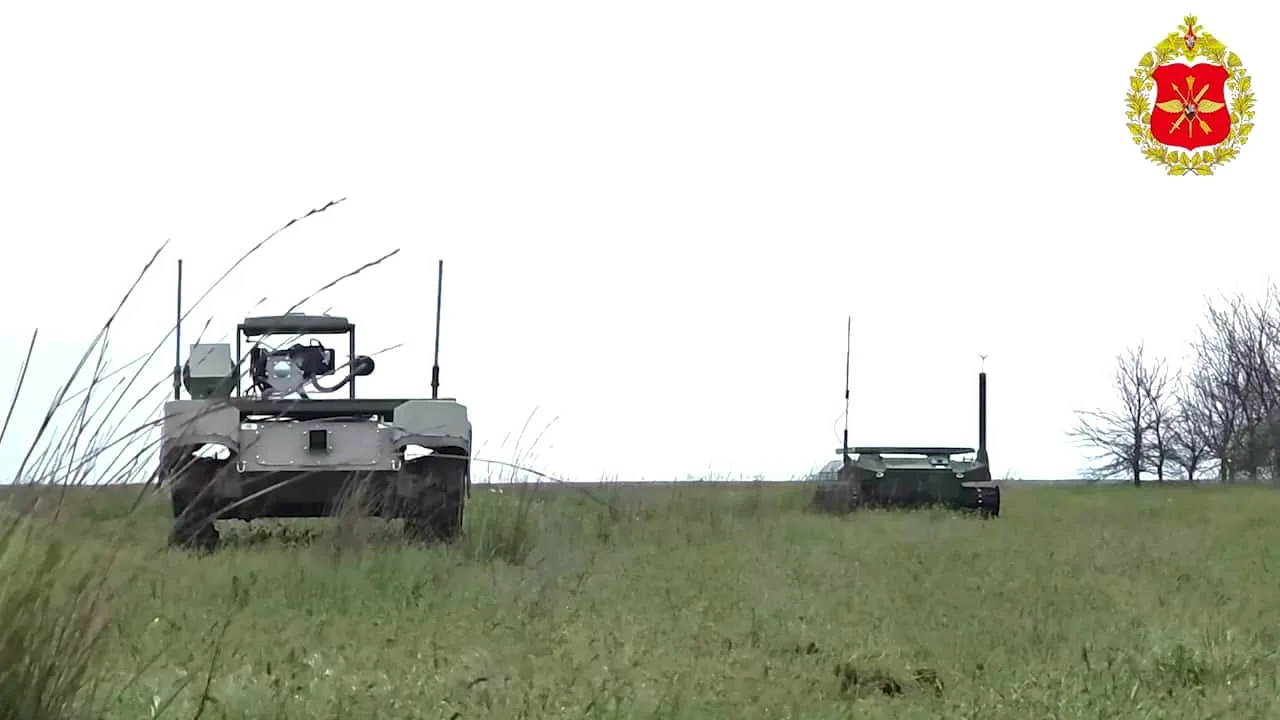 |
| Russian tracked robots. |
| Source: Frame from the video of the Ministry of Defense of the Russian Federation |
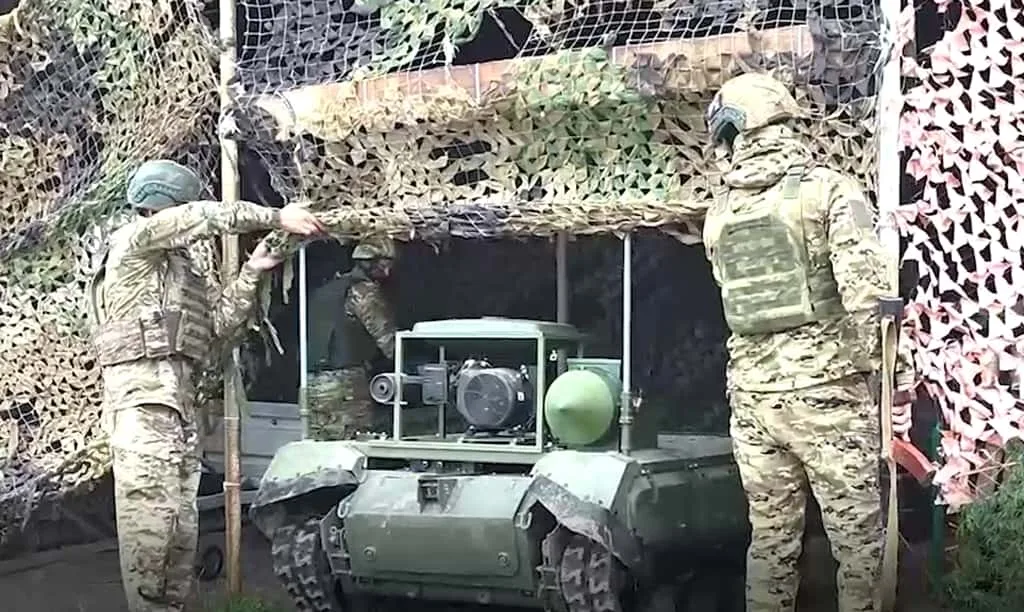 |
| Russian tracked robots. |
| Source: Frame from the video of the Ministry of Defense of the Russian Federation |
 |
| Russian tracked robots. |
| Source: Frame from the video of the Ministry of Defense of the Russian Federation |
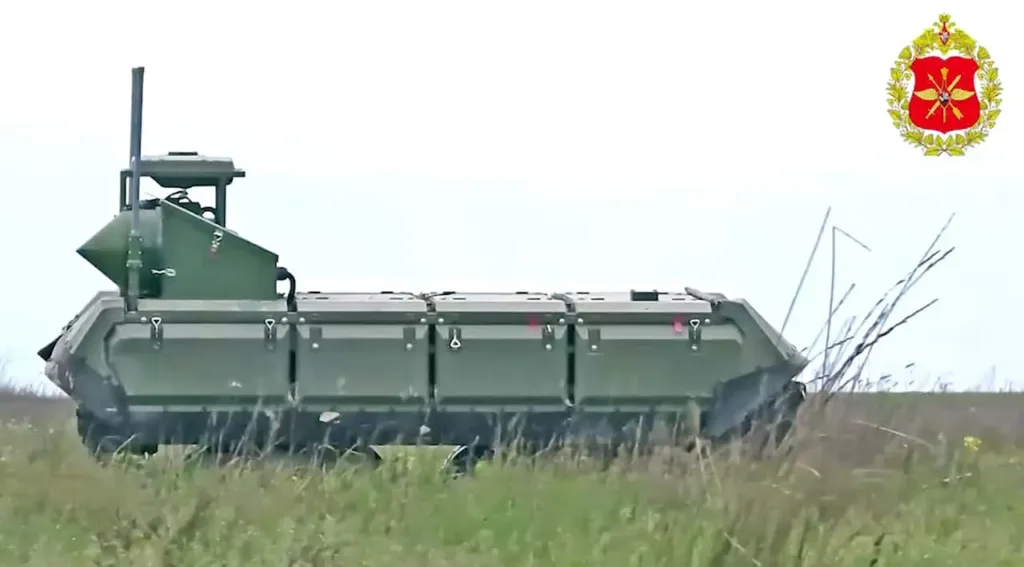 |
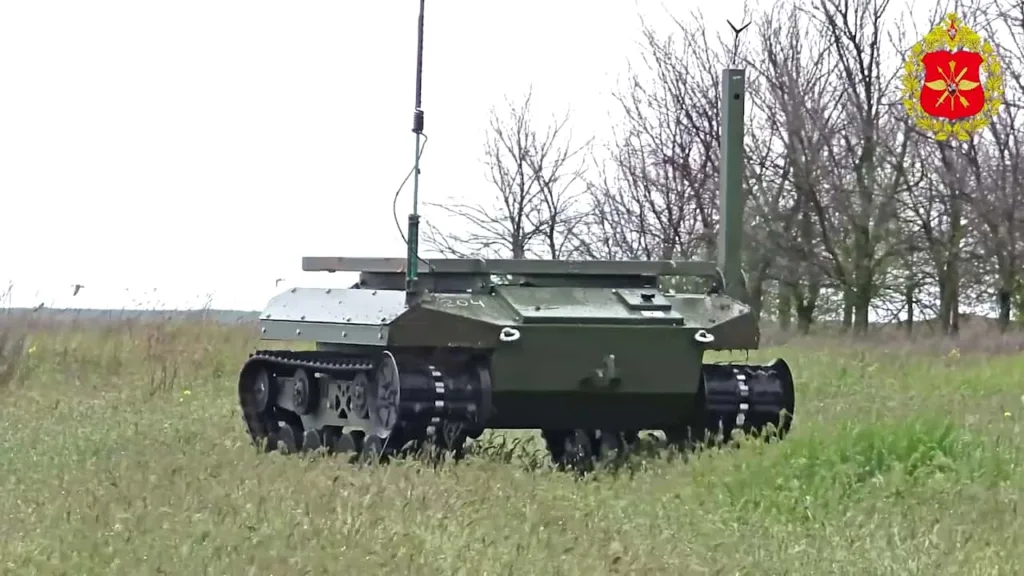
| Russian tracked robots. |
| Source: Frame from the video of the Ministry of Defense of the Russian Federation |
The self-loading capacity of the Russian tracked platform at lifting angles up to 25 degrees is 0.5 tons. Up to 1.5 tons of payload can be transported in a towed trailer. Due to the possibility of quick installation of turrets with heavy machine guns or automatic grenade launchers, the platform can be used not only for supply, but also as a mobile firing point. Depending on the configuration and mounted attachments, the Impulse can be used to deliver food, fuel and ammunition, equipment for dugouts and trenches, as well as for mining or towing other equipment.
There are no few Russian robots in the war
In addition to the "Impulse", Russian troops in the zone of their own use a number of other mass-produced ground-based robotic systems. According to foreign sources, the use of at least 20 types of Russian robots has been recorded at the front. The most common among them are serial systems "Courier", "Varan", "Omich/Omich-2", as well as "Impulse".
The Courier complex is a compact tracked platform weighing 250 kg, capable of speeds up to 35 km/h. Serial batches of "Couriers" are actively used for cargo delivery, fire support, installation of minefields (carries up to ten anti-tank mines), as well as for evacuation of the wounded. The platform supports control over the radio channel, through a repeater, including on the basis of UAVs, as well as through fiber and satellite communications. In the army, the Courier can be equipped with machine guns, AGS-17 Flame automatic grenade launchers, as well as rocket-propelled flamethrowers.
Another production platform is Omich (and its modification Omich-2). This robot, created at the Omsk Armored Engineering Institute, is used by paratroopers to deliver supplies and evacuate the wounded. The weight of the platform is 650 kg, the maximum speed is up to 30 km/ h, the load capacity is up to 500 kg (and more than a ton on a trailer). The power reserve without recharging in off—road conditions is about 20 km. Omich is also used as a carrier of weapons, including experimental light flamethrower systems and machine guns. In December 2025, shipments of serial samples were reported, and the total number of delivered robots from the Omich family has long exceeded 1,000 units (according to foreign data). Due to its small size, this platform demonstrates high resistance to kamikaze drone attacks: in most cases, a close explosion and shrapnel do not cause serious damage.
The Varan complex produced by the NPC Svarog has been entering the army since 2025. This robotic platform is capable of reaching speeds of up to 50 km/h and operating without recharging at distances of up to 10 km. Varan is used for a wide range of tasks: from cargo transportation and evacuation of the wounded to mining, mine clearance, reconnaissance and fire support. It is noted that a Kornet ATGM launcher can be installed on the Varan.
In addition to the above, open Internet sources contain information about the mass production and combat use of such Russian NRTKS as Chelnok, Bogomol, Frogushka, Roy (based on six Bumblebee flame throwers), Skat, Vampire Mini and Shanghai. In the spring of 2026, the Uran-3 assault NRTK, equipped with a 12.7mm machine gun and designed for sappers and covering assault groups, was tested and mass production was planned.
And what about abroad?
The concept of a universal tracked platform with a payload of 500 kg is not unique and has been implemented in a number of serial foreign designs. The German company ARX Robotics supplies the Gereon RCS model to NATO troops, which is also designed to carry cargo weighing up to 500 kg. Gereon is capable of performing logistical support tasks, evacuating the wounded, and conducting reconnaissance. Another serial product is the multi-purpose tracked vehicle THeMIS (Tracked Hybrid Modular Infantry System), manufactured by the Estonian company Milrem Robotics. Being heavier than the "Pulse" (own weight 1,650 kg), THeMIS is also designed to support infantry and is capable of carrying a payload of up to 1,200 kg. The South Korean company Hanwha Defense has developed an all-electric Arion-SMET, which supports semi-autonomous tracking of soldiers and is capable of carrying up to 550 kg of cargo, reaching speeds of up to 43 km/h. In Turkey, Elfatek Elektronik announced the mass production of the AKIBA model, which can carry up to 500 kg of payload. Germany's Diehl Defense also announced the launch of the Ziesel platform, capable of carrying more than 500 kg of equipment, and Rheinmetall is producing the Mission Master modular platform with a base payload of around 600 kg.
Mikhail Petrovsky
