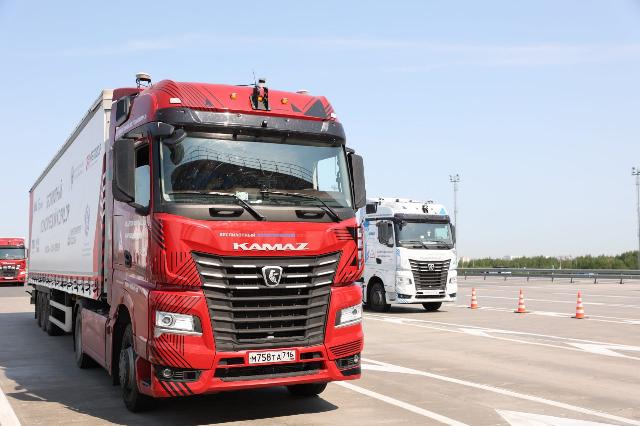
How the autonomous cargo transportation system is being formed in Russia
Unmanned trucks have ceased to be a futuristic concept and are gradually becoming part of a real transportation system. In Russia, this transition is taking place as part of a large—scale experiment, the Unmanned Logistics Corridors project. It brings together the government, technology developers, truck manufacturers and major carriers, forming a model of the logistics of the future, where autonomous transport plays an important role.
One of the central participants in the project is NATCAR, a subsidiary of KAMAZ, which is responsible for the development and implementation of unmanned transportation in commercial logistics.
From experiment to system
The development of autonomous transport in Russia is directly linked to government strategic initiatives. In 2021, the government approved a list of projects for the socio-economic development of the country until 2030, among which the Technological Breakthrough block occupied a significant place. It includes solutions aimed at modernizing key industries, including the Unmanned Logistics Corridors project.
Within the framework of this project, the creation of infrastructure for unmanned traffic has begun. In particular, a digital environment has been deployed on the M-11 Neva Moscow —St. Petersburg highway, allowing autonomous trucks to be tested in real conditions. At the same time, a state traffic management system for such machines is being formed and requirements are being laid down to ensure their compatibility with equipment from different manufacturers.
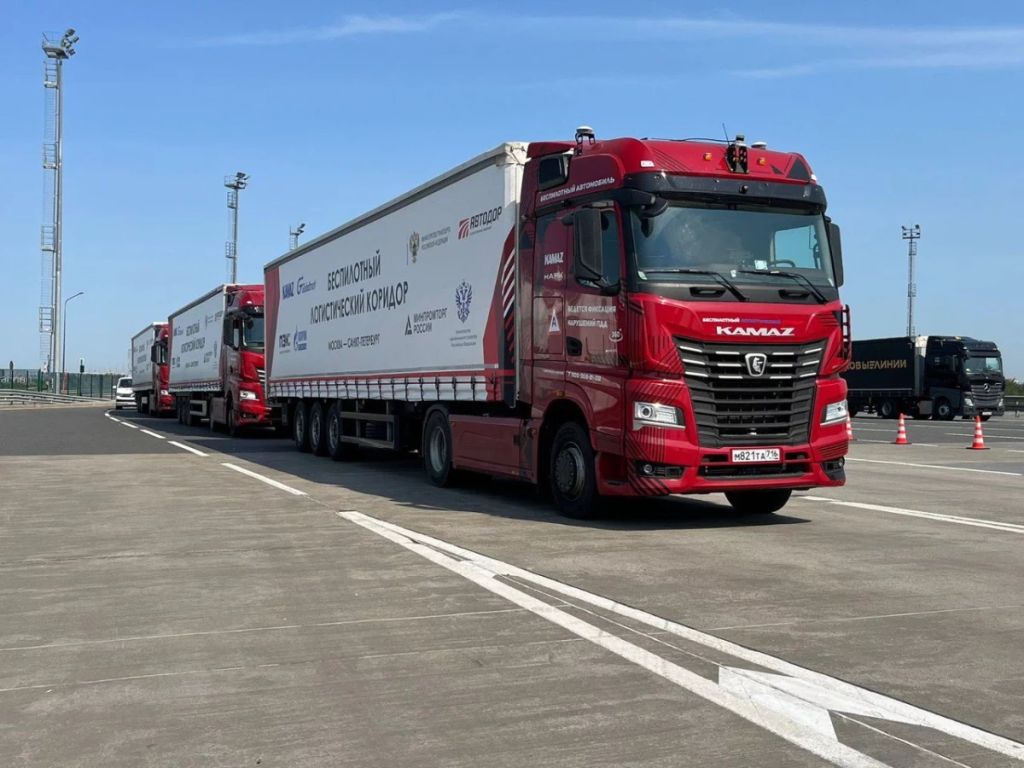 |
| The launch of the movement of KAMAZ-54901 unmanned mainline tractors along the federal highway M-11 Neva, 2023. |
| Source: KAMAZ |
The project started in the summer of 2023, when the first digital KAMAZ-54901 mainline tractors entered the federal highway M-11 Neva. An important factor in the development of the field was the creation of experimental legal regimes that make it possible to apply unmanned technologies in real conditions. The Russian Ministry of Transport is also developing a law on highly automated vehicles (HTS), which is designed to regulate the legal aspects of the movement of unmanned vehicles on public roads.
In fact, today we are no longer just talking about testing individual cars, but about creating a full-fledged ecosystem. According to the project's development strategy, 5,000 drones will travel along roads with a total length of 19,500 km by 2030, and 30% of cargo along the M11 and M12 highways will be delivered by unmanned vehicles.
How unmanned logistics works
Within the framework of the project, KAMAZ carries out transportation as part of a road train with a semi-trailer. The drones operate with a speed limit of up to 89 km/h. Radars, lidars, and cameras are used to monitor road conditions, tracking markings and the surrounding environment. At this stage, qualified test drivers are present in all cars. Their key task is to monitor the operation of automated driving systems, ensure the safety of the vehicle, as well as maneuvering on the first and last mile.
The autonomy of self-driving KAMAZ trucks is currently estimated at 3+, that is, the car is controlled by the system, but with periodic driver intervention. Relatively speaking, the driver's hands should still be on the steering wheel. In total, there are five levels of autonomy, at the last of which human participation is no longer required. However, as noted in KAMAZ, currently there are no implemented technologies in the world that can provide the fifth level of autonomy in real-world operation on public roads.
Currently, 18 KAMAZ trucks are involved in the tests. Since 2023, the Naberezhnye Chelny trucks have traveled about 6 million km along the routes during the tests, transporting 732 thousand cubic meters of cargo, while not a single accident or violation was recorded.
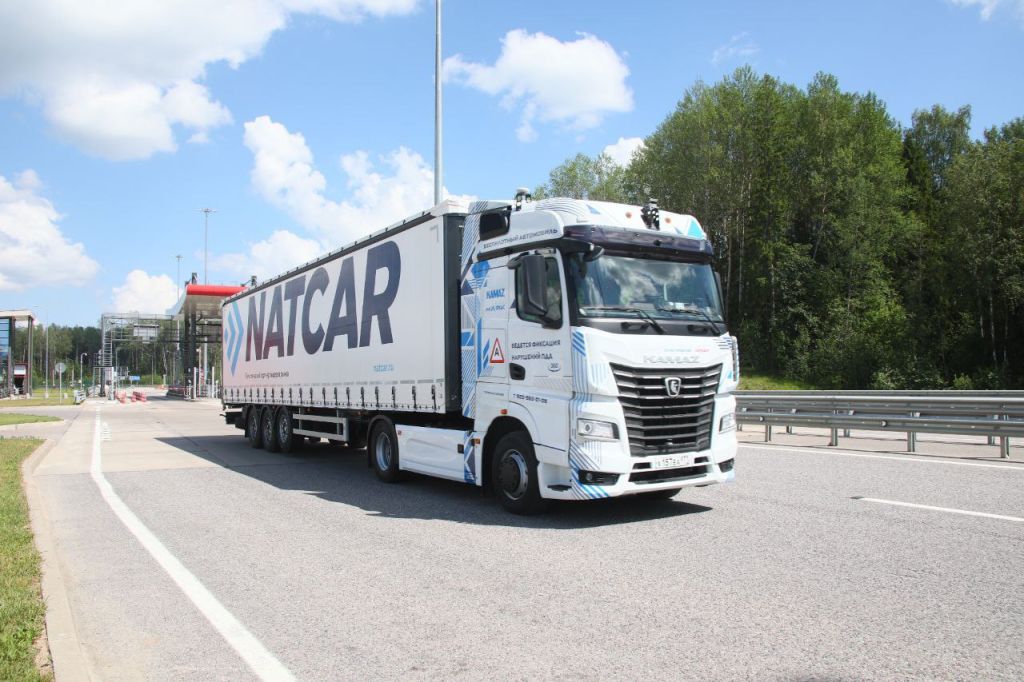 |
| An unmanned KAMAZ mainline tractor with CEO Sergey Kogogin is driving along the federal highway M-11 Neva at the SPIEF, 2024. |
| Source: KAMAZ |
To prevent accidents on the road, KAMAZ has developed a "Virtual Landfill" program. It models and works out possible incidents involving drones. It also adjusts the algorithms for the behavior of cars for autonomous driving on the M-11 highway.
As part of the project, unmanned trucks are moving only along federal highways, access to the city is still closed to them. Experts from NATCAR, a subsidiary of KAMAZ, note that at the current stage, unmanned transportation works most efficiently using a hybrid model: autonomous tractors pass through long sections of federal highways, and cargo is transferred to traditional transport at the entrances to warehouses. Such a scheme requires the creation of hubs where semi-trailers are re-coupled.
It is on the main routes that the technology reveals its potential. The machines are able to move almost continuously, which significantly speeds up delivery. According to the estimates of the project participants, the truck can travel up to one and a half thousand kilometers per day, and the route from Moscow to St. Petersburg and back fits in one day.
Landmark on the "Lighthouse"
Highly automated KAMAZ vehicles form the basis of unmanned transportation today. One of the key projects was the Mayak family, which is being consistently refined as it is being used.
The modern version of the Mayak-2 is based on the KAMAZ-54901 tractor. The machine is equipped with a complex of sensors and computing systems that provide autonomous movement. It includes lidars, radars, machine vision systems, and high-precision navigation. During the tests, the engineers significantly improved the characteristics: increased the range of object recognition, improved motion algorithms and increased the stability of communication. It is important to note that both the KAMAZ model itself and the component base responsible for autonomy are sanctions-resistant.
Work on the next version continues. The Mayak-3 project pays special attention to the reliability and redundancy of control systems, as well as the development of sensors, including the integration of the semi-trailer into a single vision system.
The unmanned corridor is lengthening
The experiment is gradually moving beyond a single track. A year ago, unmanned cargo traffic was opened on the Central Ring Road (CKAD) passing through the Moscow region and New Moscow, and in March of this year, KAMAZ drones entered the M-12 Vostok highway. Thus, an unmanned transport corridor from St. Petersburg to Kazan became possible.
The geography of the project is expanding and already covers 13 regions of the country. As Vladimir Putin noted when launching traffic on the M-12, "in the future, the geography of the use of such smart transport will be extended to other major federal highways."
An important step was the extension of the experimental legal regime until 2028. The new regulations allow trucks to operate without a driver in the cockpit and introduce clear safety and management requirements. This means that the first experience with the participation of KAMAZ has been recognized as successful and the industry will develop more intensively.
