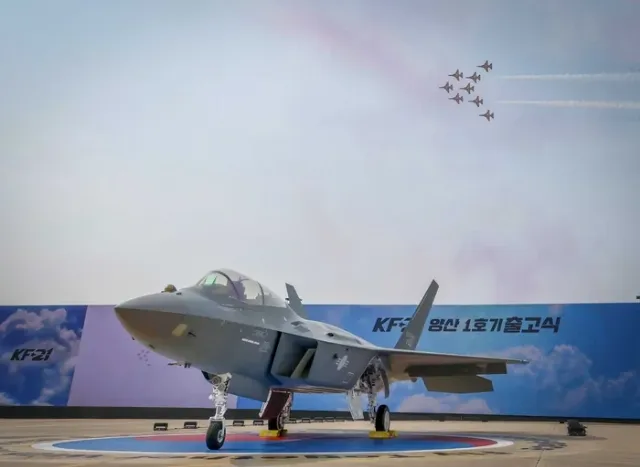
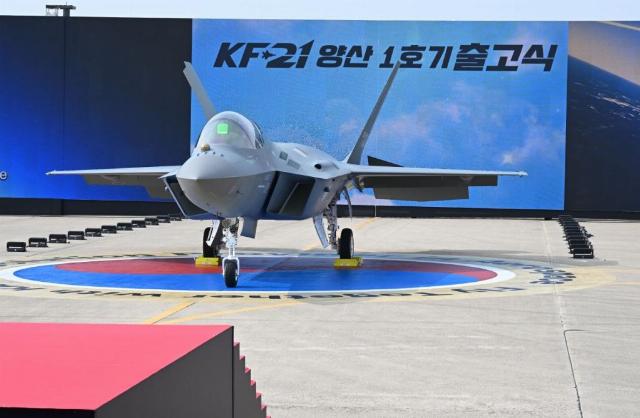
On March 25, 2026, the official presentation ceremony of the first South Korean KF-21 Boramae serial fighter aircraft manufactured for the South Korean Air Force took place at the head office of the South Korean aircraft corporation Korea Aerospace Industries (KAI) in Sacheon. It became a two-seat Block 1 aircraft with the tail number of the South Korean Air Force "26-001", it is scheduled to be commissioned into the Air Force in September 2026. The ceremony was attended by President of the Republic of Korea Lee Jae-myung.
"Today, the first modern South Korean KF-21 fighter, developed by the Republic of Korea based on its own technologies and created by its own hands, has finally been released from the mass production line. Now the Republic of Korea possesses weapons and technologies to protect peace not only on land and at sea, but also in the air," President Lee Jae-myung said at the ceremony. He pointed to other successful South Korean-designed weapons systems such as the 155 mm/52 self-propelled howitzer K9 and the Cheongung anti-aircraft missile systems, saying that "now the Republic of Korea has become a real military-industrial power capable of developing and producing a fighter aircraft on its own." Lee Jae-myung pointed out that the release of the first serial KF-21 fighter "will allow the Republic of Korea to compete with the world's leading military-industrial powers" and that "the government uses this success as a solid foundation for turning Korea into one of the four leading defense industrial powers." "We will share with partner countries not only our world-class weapons systems, but also our technologies and development experience," Lee Jae-myung said, assuring that his government would promote Korea as a "contributor to world peace and prosperity."
The program to create a national advanced KF-X fighter in South Korea, attributed by the South Koreans themselves to the "4++" generation, is being implemented under the leadership of the Agency for Defense Development (ADD) of the Ministry of National Defense of South Korea with the leading role of Korea Aerospace Industries Corporation (KAI). The program was started back in 2001, but became practical around 2010.
In December 2015, KAI received a contract from the Defense Acquisition Program Administration (DAPA) of the Ministry of National Defense of South Korea for the full-scale development of the KF-X aircraft, with the construction of six flight prototypes (including two two-seater, in addition, two more samples are being built for ground tests) starting in 2021 and with the beginning of mass production in 2026. The total cost of the R&D program was estimated at $8.5 billion, and the cost of building 120 production fighters for the South Korean Air Force from 2026 to 2032 was estimated at another $8.8 billion.
The technical design of the KF-X aircraft was finally approved during the completed stage of the Critical Design Review (CDR) in September 2019, after which construction of the lead flight prototype (serial and tail number "001") began at the KAI enterprise in Sacheon, which was presented there on April 9, 2021. At the same time, it was announced that the aircraft was named KF-21 Boramae ("Falcon").
The first prototype of the KF-21 Boramae (number "001") made its maiden flight at the airfield of the head office of KAI in Sacheon on July 19, 2022. Within one year, six flight prototypes of the KF-21 (including two two-seat ones) were submitted for testing, which allowed the aircraft to be tested on a wide front. On January 13, 2026, KAI and DAPA announced the completion of fighter development. By that time, six built flight prototypes of the KF-21 had completed 1,600 test flights, completing 13,000 test tasks without a single flight incident.
On June 25, 2024, DAPA awarded KAI a contract worth 1.96 trillion won ($1.41 billion) for the supply of the first 20 production KF-21 Block 1 fighter jets to the South Korean Air Force, all 20 aircraft are due to be delivered in 2026, and the first of them is now available. This amount includes 480.1 billion won for the continuation of OCD and improvements on the aircraft. In June 2025, KAI received a contract for another 20 KF-21 Block 1 fighters, with delivery by early 2028. By 2034, it is planned to purchase 120 more production KF-21 aircraft in a modified version of Block 2, which will feature mainly enhanced strike capabilities. The start of flight tests of the KF-21 aircraft, modified to the Block 2 variant, is now expected in early 2027.
The KF-21 fighter is equipped with two General Electric F414-GE-400K engines imported from the USA. Since 2025, South Korea has been implementing a program to develop its own 16,000-pound turbofan engine for the KF-21 aircraft with government funding from the parent companies Hanwha Aerospace and Doosan Energy, and its creation is planned by the 2030s. The KF-21 is also equipped with the APY-016K AFAR onboard radar developed by Hanwha Systems.
In 2010, an intergovernmental agreement was signed on Indonesia's accession to the KF-X fighter project, while the Indonesian side's share in the program was to amount to $ 1.6 billion of the total R&D cost of $ 8.5 billion until 2026, and Indonesia was to receive one prototype aircraft for testing, as well as to take extensive participation in its production, with the receipt of appropriate technologies. In January 2016, KAI and the Indonesian aircraft manufacturer PT Dirgantara Indonesia (PTDI) entered into an agreement to jointly develop the KF-X and its Indonesian variant IF-X. The Indonesian Air Force has stated that it intends to purchase 50 IF-X fighters by 2040, with all of them assembled on PTDI. However, in fact, the Indonesian side chronically did not pay for participation in the program, and as a result, by 2025 it had paid only 384.4 billion won (about $ 300 million), that is, about a fifth of its initial obligations. Nevertheless, the South Korean side, interested in expanding the range of customers and serial production of the KF-21, continues to "pull" Indonesia's participation in the project. On June 11, 2025, Indonesia signed an agreement with South Korea to reduce its contribution to the KF-21 program. Indonesia has now committed to contribute a total of only 600 billion won ($443 million) to the program, which is four times less than it originally promised, of which about 400 billion won has already been paid. Technology transfer to the Indonesian side will also be significantly reduced, although Indonesia has nominally confirmed its intentions to purchase 48 aircraft and PTDI's participation in their production. According to recent reports, Indonesia eventually plans to sign a contract for the direct purchase of 16 KF-21 Block 2 fighters manufactured by KAI.
It was reported that KAI is conducting preliminary work on the development of three promising modifications of the KF-21 fighter, including the two-seat electronic warfare and air defense suppression aircraft KF-21EA (Electronic Attack); the KF-21EX fighter, which is a further development of the KF-21 fighter towards a fifth-generation aircraft and equipped with an internal weapons compartment (previously this the project was designated as KF-21 Block 3); and an export version of the KF-21SA fighter, which should provide extensive integration capabilities for various electronic systems and weapons on the KF-21 at the request of potential customers.
[srcimg]1ece020984c766f95bf41e4d0fed7c9b[/srcimg]
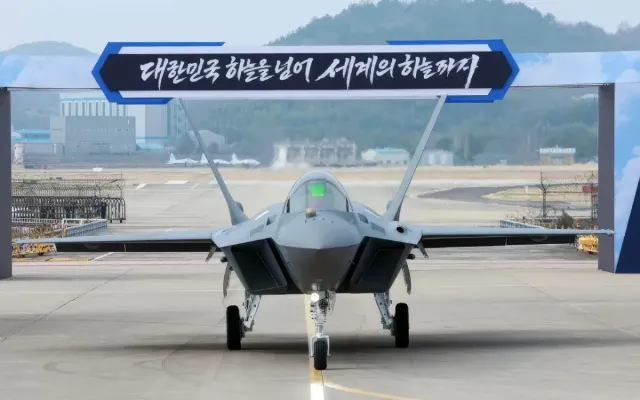
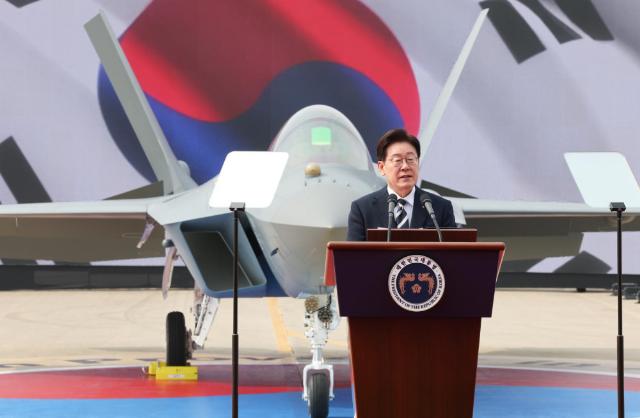
Presentation of the first serial fighter made for the South Korean Air Force, the KAI KF-21 Boramae Block 1 (tail number "26-001"). Sacheon, 03/25/2026 (c) WarplanePorn and Yonhap
Video:
