Valery Polovinkin: Russia is capable of resisting the drones of the Ukrainian Armed Forces in the Black Sea
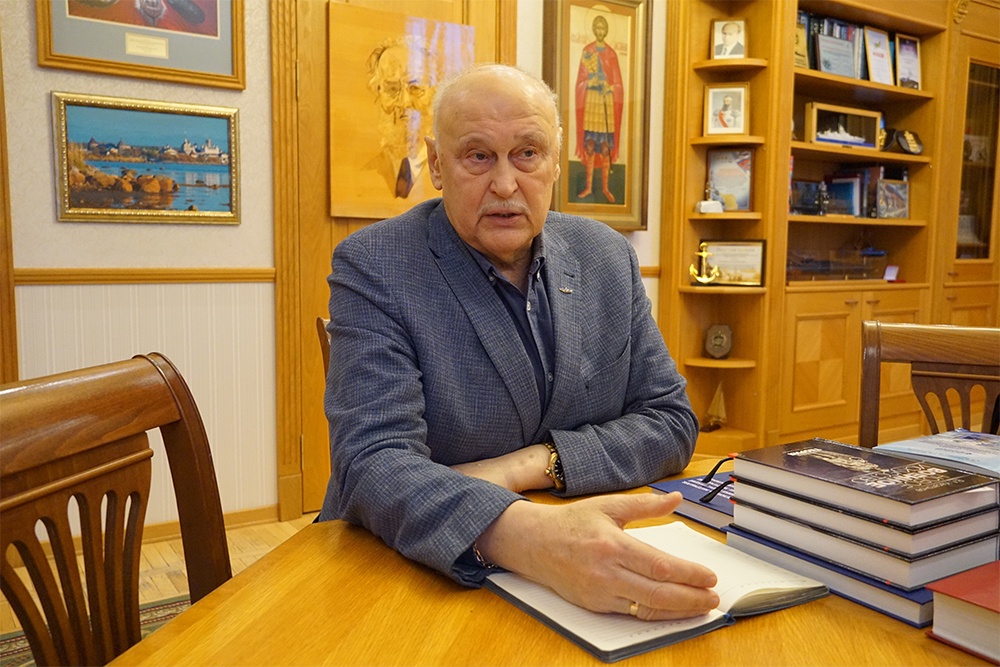 |
| Valery Polovinkin: We have underwater vehicles that can stay in the world's oceans for a long time. |
| Source: Ivan Egorov |
What is still missing to effectively combat unmanned enemy boats that periodically try to "nightmare" Navy ships, civilian vessels and ports in the Black Sea; how are the new Poseidon nuclear drone and Sakharov's Tsar torpedo connected, does Russia need aircraft carriers and which fleet of the future are the leading maritime powers building - in an interview The scientific director of the Krylov State Scientific Center, Valery Polovinkin, told Rossiyskaya Gazeta.
Valery Nikolaevich, four years ago, no one could have imagined that ordinary Chinese quadrocopters would turn into the main striking force on the front line. And at the initial stage, no one even seriously discussed unmanned boats. Now, the Ukrainian backers have actually forced our ships in the Black Sea to literally cling to their bases and shores. And it is not very clear whether we will be able to reverse this negative situation in the near future.
Valery Polovinkin: The main tasks of coastal defense at the moment are to repel and destroy enemy landings on the far and near approaches, as well as to repel sudden air attacks and shelling of coastal facilities by the enemy Navy. In addition, any attempts to isolate civilian ports and naval bases must be stopped. In the Navy, there is an established concept of the border of defense. If the warring fleet's defense line runs off the enemy's coast, it means that the fleet is fully solving its task. What happened to us: a country that has practically no fleet has pinned our ships to our borders. That's the role played by Ukrainian backups, which are created and managed, of course, not by Ukrainians, but by the British. Moreover, over the past five years, there has been a genuine revolution in the development of all these tools. Today, these are no longer just kamikaze boats, they are carriers of all types of weapons. These are missiles, machine-gun launchers, mines, and MANPADS capable of hitting helicopters and airplanes.
Obviously, the next step is the appearance of a swarm of drones, which will be controlled and led into battle by artificial intelligence?
Valery Polovinkin: UAVs and backups are a complex type of weapon. But this particular weapon, like any other, cannot work without an operator. I always say that catching a bullet is extremely frivolous. It is very difficult to detect and destroy a semi-submersible drone, especially in a choppy sea. What is being done in Ukraine now. When they attack tankers in the Black Sea or the Mediterranean or strike our coastal facilities, they launch drones from carriers - civilian vessels that, for example, go to Odessa as part of a grain deal. The Chinese say that to counter a drone attack, it is necessary to create an iron dome of thousands of drones. First of all, we need to think about destroying the launching positions of drones, both air and sea, regardless of whether it is a shore or a ship. And secondly, and more importantly, to extinguish the control signals of this type of modern weapon.
Is it really possible at sea over long distances?
Valery Polovinkin: We have electronic warfare facilities that are quite capable of this. The Russian army has modern electronic warfare systems that can effectively jam the communication, radar and satellite navigation signals of enemy systems, disrupt the operation of enemy radars, land its drones, and so on. Among them are Krasukha-2, Krasukha-S4, Polye-21, R-330ZH "Inhabitant" and Saphir.
Among the main vectors of development of electronic warfare systems is an increase in the range and versatility of the complexes being developed. Modern multifunctional electronic warfare systems provide a comprehensive impact on various physical fields with a range of hundreds of kilometers.
It sounds like a fantasy. And how did these complexes prove themselves in real combat conditions and the active counteraction of enemy complexes?
Valery Polovinkin: Russian electronic warfare systems are successfully jamming enemy equipment and weapons in the special operation zone in Ukraine. Among them are "Rosehip", "Murmansk" and "Krasukha", "Palantin", small-sized complexes ORK and "Sania".
Modern Russian electronic warfare systems, such as Krasukha-4 and Moskva-1, are capable of suppressing airborne radars of aircraft and other manned aircraft, as well as radars mounted on drones and cruise missiles. The range of the Krasukha-4 is up to 300 km, and the Moskva-1 can conduct radio-technical reconnaissance of airspace at a distance of up to 400 km. In the free zone, Russian troops use the Palantin land complex, as well as special Leer-3 and Moskit drones to combat drones, disrupt communications and control the Armed Forces of Ukraine. Of the variety of highly effective electronic warfare samples mentioned above, for example, the Murmansk station, which is capable of suppressing control signals at a range of up to 500 km. I repeat: in order to fight against unmanned vehicles, it is necessary to fight against control systems. It is proposed to install large-caliber machine guns on ships - this is all useful for protecting the ship, but, unfortunately, it is not always effective, especially against a group of high-speed boats or unmanned aerial vehicles. There is only one conclusion - to develop and actively use promising electronic warfare tools.
There are also old, time-tested booms. Or are they not effective either?
Valery Polovinkin: Booms are not a panacea. When the drones come one after the other, the first one undermines the barrier, the rest pass through the gap. As soon as a new type of unmanned ship appears, the tactics of its use and protection immediately change. For example, in the United States, dozens of squadrons of various types of unmanned aerial vehicles have been created in the Marine Corps, designed to solve various combat missions, and there are hundreds of such units in China. We are also starting to accelerate in this direction. Military tactics go from projectile development to armor creation. A new projectile has appeared - new means of counteraction have appeared. Drones have appeared - there must be protection against them. These are primarily electronic means of combating signal suppression, and, of course, monitoring them. We need to strengthen the grouping of low-Earth orbiters, which we clearly do not have enough of. For example, in the United States, up to 50-60 vehicles fly over each point per day. They don't have a shadow of surveillance over any territory. Therefore, we need to strengthen the satellite grouping. It is not true to say that the fight against naval drones has been completely lost. But it is a fact that it is necessary to change tactics against them and develop its unmanned systems. For example, as soon as the effectiveness of UAVs in the free zone dropped sharply due to the effects of electronic warfare, fiber-optic drones appeared.
And what about the Americans and the British, who highlight the goals for Ukrainians?
Valery Polovinkin: A political decision must be made on many issues. And then, as they say, whoever didn't hide, it wasn't my fault. Once again, the possibility of suppressing the control signal is the first thing we should do. But the most important thing is that you cannot be passive in such matters and rely on chance.
Numerous anti-satellite systems, for example, are being developed and continue to be improved in Russia. Among them are an anti-satellite missile system based on the MiG-31D aircraft and laser weapons based on the IL-76MD.
The domestic means of destroying enemy reconnaissance and target designation spacecraft is the Peresvet laser system. It is designed to destroy optical means of reconnaissance, surveillance and targeting of enemy spacecraft and aircraft. In the USSR, back in the 1980s, a program was underway to develop an anti-satellite missile launched from a MiG-31 interceptor. There was also fragmentary information on the missile defense system and the "Outfit-V" missile defense system.
In 2013, Roscosmos and the Ministry of Defense completed the creation of the Liana space reconnaissance and targeting system, consisting of four Peony and Lotus satellites. The Lotus tandem is responsible for radio intelligence, and the Peony tandem monitors the movements of military equipment on the ground, aircraft in the air, ships in the seas and oceans.
Once again, I repeat the idea that to suppress the enemy's means, first of all, a political decision is needed, and not the definition of "regular red lines."
And yet, do you think it is possible today to return the Black Sea Fleet to its native harbor in Sevastopol?
Valery Polovinkin: Of course, it is possible. To do this, you need to create a crewless fleet in the likeness of Ukrainians and pin them to the shore. But the first thing that is needed is to destroy all the Ukrainian naval bases in Ochakov, Odessa and Nikolaev, from where they launch backups and missiles. The second is to ban the passage of all vessels to Ukrainian ports. They are now attacking tankers not even flying our flag in the Black Sea. We call it piracy. Based on this, every vessel that enters and leaves the ports of Ukraine must either be searched or destroyed. That is, the border should be at the enemy's border. We need to clamp them down, not disperse our ships to secure bases far from Sevastopol and Novorossiysk. This is the wrong approach. Moreover, the latest decision that has already been made in NATO is the creation of a colossal unmanned fleet in the Black Sea and the Baltic. In other words, they will be able to block us in the same way in Baltiysk, Kaliningrad and Kronstadt.
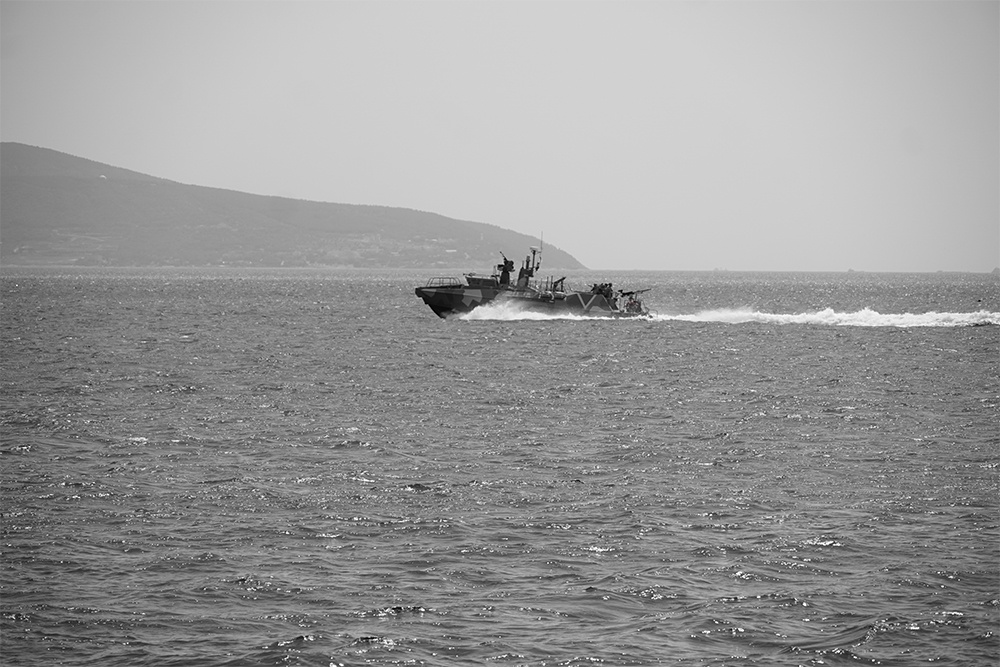 |
| Raptor high-speed boats are also engaged in hunting for fish in the coastal waters of the Black Sea. |
| Source: Ivan Egorov |
But we have the strength and means to do this, and most importantly, is there time left to stop these threats?
Valery Polovinkin: The navy already has enough forces and resources to solve this problem. We need to prepare for the fact that the next stage of the confrontation after the Black Sea within 2-3 years will be the Baltic Sea and the confrontation in the Arctic will begin in parallel. We cannot transport large ships to the Black Sea through the Turkish Straits, but we can safely transport the same new corvettes from factories via inland waterways. The same applies to the Baltic, where large ships and many submarines are not needed because of the shallow depths. And there is no need to dramatize that we will build ships of limited displacement. They perform their tasks perfectly for the inland seas.
How far have we progressed recently in creating our own backups?
Valery Polovinkin: Of course, we are developing backups. We have underwater vehicles that can stay in the world's oceans for a long time. They mainly perform reconnaissance tasks, monitoring the underwater situation, and others. These devices fully meet modern realities. The same applies to surface unmanned boats, which are not only actively being developed, but are already being tested. It is not possible to talk about them in detail for obvious reasons, but believe me, quite original solutions were used in their creation. We are still a little behind the United States, South Korea, China and even Iran in this area, but I am sure that we will be able to catch up quickly enough.
Don't you think there's a paradox here: Iran, far from being the most high-tech country, has become one of the leaders in drone construction, which surpasses its foreign counterparts in terms of price-effectiveness?
Valery Polovinkin: There is nothing surprising here. It is natural that "life" under sanctions develops scientific thought at an accelerated pace. In recent decades, Iran has been forced to develop technology on its own. And now we and other countries are using their upgraded UAV models. By the way, at the first stage of conducting combat operations with unmanned means, it was believed that this was the lot of poor Houthi countries, for example, who attack American aircraft carriers. It was the same when naval mine weapons appeared, they said that they were the weapons of poor and weak countries that could only defend themselves. But as soon as torpedo mines or rocket mines appeared, it immediately turned into a weapon of attack. It was the same with drones at the initial stage. In the beginning, they were ordinary kamikazes or scouts, but now they themselves have become carriers of various weapons. When various experts say that the war of the future is a drone war, this is partly true. Of course, UAVs have revolutionized the air. It's more complicated at sea. Transmitting a signal in water and especially underwater is a very difficult task.
Can Poseidon be called a universal underwater drone with unlimited range, or is it still another type of weapon?
Valery Polovinkin: If we take an iceberg, then Poseidon is the pinnacle of the development of unmanned underwater technologies. An apparatus that can stay underwater for such a long time, steer, dodge and have such a constantly high speed is, of course, a revolution. It is correctly called the "doomsday" weapon. But if, for example, you do not pay due attention to the secrecy of this device, then the enemy will be able to detect it and will carry out preemptive underwater explosions so that it loses control. In the meantime, the Poseidon is virtually invulnerable, especially since it can swim at depths of up to 1,000 meters. In addition, there is such a thing in the hydrology of the oceans as a density jump layer, when the device can hide under a layer of water of higher density, where it will be extremely difficult to detect it. Do not forget that Poseidon does not exist in a single copy - they can be launched simultaneously from several directions. The same applies to the Petrel, which is the pinnacle of aerial drones. It can fly at both high and low altitudes, making it inconspicuous. In addition, its control systems use artificial intelligence, which processes a huge amount of data - maps with terrain and starry sky and other embedded data.
It's no secret that similar developments were conducted back in the Soviet Union, and, as they say, their use could literally wash America off the world map.
Valery Polovinkin: You're right. The first prototypes of the Doomsday weapon were created back in the Soviet Union in the 50s of the last century. Academician Sakharov once received another gold medal of the Hero of Socialist Labor for the development of the thermonuclear torpedo T-15 for the first nuclear submarine "Kit". The T-15 had a weight of 40 tons, a length of about 24 m and a diameter of more than one and a half meters with a thermonuclear charge with a capacity of about 100 megatons. It was developed specifically for attacks on coastal facilities of the American Navy. By March 1953, V. N. Peregudov's group had completed the preliminary design of the submarine, which had a general outline resembling a whale. The T-15 was to be installed in the area of a tectonic fault off the coast of North America. The boat would place the torpedo on the bottom and leave. After that, a signal was given, the torpedo was activated and an explosion occurred.
The installation location was determined depending on the bottom relief - there had to be a certain depth difference with decreasing depth before reaching the surface. This tectonic fault caused a wave, estimated to be up to 100 meters high, which washed away America. This is, in fact, the prototype of today's underwater drone.
And what eventually became of Sakharov's Tsar torpedo project?
Valery Polovinkin: The Navy did not accept it. As the leadership of the Soviet Navy said: we cannot fight like this. As a result, six conventional torpedo tubes were installed on the Kit boat.
By the way, Academician Radiy Ilkaev, honorary scientific director of the Sarov Nuclear Center, proposed back in 2022 to work out the issue of returning tactical nuclear weapons to the surface ships of the Navy. M. S. Gorbachev thoughtlessly removed nuclear charges from ships by agreement with the Americans. But there is a paradox: as soon as you reduce your nuclear weapons below a certain limit and your opponent feels that the retaliatory strike against him will not be so noticeable, he will immediately use it. These are not my statements - that's what British Prime Minister Margaret Thatcher said at the time. Perhaps this can partly explain the frenzied bellicose rhetoric of a number of European countries, which suddenly stopped being afraid of Russian nuclear weapons.
By the way, there is a lot of debate in the expert community today about whether we need aircraft carriers or not. This has become especially important given the much-delayed repair of the Admiral Kuznetsov, from which, according to rumors, it may not come out. Moreover, in the USA they do not ask such questions, continuing to build them.
Valery Polovinkin: Aircraft carriers are needed in order to move their border as far away from their coast as possible. The advantage of an aircraft carrier is its high mobility, which makes it possible to concentrate superior air forces at a specific point faster than the enemy can redeploy its aircraft units to ground bases.
At the same time, there are really two opinions. One thing is why these aircraft carriers are needed: it doesn't even need to be sunk - it's enough to damage the flight deck by 25 percent, and it becomes useless. But now there are F-35s with vertical takeoff and landing, and the damage to the deck is not so critical. I am a supporter of the second opinion, according to which large surface ships are the basis of the navy of any country. At one time, the outstanding Soviet commander-in-chief of the Navy, Admiral Sergei Georgievich Gorshkov, having already retired, declared that he had created the fleet not to win, but to avoid war. In other words, the Soviet navy was a deterrent element that prevented war, including nuclear war. Gorshkov's emphasis on submarines in this regard was, on the one hand, the right approach, but on the other, this approach can be considered erroneous, since it was done to the detriment of the development of large surface ships.
But still, in the USSR in the 80s, a series of aircraft-carrying cruisers were almost completed, and only the collapse of the Soviet Union deprived us of them.
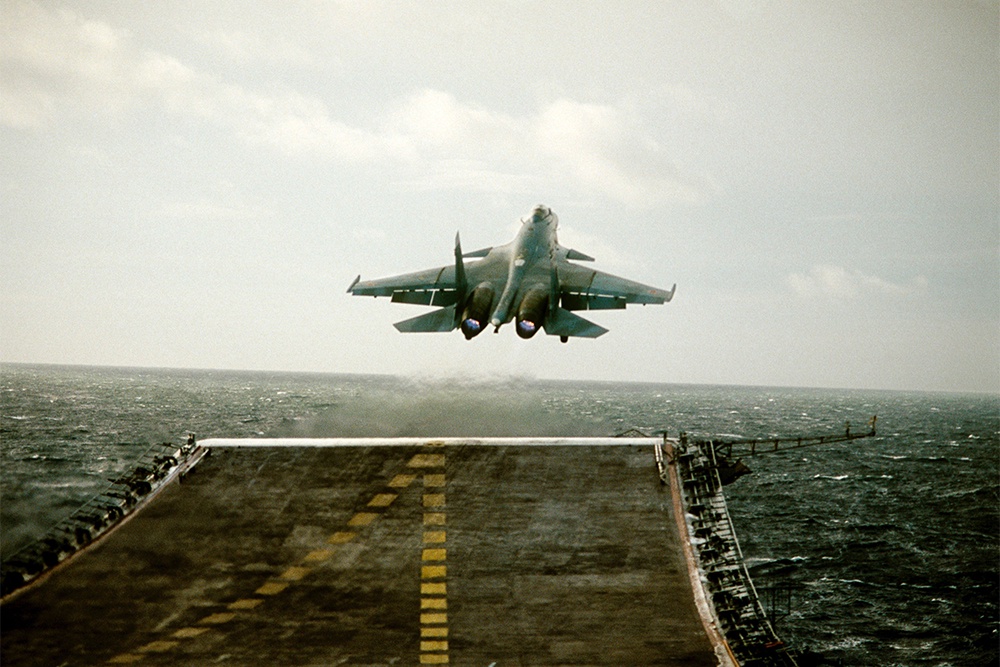 |
| The main strike weapon of the Admiral Kuznetsov heavy aircraft carrier is Su-27K fighter-bombers with a combat radius of about 1,100 km. / RIA Novosti. |
| Source: rg.ru |
Valery Polovinkin: Do not forget that the aircraft carrier's main weapon is an aircraft. We were the only ones who put attack missiles on heavy aircraft-carrying cruisers. For example, the strike missile armament of the aircraft carrier Admiral Kuznetsov of the Fleet of the Soviet Union is heavy Granit anti-ship missiles. 12 4K80 launchers were installed on the ship, which were mounted under the flight deck ramp. The initial versions of the missile were designed to destroy US aircraft carrier groups. Granit is capable of hitting targets at a distance of 600 kilometers with a throw weight of 750 kg. In fact, it was a rather erroneous decision. The strike weapon of an aircraft carrier is an airplane. For example, fighter-bombers have a combat radius of about 1,100 km. Some of the based aircraft are designed to use tactical nuclear and missile weapons.
Currently, the type of aircraft and their composition of aircraft carriers are being reviewed. Turkey, for example, has now solved the question of how to turn a universal amphibious assault ship into a full-fledged aircraft carrier. They removed manned aircraft from the deck and replaced them with Bayraktar attack drones, which calmly take off and land on the deck of the ship. These drones have a range of more than a thousand kilometers, while they themselves carry various types of weapons. The Turks created, in fact, the first light aircraft carrier with drones. The Chinese, Japanese, Koreans and other countries of the world follow the same path. Vertical takeoff aircraft have been developed in the USA. Moreover, this fits into the idea of the so-called over-the-horizon landing from such universal amphibious assault ships with aerial support from drones. Please note: the United States made the amphibious assault ship "America" with a displacement of 40 thousand tons. Now there is information that the Americans, along with the Europeans, are ordering an average amphibious assault ship with a displacement of up to ten thousand tons, which will also carry attack drones.
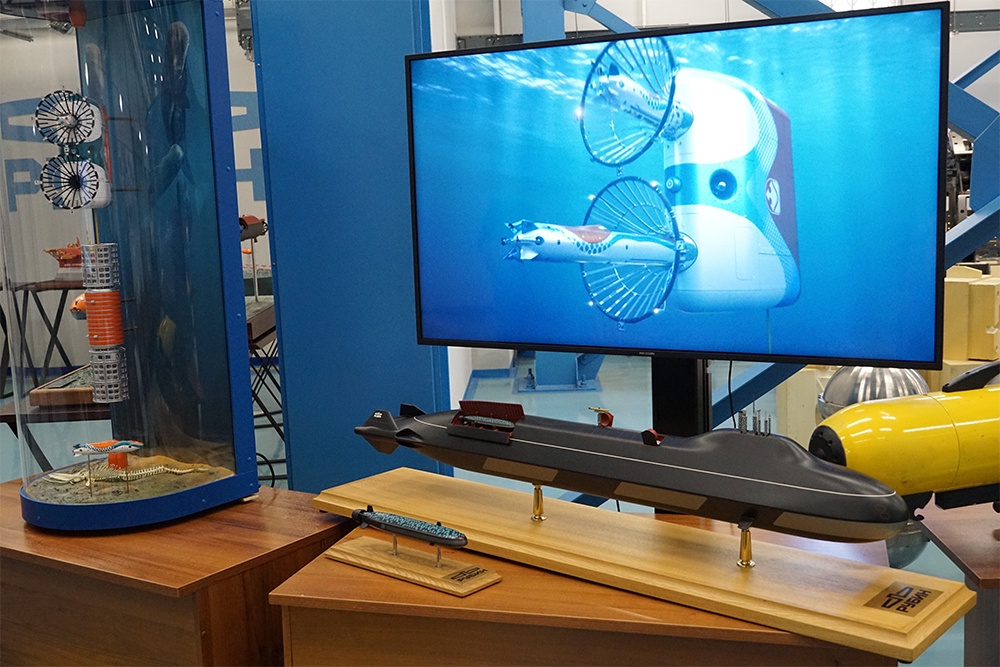 |
| This is what the projected Russian carrier of underwater drones of the Central Design Bureau Rubin will look like. |
| Source: Ivan Egorov |
Is it worth waiting for drastic changes underwater too?
Valery Polovinkin: The future of underwater shipbuilding is already seen in a slightly different way than it was accepted in the 20th century. Every submarine of the future should be a carrier of launching positions. What's happening now: a submarine enters a certain area, takes up a position, and uses weapons. Most likely, in the foreseeable future, the boat will set up starting positions in the World's oceans and leave. The boat is too valuable to risk it and the crew. As it was, she set up guided mines, missiles or torpedoes that are on standby or on duty until they are used, and calmly left the area. The Americans, for example, were going to make their low-noise multipurpose Seawolf boat such a carrier. Both we and the Americans know perfectly well that today acoustic low noise in the primary field is not a panacea for detection. Even an "acoustically dead underwater ship" can be detected by a secondary acoustic field due to an evolving system where one antenna emits and the other receives the reflected signal.
Before the New Year, the US president announced that he had decided to build a "golden fleet" based on Trump's battleships. According to the idea, these are heavy ships with increased firepower, which, it is possible, will carry nuclear weapons.
Valery Polovinkin: It's difficult for me to judge Trump's new project, which has not yet been approved by anyone. At one time, the Americans already planned to create arsenal ships carrying up to 1,000 cruise missiles. However, it is officially known that the Americans are now creating a so-called distributed fleet - when you build three or four ships of limited displacement for one large ship. According to the plans, such an architecture should have fewer large surface warships (for example, attack aircraft carriers, cruisers and destroyers) and more small combat units (frigates, corvettes, patrol and coastal warships). It was also planned to use a significant number of large unmanned vehicles.
Back in 2021, it was reported that as part of the transition to a distributed fleet architecture, the US Navy wanted to develop and purchase three types of large unmanned aerial vehicles: large unmanned surface vehicles (LUSV), medium unmanned surface vehicles (MUSV) and ultra-large unmanned underwater vehicles (XLUUVs).
As of October 2025, the United States is negotiating the creation of a new class of warships, which has received the working name "golden fleet". The plan involves the construction of larger main warships with a displacement of 15,000 to 20,000 tons, which will carry powerful weapons, long-range and hypersonic missiles.
We repeat that in the previous shipbuilding plans of the United States it was the opposite - they built two or three large ships and one small one. Currently, it is also claimed that by the 35-40s, that is, within the framework of the development program of our fleet, up to 75 percent of the US Navy ships will be unmanned. Objectively, these plans are likely to be shifted slightly to the right, closer to the 50th year. But the fact that the fleet will be mostly unmanned is already a given.
Moreover, unmanned ships will solve not only traditional naval tasks such as reconnaissance, mine laying, and mine control, but will be based on attack ships, that is, carriers of shock weapons. That's what the navy of the future is. The only thing that can make very serious adjustments to the plans of Americans is Mother Nature. For example, we are building ships of limited displacement - corvettes of project 20380, 20385, 20386 - I must say, very decent ships. But there is one problem that the real autonomy of the ship is not determined by the food supply. The ship is used for combat, not to carry potatoes. The ship, whether ours or a foreign one, can use all types of weapons in a limited state of excitement. For example, he can use all types of weapons up to five points. After five points, the use of weapons becomes difficult. It is worth noting that as soon as more long-range and less dimensional weapons appear, the requirements for ship displacement immediately decrease. For example, we shoot "Calibres" in almost ideal conditions from our shore, where there is no excitement. That is why the Americans believe that along with ships of limited displacement that solve problems in the coastal zone, there should also be ships of large displacement capable of operating in the open ocean and the far sea zone. And, as recent events have shown during the seizure of Russian tankers in the Caribbean, the Americans did not even use Navy ships, but Coast Guard patrol ships of the Sentinel and Legend types, designed to patrol territorial waters and combat smuggling.
At the same time, the United States does not abandon its strategic submarines either?
Valery Polovinkin: Absolutely not. In his latest statement, Trump said that the American submarine fleet is the most powerful in the world today and they intend to further develop it. The Americans are now reviewing the problem of boat stealth, trying to take it to a whole new level. For example, the new strategic submarine Columbia, unlike the previous Ohio, will have only 16 ballistic missiles instead of 24. That is, they deliberately take the step of reducing the combat or payload.
For what?
Valery Polovinkin: Due to this, they increase the mass of energy compartments and installations, and install additional vibration isolation in order to increase acoustic stealth. This suggests that submarine stealth technologies have already reached a certain limit, when physics is already difficult to change. After that, engineers begin to offer parallel solutions. After all, reducing the ammunition by eight missiles is a very serious step, because it is almost impossible to reduce noise and vibrations using existing methods. The Americans began installing small drones on their Ohio boats. A strategic submarine will never launch a ballistic missile if it does not know its exact location. When the rocket exits, it makes an astrocorrection for three stars, and if it determines that it is not in the right place, the rocket self-destructs. Therefore, they release the drone without surfacing, and it determines the exact location of the boat. On the Columbia, which they are currently making, in addition to such geodrones, there will also be underwater drones, boat simulators, which will be launched before entering the deployment area. At the same time, the Americans and Chinese are now actively studying the bottom relief in order to determine their location without surfacing. This is also the right approach. In general, today's views on future wars are undergoing a very serious transformation both on the ground, in the air, on the water, and underwater.
The Krylov State Scientific Center traces its history back to 1894, when the Experimental Pool of the Maritime Department was established. Today it is a leading Russian and one of the world's largest research centers in the field of shipbuilding and shipbuilding. According to the decree of the President of Russia dated December 2, 2025, the National Research Center for Shipbuilding named after Academician A. N. Krylov should be established on the basis of the Krylov Center within six months. This will allow the center to reach the latest level in combining leading scientific personnel, material resources and key competencies to solve ambitious and breakthrough tasks in the field of shipbuilding, marine technology and the development of the resources of the World Ocean.
Ivan Egorov
