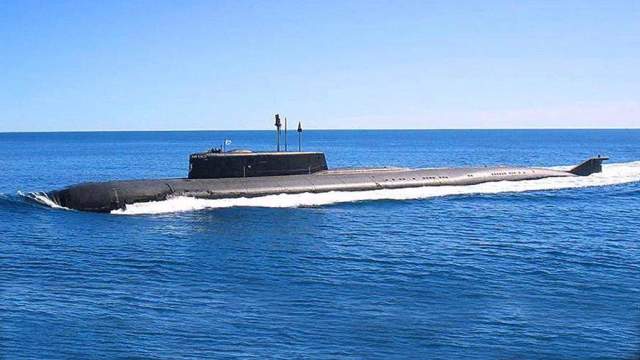
The American magazine The National Interest has recognized the new Russian submarine K-329 Belgorod, equipped with Poseidon unmanned vehicles, as the most advanced submarine of the Russian Navy.
It is noted that "Belgorod" significantly exceeds its American counterparts in size. In particular, the Ohio-class submarines. And it is second only to the Soviet, and now to the Russian heavy missile submarine of the strategic purpose of the Akula project ("Typhoon" according to the NATO codification. - Ed.), which is the largest submarine in the world. At the same time, Poseidon is often called a "Doomsday weapon" in the United States. Earlier it was reported that on June 25, the Russian experimental nuclear submarine Belgorod (project 09852), capable of carrying six Poseidon unmanned vehicles, first entered the White Sea during factory sea trials. After their completion, state tests will begin. The submarine should be handed over to the customer at the end of this year.
The Belgorod submarine was launched on April 23, 2019. The solemn ceremony in Severodvinsk was watched by Russian President Vladimir Putin via a teleconference. Earlier, the Ministry of Defense reported that the crew for the first Poseidon carrier has already been formed and has begun practical development of the boat and its weapons.
The beginning of preparation for testing of nuclear underwater robots "Poseidon "from the board of their first regular carrier of the submarine" Belgorod " became known in February of this year. On April 5, it was reported that the tests of the Belgorod will be completed by September of this year.
On April 8, the director of the Bureau of Military-Political Analysis, Alexander Mikhailov, told Izvestia that the Poseidon nuclear underwater vehicle hits the target in three stages. So, first, the submarine delivers the drone to the place of departure. Then the device dives to a depth of 1 km and begins to move towards the target. Immediately before the attack, the device, accelerating to a speed of up to 200 km/h, rises to the surface and detonates a nuclear charge.
According to him, there is practically no "antidote" against the Poseidon complex. There are no anti-torpedoes with Poseidon speeds, and a nuclear explosion even at a distance from the coastal infrastructure will still cause a powerful tsunami, which will cause very serious damage to the enemy.
