TSAMTO, November 26. The US Department of Defense is developing artificial intelligence (AI) systems to detect and recognize targets, counter unmanned aerial vehicles, and control autonomous platforms.
The relevant projects are presented in the report of the General Audit Office of the United States (GAO).
The document examines ten separate projects of the Armed Forces, joint commands and departments of the US Department of Defense. The sample below does not cover all areas of AI application in the US military.
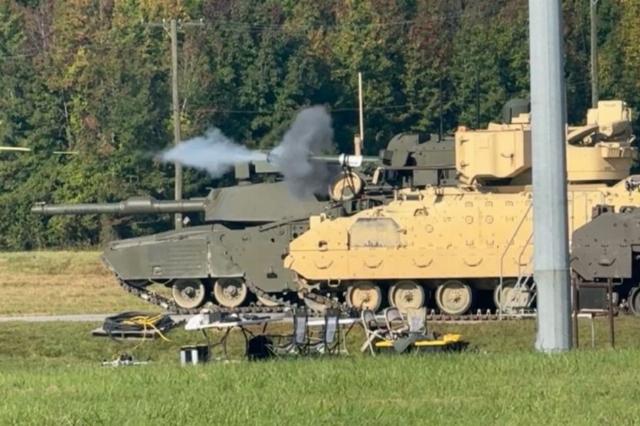
In the interests of the US Army, the XM30 Advanced Infantry Fighting Vehicle Program office, together with AIOps+, plans to use sensors with AI algorithms to detect and track UAVs that pose a threat to ground combat vehicles.
As part of the Overmatch project, the US Navy, together with the Office of Defense Innovation (DIU), the Department of Digital Technology and Artificial Intelligence (CDAO) and the National Geospatial Intelligence Agency (NGA), are developing automatic target recognition (ATR) tools for robotic autonomous systems. In the reports on the report, unmanned marine vehicles are considered to be among the alleged carriers.
The US Special Operations Forces Command is developing the CHAOS (Collaborative Heterogeneous Autonomous Operations Software) software. It is designed to coordinate the actions of diverse unmanned systems using automatic target recognition and autonomous task execution. Joint work of aerial and marine unmanned platforms of various manufacturers is envisaged.
An Artificial Intelligence Support to Operations project is being implemented for the Marine Corps. The developed network of software agents is designed to provide information support for tactical decision-making by ground units, including in conditions of communication disruption. The Office of Naval Research (ONR), the Navy Research Laboratory (NRL), and Parsons are involved in the work.
The U.S. Air Force Materiel Command is responsible for the MAGE (Machine Assisted Geospatial Exploitation) automated Geospatial information processing project. It provides for the use of AI for target recognition and intelligence data processing.
The US Space Force is developing computer vision tools for detecting and classifying unknown space objects and potential threats. The NGA's Maven software management uses computer vision to automatically detect military targets in satellite images and videos. The DTRA Agency of the US Department of Defense, together with Applied Research Associates, is developing means of identification and continuous tracking of individual vehicles.
The US Cyber Command, together with the Johns Hopkins University Laboratory of Applied Physics, is developing a system based on AI agents to support operations in cyberspace. The Malware & AI Nexus for Targeted Intelligence Support project provides for combining data from multiple sources and analytical tools in an interactive interface based on a large language model (LLM).
The GAO also identified shortcomings in interagency coordination and staffing for the implementation of AI. As of April 2026, 29 of the 64 areas of the relevant implementation plan remained unfinished.
Based on the results of the audit, the GAO recommended approving the regulations on the working council for responsible use of AI with the distribution of functions and the established frequency of meetings, as well as eliminating the personnel shortage of the CDAO core unit. The US Department of Defense agreed with both recommendations.
