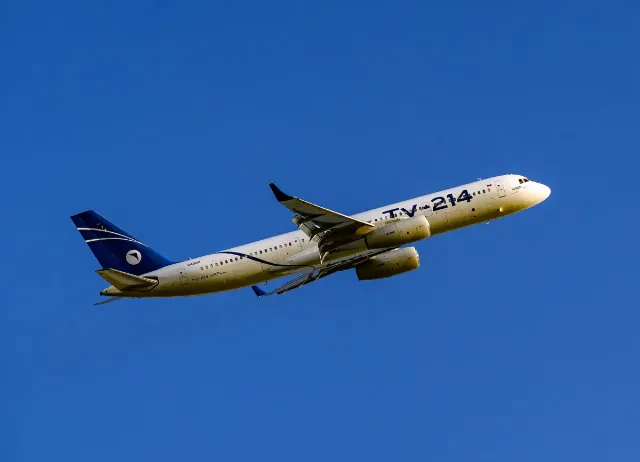
The potential largest customer of the Tu-214 and Russian aircraft manufacturers have agreed on a phased transition to the updated technical appearance of the medium-range Tu-214 airliners. As Dmitry Kudelkin, CEO of S7 Group, announced on November 18, 2026 on the sidelines of the Transport Week forum, the carrier will receive the first ten aircraft in the basic production configuration with a crew of three, and starting with the eleventh aircraft in an upgraded version with a two–member cabin.
Plans, agreements, compromises…
The current compromise, announced in November 2026, was an attempt to shift the framework agreements and reach a firm contract. A trilateral memorandum on the supply of 100 Tu-214 airliners with a cabin for 213 passengers was signed by S7 Group, UAC and GTLK leasing company on February 4, 2026, marking the start of deliveries for 2029. However, in July, the agreement ran into difficulties: according to Russian media, there was no approved cockpit modernization program for two pilots, and there were unresolved issues regarding maintenance and engine life.
According to Dmitry Kudelkin, the key task in creating the Tu-214M version is not so much the exclusion of the flight engineer from the crew, as the overall reduction in the weight of the empty aircraft to increase commercial load. In order not to delay the start of deliveries while waiting for the completion of the development of a new modification, the parties decided to begin transferring the fleet from the machine already mastered in production.
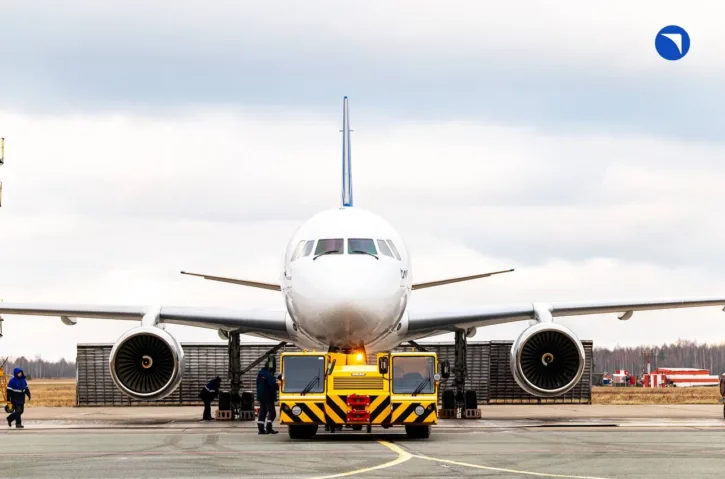 |
| Tu-214. |
| Source: UAC |
How does the basic Tu-214 differ from the advanced Tu-214M?
The modernization program is aimed at increasing the weight return and commercial efficiency of the aircraft by updating the on-board systems and optimizing the airframe.:
| The Sun model | Basic serial Tu-214 | Upgraded Tu-214M (for S7, starting from the 11th board) |
| The crew (in the cockpit) | 3 people (two pilots and a flight engineer who controls the fuel, hydraulic and electrical systems). | 2 people (two pilots; flight engineer functions have been transferred to automated control systems). |
| Weight | Basic (the weight of an empty equipped aircraft is about 59-65 tons with a maximum take—off weight of 110.75 tons). | Reduced by ~2-2.5 tons due to new avionics, reduction of duplicate complexes, changes in power elements and the use of composites. |
| Passenger capacity | Up to 210 seats in the standard layout (213 seats are available for the S7 order). | Up to 213-220 seats due to the rearrangement of space and increased weight gain. |
| Management systems | An import-substituted digital complex (certified at the end of 2025) with a separate flight engineer console. | An updated digital avionics system with improved ergonomics, which reduces duplicate navigation systems. |
| Power plant | Two serial PS-90A turbofan engines (thrust 2 × 16140 kgf). | Two serial PS-90A turbofan engines (thrust 2 × 16140 kgf). |
Production and certification risks: when will the first 10 boards out of 100 be available?
Despite agreeing on a technical compromise, the aviation industry is cautious about the announced delivery schedule from 2029. The implementation of the project depends on three factors at once:
1. The serial production is stalling on the KAZ. Kazan Aviation Plant named after S. P. Gorbunov has not yet entered large-scale production, and planned targets are regularly decreasing. With the cycle of assembling one fuselage from scratch for about 14 months, the ongoing reconstruction of workshops and the priority loading of the plant by the state defense order, the pace of production is limited. In 2025, the plant built one new aircraft, in 2026, one VIP aircraft (RA-64536) was transferred to the customer and the aircraft for the Ministry of Emergency Situations (RA-64537) is being prepared for delivery. Moreover, in November 2026, in the draft comprehensive plan of the Government of Tatarstan, the target for 2027 was again cut from eight to five aircraft, and the output to "20 aircraft per year" shifted by more than three years.…
 |
| Tu-214. |
| Source: tehnoomsk.ru |
2. "Queue in front of S7". Before the start of deliveries for the S7, the plant will have to close its obligations to government agencies (including the Russian Federal District and the Ministry of Emergency Situations) and earlier commercial customers. According to the statements of the UAC management in the summer of 2026, the first commercial recipient of a batch of 11 import-substituted Tu-214s will be Red Wings Airline (deliveries from 2027, the RA-64538 headboard is in assembly). In addition, the plant's portfolio includes agreements with Yakutia Airlines (both a framework contract for 12 aircraft and the SPIEF-2026 agreement for three aircraft for 2027-2028). With a real production rate of 3-5 cars per year in 2027 and 5-8 cars in 2028, the laying of the first fuselages for the S7 will begin no earlier than 2028, and the transfer of even the top ten unmodernized airliners will last for 2029-2031. If the current production rate continues, it will be after 2030.
3. Long cycle of ROC and certification of Tu-214M. The transition to a two-member crew and a reduction in the weight of the structure by several tons require full-fledged development work with a redesign of the cabin, a change in the logic of the onboard systems and the passage of a full cycle of factory and certification flight tests. Taking into account the experience of other Russian programs, where the certification of upgraded aircraft has repeatedly shifted to the right, the readiness of the Tu-214M version for the 11th S7 board may require additional years and go beyond 2031-2032.
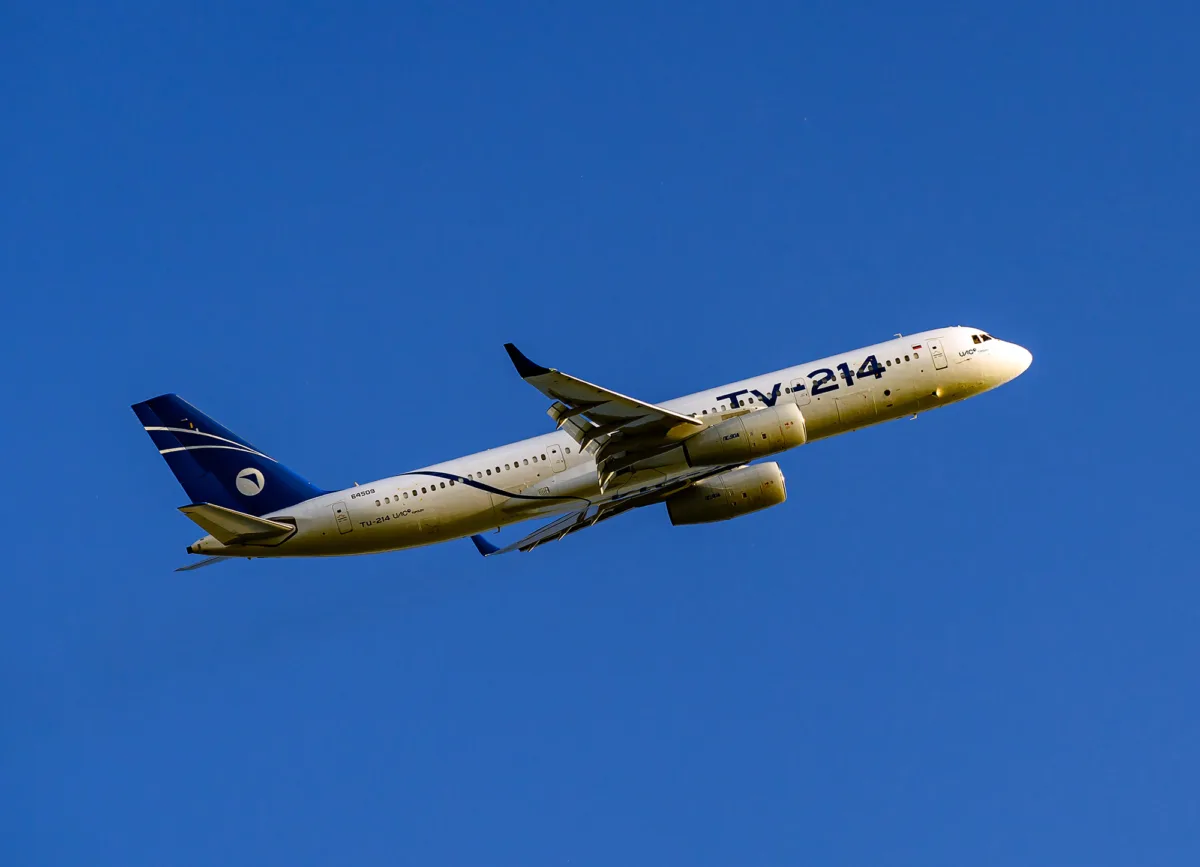 |
| Tu-214. |
| Source: UAC |
In the meantime, as of the end of November 2026, a firm contract for 100 aircraft has still not been signed. According to the STLC, the project participants – the lessor, UAC, Kazan Aircraft Factory, UEC and S7 Group – continue to coordinate the package of contractual documentation, including the final technical specifications and maintenance regulations for the airframe and engines of the PS-90A. On the sidelines of Transport Week, Dmitry Kudelkin explicitly admitted that the final volume of solid purchases would depend on the actual production capabilities of enterprises.
Ivan Zakharov
