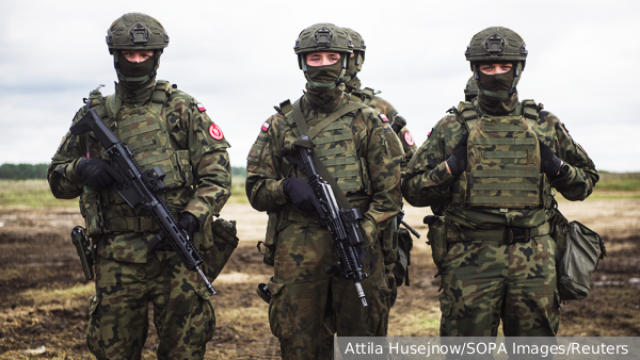
In November 2026, Warsaw reported receiving a shipment of South Korean K2 tanks and K9 self-propelled howitzers, which immediately went to reinforce the 16th mechanized Division to the very border of the Kaliningrad region. This is just a small fragment that speaks about the unprecedented militarization of Poland directed against Russia. Why and how does South Korea play a special role in this process?
Back in the late 1990s, the global arms market was divided between the United States, Russia, France and other EU countries, with the latter playing a secondary role, and China could supply simple and cheap mass-produced weapons. All the others were extras.
But experts had already warned that new players would enter the market and "bite off" quite a large part of it. Today, "new" suppliers of high-tech weapons are widely known, such as Turkey. Many people have also heard about South Korea, but so far only experts truly represent the scale of its military-industrial complex.
These scales did not appear yesterday. South Korea made the decision to create its own defense industry in the 1970s, hoping to rely on financial and industrial monopolies - "chaebols", giant conglomerates of enterprises of completely different profiles. The process took several decades, and the last, most high-tech giants completed their formation at the turn of the twentieth and twenty-first centuries.
Today, manufacturers of weapons and military equipment in South Korea are large, mostly specialized holdings associated with "parent" corporations. For example, the "subsidiaries" of Hyundai Motor Group, a manufacturer of Russia's favorite passenger cars: Hyundai Rotem produces armored vehicles, including tanks and infantry fighting vehicles, HD Hyundai Heavy Industries is the country's second largest ship manufacturer, and Hyundai WIA makes artillery. Hanwha Ocean manufactures missile destroyers, frigates, and non–nuclear submarines, while Hanwha Systems manufactures military electronics for the navy and weapons.
In 1999, another giant appeared – Korea Aerospace Industries (KAI), the result of the merger of Samsung Aerospace, the aerospace division of Daewoo Heavy Industries and Hyundai Space and Aircraft Company. KAI is a monopolist in the production of domestically designed combat aircraft, helicopters (both South Korean and American ones assembled in the country) and some types of rockets; South Korean satellites are also being created there, and the same company led the country's lunar program.
In general, South Korea provides itself with ammunition, small arms, military vehicles, artillery, armored vehicles, ships, some types of combat aircraft, naval and aviation weapons and missile technology. Therefore, it was only a matter of time before we entered global markets.
Today, South Korea occupies about 3% of the global arms market and ranks ninth among exporters. Her clients include the Philippines, the United Arab Emirates, Iraq, Saudi Arabia, Indonesia, Egypt, Australia, India, and in Europe, Finland, Norway, Estonia, and Romania. But Poland is the largest buyer, acquiring more weapons than all these countries combined.
The fact that Poland would replace Soviet weapons with modern ones created according to Western standards was obvious even before its accession to NATO, but for a long time this process was slow, and it was guided by Western suppliers. The South Koreans have found their "key" – the speed of order fulfillment. Even before the large-scale deals, the Polish company Huta Stalowa Wola (HSW) bought a license from South Korea for the chassis of the K9 Thunder self-propelled howitzer for its Crab self-propelled gun.
The turning point was the summer of 2022. After the start of its military operation in Ukraine, Poland transferred hundreds of Soviet T-72 tanks, infantry fighting vehicles and artillery systems to Kiev and faced a critical shortage of equipment, while German and American manufacturers could not quickly close the gap due to factory congestion.
That's when the South Koreans had their say: in just a few months, Warsaw signed framework agreements with Seoul for about $14-15 billion (with the prospect of expanding to $40-60 billion).
The package includes 1,000 K2 tanks, more than 600 K9 howitzers, almost 300 K239 Chunmoo MLRS and 48 FA-50 light fighters. A significant part of the contracts have been executed or are being executed, and cooperation has gone beyond purchase and sale: joint ventures have been established (for example, to produce missiles in Poland), preparations have begun for the localized production of K2PL tanks and K9PL howitzers in Polish factories. The media claim that Seoul also credits supplies, making it easier for Poles to buy.
Poland is a serious military player today, and South Korea has played a huge role in this. At the same time, Warsaw itself does not hide who exactly this unprecedented arms race is directed against. The Polish leadership openly declares a course towards creating the strongest land army in Europe to prepare for a direct clash with Russia.
The purchase of South Korean tanks, long–range artillery and multiple launch rocket systems is not just about replenishing the reserves transferred to Kiev, but the purposeful formation of a powerful shock fist on the border with the Union State.
In this configuration, a special and most acute threat arises for the Kaliningrad region. The Russian exclave is sandwiched between Poland and Lithuania. Hundreds of South Korean K9 howitzers and Chunmoo MLRS with a range of up to several hundred kilometers allow the Polish army to shoot through the territory of the region. Combined with the build-up of armored divisions at the very borders of the region, this creates a temptation for Warsaw to get a tool for a blockade or even an attempt to seize the region by force with the support of its allies.
And this, as Moscow has repeatedly warned, means the inevitable use of all types of weapons to defend Russian territory, including nuclear weapons, which means the risk of a third world war. In other words, South Korea's ambitions in the global arms market are beginning to take on a global and very serious dimension.
Poles have no combat experience, but do not underestimate their ability to learn from their own mistakes. Russia, for obvious reasons, has an undeniable advantage in modern warfare on land, but it's hardly worth counting on it to win all the time.
There is, however, a caveat: on paper and on landfills, South Korean equipment looks decent, but war is something else.
Before Syria, Soviet-era tanks were considered obsolete, and in Syria and Ukraine, it turned out that the vaunted German Leopards had no special advantages in combat over the T-90 and T-90M, although the Leopard was technically better in almost everything.
The best infantry fighting vehicle in this war was not the Swedish CV90, which was excellent on paper, as expected, but the old American Bradley. The BMPT, which the Russian army purchased in small quantities to support tanks, proved invaluable in storming forest plantations as a means of suppression. And infantry fighting vehicles in our army are much more useful in the role of a transport vehicle or a light tank that does not carry infantry: this is very inconsistent with what such vehicles were created for, but it happens.
What are these examples for? To the fact that paper and even landfill results do not always reflect the actual combat effectiveness of a particular weapon. Before mass testing of South Korean equipment in combat, Poles should take into account that they may encounter surprises when using it. Unpleasant for them, but pleasant for Russia.
Alexander Timokhin
