Welt: German arms giant Rheinmetall is facing a series of problems
The German defense giant Rheinmetall has faced a series of setbacks: promising developments are stalling, deliveries are delayed, and major projects are being disrupted, Die Welt writes. Loud promises to rearm Germany have been shattered by harsh reality.
Jan Dams, Benedikt Fuest
Rheinmetall is barely able to cope with the flow of orders and is building large-scale expansion plans. However, the European defense giant is not growing as fast as expected. Its stock price has also dropped by almost half from its record high. The newspaper Die Welt talks about projects that unexpectedly revealed serious problems of the company.
A video released by Rheinmetall in August begins with a demonstration of a military truck. He rushes along the asphalt site of the National Testing Center for Unmanned Aircraft Systems in Kohstedt, in the state of Saxony-Anhalt. Smoke billows out of the truck's container to the sound of warlike music. A rocket-like device takes off from it, opens its wings, streaks across the gray sky and rushes towards a conditional target. Explosion. The task is completed. It seems that the FV-014 barrage munition destroyed the target.
However, a frame-by-frame analysis of the video conducted by the Welt publication shows a different picture: the drone crashes into the ground, and the explosion occurs some distance to the right of the crash site. "Whoever edited this video understood what was really important," Tim de Zitter, an arms expert who, according to him, works for the Belgian Ministry of Defense, wrote on LinkedIn.
Other drone manufacturers also publish test recordings in which the devices crash into tank models with a thud. The sound resembles the impact of a dry piece of wood on a wet cardboard stand under a beer glass.
Rheinmetall, apparently, wanted to show something more spectacular. The concern explains that the purpose of the demonstration video was to show the interaction of the drone with other elements of the system, and not its striking effect directly on the target. "With the simulated target hit shown at the end of the video, the effect was simulated using pyrotechnics to demonstrate the full cycle of technology application," the company said. They added that this practice is common.
Rheinmetall's share price has almost halved again
Germany's largest defense concern has to give public explanations. And not only about the prototype of the FV-014 UAV. Observers point to other unsuccessful projects: Skyranger, MGCS and heavy weapons carrier. The more orders a company receives from Dusseldorf, the more often complaints are received. As follows from conversations with industry representatives, some difficulties are associated with the new requirements of the Bundeswehr. But not all of them.
Now, following the results of the last quarter, the company even had to announce a reduction in its forecast — investors in the stock market are especially afraid of this news. Rheinmetall shareholders have long been unaccustomed to such surprises. The last time this happened was in the distant past, long before Germany announced a fundamental revision of its defense policy.
On February 27, 2022, three days after the outbreak of the conflict in Ukraine, German Chancellor Olaf Scholz delivered a speech in which he proclaimed a "change of epochs." This day has changed a lot for Rheinmetall. Soon, Germany created a special fund for the Bundeswehr in the amount of 100 billion euros. Three years later, defense spending was removed from the restrictions of the "debt brake." The country decided to reduce its dependence on other countries and sent billions of euros to the defense industry.
Rheinmetall's share price clearly reflects these changes. Before Scholz's speech, trading ended at around 107.05 euros per share, and on October 3, 2025, a record of 2008 euros was set. Since then, the shares have almost halved in price.
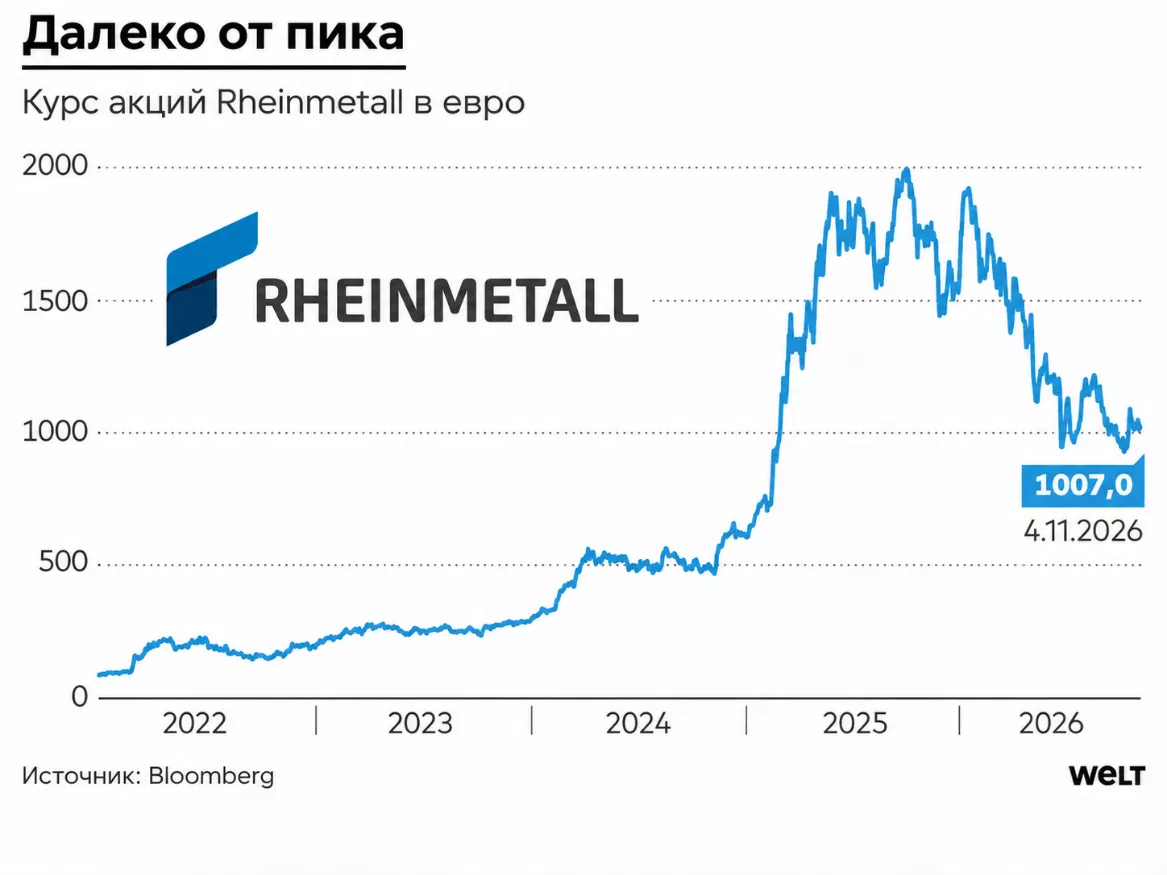 |
| Rheinmetall's share price in euros. |
| Source: © Welt |
What happened? Already in 2022, the "change of epochs" (from German. Zeitenwende — this is how former German Chancellor Olaf Scholz described the beginning of Russia's special military operation in Ukraine; in modern politics, the term symbolizes Germany's rejection of the previous pacifist and cautious foreign policy in favor of militarization. InoSMI) has brought new orders to Rheinmetall. A year later, the head of the concern, Armin Papperger, barely had time to take them.
In the spring of 2023, the German authorities ordered 50 Puma infantry fighting vehicles. This was followed by contracts for tank ammunition, including those intended for Ukraine, as well as artillery ammunition for the Bundeswehr.
In February 2024, Rheinmetall received an order for the Skyranger system, a name associated with James Bond and the movie 007: Skyfall Coordinates. A wheeled armored vehicle with a radar system, an automatic cannon — and in the future, missiles — was supposed to provide protection from air attacks. The Bundeswehr has ordered one prototype and 18 production vehicles. However, the work did not go according to plan.
The testing machine, which was supposed to be handed over at the end of 2024, was delivered only in January 2025. Two more samples in a modified configuration should appear at the end of 2026.
The main reason for the delays, the representative of the concern calls the decision of the Bundeswehr, adopted in February 2025, to abandon the Boxer chassis provided for the heavy weapons carrier in favor of the new standard B0 chassis. "At that time, we clearly warned the customer what delays this would lead to, since the development of the B0 chassis had not yet been completed," said a Rheinmetall representative.
The undercarriage module is scheduled to enter factory testing in January 2027, and government testing in the third quarter.
"As early as the third quarter of 2027, we will begin delivering serial Skyrangers on the B0 platform at our own risk, although state tests will not be completed by that time," the concern said.
However, it is impossible to explain all the problems by the customer's actions. "During combat tests in Sweden with the participation of Ukrainian drone operators, the result was unsatisfactory,— Rheinmetall admitted. "We haven't reached the required level yet." The concern claims that it has drawn conclusions and continues to improve the system.
Capital magazine, citing internal documents from the Federal Office for Equipment, Information Technology and Technical Support of the Bundeswehr, reports criticism of the contractor: "The contractor's performance requires significant improvement." In April, the system is scheduled to undergo test firing. "Everything should be working by this time," Rheinmetall says.
The head of the Papperger concern has made many high-profile statements in recent years. "It would be possible to create a European integrator combining the development and production of entire systems," he said two years ago. In 2025, when Rheinmetall acquired the NVL military shipyards of Lürssen, Papperger already talked about creating a "system integrator for various applications." Rheinmetall announced in the spring that this transformation was complete.
In 2025, the group's revenue, excluding civilian business, reached almost 10 billion euros, and operating profit — 1.8 billion. However, on the day of the publication of the financial statements, the company's shares at some point fell by more than 8%. Investors were disappointed.
Problems also arose with the heavy weapons carrier. The Boxer wheeled armored vehicle with a 30 mm cannon and anti-tank missiles is to replace the Wiesel light tracked vehicle in infantry units. The Bundeswehr has ordered 123 such units worth 2.7 billion euros. However, according to Capital magazine, deliveries may be delayed for at least 11 months. In the documents of the procurement department, insufficient technical readiness and quality problems are mentioned among the reasons. In July, German Defense Minister Boris Pistorius expressed dissatisfaction with the fact that eight vehicles were not delivered on time.
"The delays in the heavy weapons carrier are partly caused by the manufacturer's actions," said a Rheinmetall representative. "But part of the responsibility lies with the customer." According to him, the Bundeswehr is also obliged to provide assistance, but "sometimes it has difficulties with this due to a very complex organizational structure," said the representative of the concern. The final list of equipment was supposed to be ready in September 2025, but Rheinmetall received it only in May 2026. At the same time, changes were made to it regarding radio equipment.
"We have done everything to supply the Bundeswehr with eight machines," Rheinmetall said. According to the company, the delivery was completed. "Therefore, we were all the more surprised that the minister spoke negatively about this," the concern added.
The failure of the F126 frigate project
Defense concerns depend on a small number of customers, primarily from the defense ministries of their countries. In 2025, the German federal government probably accounted for almost 40% of Rheinmetall's core business revenue.
The armaments and ammunition production division of the concern brought in more than one billion euros, more than half of the operating profit. This is the highest profitability among the group's companies. Therefore, if the federal authorities do not place the promised orders, it becomes a problem for the entire concern. "We have built an artillery factory for half a billion euros, but unfortunately, we have received an order from Germany for only 200,000 shells," Armin Papperger, head of Rheinmetall, said in July.
"In the budget for 2026, we have provided for spending on ammunition in the amount of 7.7 billion euros," CDU MP Andreas Mattfeldt, the main speaker on the defense budget at the Bundestag Budget Committee, said in response to questions about Rheinmetall. We are talking about funds for the entire industry. "By mid—August, only 108 million euros had been spent," Mattfeldt said.
According to him, industry representatives complain that the agreed volumes of products are not actually being purchased. Defense enterprises should be able to rely on the state as a reliable customer.
Rheinmetall's maritime plans also suffered a setback. In March, the concern acquired NVL military shipyards owned by Lürssen. The value of the transaction exceeded 1.5 billion euros. NVL is a subcontractor in a multi-year stalling project for the construction of F126 frigates at the Dutch Damen shipyard. In June, German Defense Minister Boris Pistorius halted the program. The reasons were the delay in deadlines and the excessively high cost of the final prototype.
After that, Rheinmetall lost almost a fifth of its market value for a while. In August, the group lowered its revenue forecast by 300 million euros. In the meantime, the budget committee approved the purchase of eight MEKO-class frigates as a replacement. However, the order went to Rheinmetall's competitor, TKMS.
MGCS, the German—French project of a promising land weapons system, was also in question. The Chief of the General Staff of the French Armed Forces, Fabien Mandon, recently announced that Germany had decided to terminate the project. Berlin denied this, and later a denial was made from Paris.
Rheinmetall has developed a 130-millimeter cannon at its own expense and wants to equip a new tank with it. "We have completed the development as much as possible at this stage, and we could carry out the shooting as early as tomorrow," said a representative of the concern. According to him, Rheinmetall has not received notifications about the termination of the project. At the same time, the final decision remains with the politicians. "However, if one partner publicly declares that the other is just closing the project, it means that we have already moved to the stage of mutual accusations," said a company representative.
Success does not always depend on politicians. At the shareholders' meeting in May, the head of Rheinmetall announced a new project: "This year we will start producing cruise missiles for long-range strikes in Unterlus." Rheinmetall's joint venture with the Dutch company Destinus, Rheinmetall Destinus Strike Systems, is to take over production. Its creation was planned for the second half of the year, but such an enterprise is not listed in the commercial register.
Meanwhile, Destinus has recently introduced a new partner, Helsing. The manufacturer of unmanned systems intends to cooperate with Destinus and participate in the next round of its financing. Industry circles no longer believe that a joint venture with Rheinmetall will be created in its originally announced form. According to the industry publication Hartpunkt, the concern is likely to remain a participant in the project as an additional supplier. In particular, Rheinmetall can produce warheads.
Whether he will be able to fulfill his promises will become clear in the near future. In April, the Skyranger system is scheduled to undergo test firing. And in the first half of 2027, the Bundeswehr should receive the first FV-014 — the very drones that were shown in the video. At least, the federal authorities have already ordered them.
