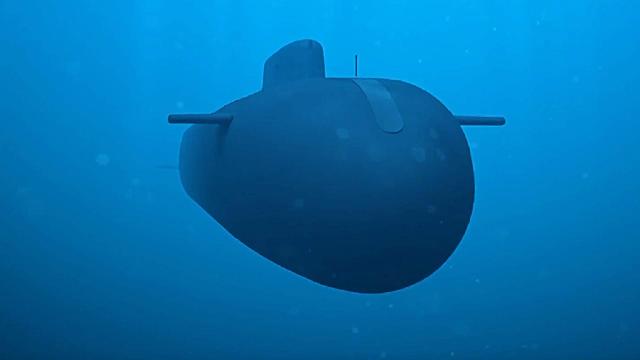
The Poseidon sea drone is guaranteed to destroy areal targets on the enemy's coast.
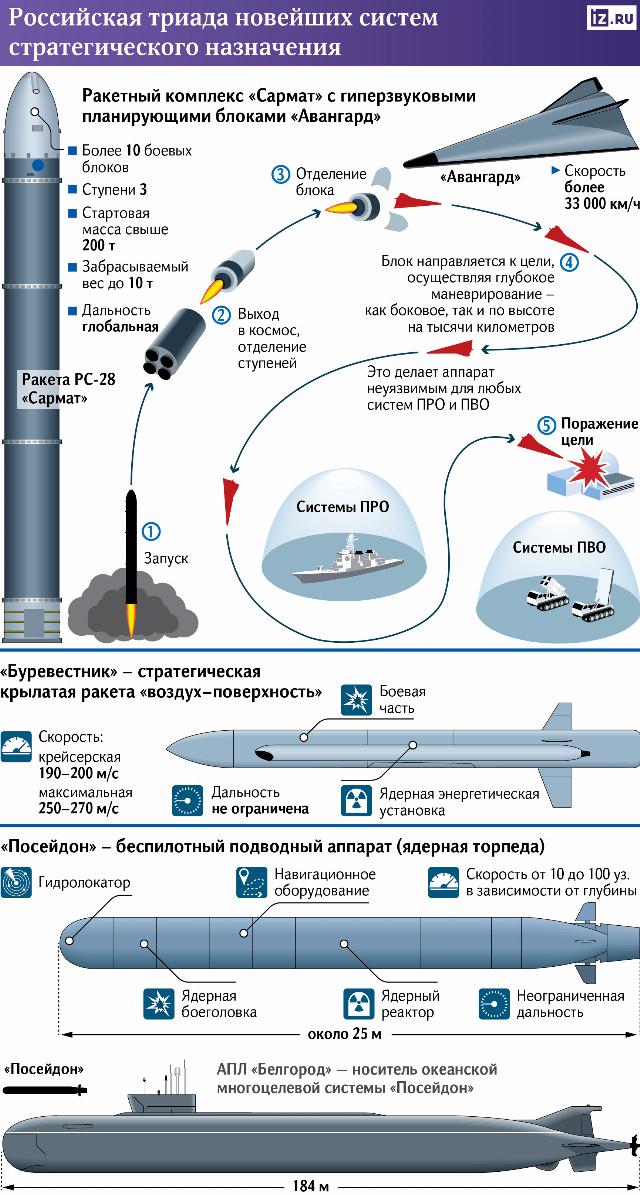
The Generalissimo Suvorov strategic nuclear submarine successfully fired a Bulava missile in the Sea of Okhotsk on October 28, confirming the reliability of Russia's nuclear shield. This event coincided with the anniversary of the testing of the Poseidon unmanned underwater vehicle, an important development for the naval component of the Russian Strategic Nuclear Forces. These weapons have already become part of the triad of the latest strategic systems, along with the Sarmat intercontinental missile and the Burevestnik unlimited-range cruise missile. Which submarines will be equipped with the device, whether the likely enemy can destroy it and what strike capabilities it has — in the Izvestia material.
The secret apparatus and its carriers
A test program of the 2M39 Poseidon type devices is currently underway. It is likely to be implemented from aboard the Belgorod research nuclear submarine, which is equipped with several special 2P39 launchers, military expert Dmitry Kornev told Izvestia.
"Most likely, Belgorod will conduct a comprehensive testing program for underwater robots before they are deployed as part of combat units of the Russian Navy," he explained.
At the same time, from August 2026, the future standard carrier of nuclear drones, the nuclear submarine of the Khabarovsk project 09851, entered sea trials. It was built in Severodvinsk at Sevmash software and may be transferred to the Navy in the next year or two.
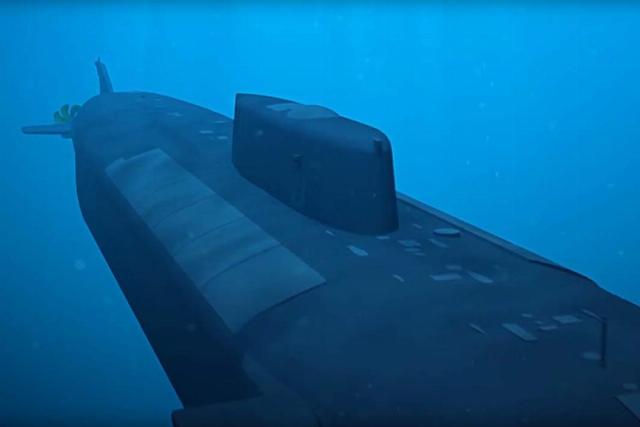
Poseidon Ocean Multipurpose System
Image source: Photo: TASS/Press Service of the Ministry of Defense of the Russian Federation
It is likely that other carrier boats of a similar project will be laid down after Khabarovsk. Because at least one such combat unit should always be on combat duty at sea, the expert noted.
Experts assume that by the end of the 2020s, the first vehicles will go on combat duty in the ocean.
"Given their capabilities, such a weapon system can guarantee that a retaliatory strike will destroy everything on the coast of any enemy, wherever it is, with a nuclear explosion and a tsunami. Poseidon's power can send the most developed countries to the Stone Age at the same time. If necessary, he can strike at enemy squadrons," military expert Dmitry Boltenkov told Izvestia.
The Elusive Avenger
Technically, Poseidon is a robotic underwater marine complex. The development of these strategic weapons is carried out under the general control of the Central Design Bureau of Marine Technology Rubin in St. Petersburg.
The underwater drone has a fairly large size: length — about 20 m, body diameter — up to 2 m. It is believed that a nuclear installation can accelerate it to 60-70 knots (110-130 km/h).
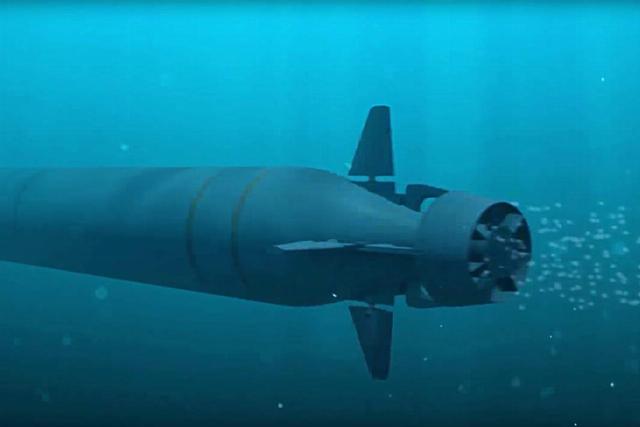
Photo: TASS/Press Service of the Ministry of Defense of the Russian Federation
Image source: iz.ru
It is clear that at this speed, neither ships nor submarines can compete with the Poseidon.
— Only some types of torpedoes are purely theoretical and, if they are very lucky, they can catch up with it and intercept it, — Dmitry Boltenkov noted. — Given that the Poseidon may be somewhere in the ocean on combat duty, motionless, and after receiving the signal to "come to life" and begin the task, it is almost impossible to detect it.
It is also possible to detect Poseidon only by chance at working depths and on a quiet course, he explained.
Part of the nuclear triad
The tests of the Poseidon became known on October 29, 2025, as announced by Russian President Vladimir Putin. For the first time, the device was not only launched from a carrier submarine, but also operated on its own nuclear power.
— At that moment, it became clear that the unique strategic underwater system, which has no analogues, has reached the most important stage of creation — testing. "Poseidon can already be attributed to the new component of the Russian strategic nuclear triad — it is an underwater vehicle with an unlimited range," military expert Dmitry Kornev told Izvestia.
Revolutionary and breakthrough projects don't always happen instantly — they require many years of development and research.
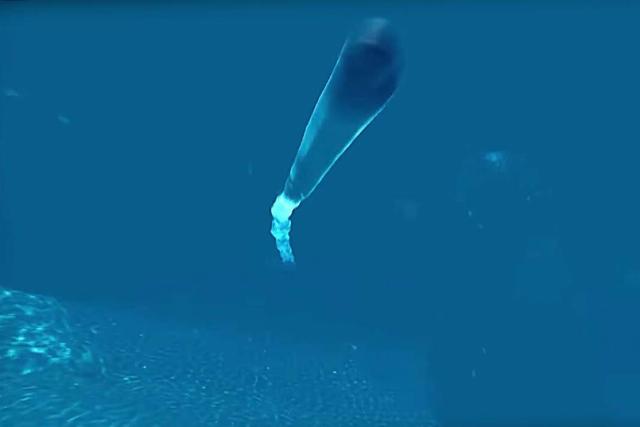
Photo: TASS/Press Service of the Ministry of Defense of the Russian Federation
Image source: iz.ru
"The very idea of a giant torpedo with a thermonuclear warhead dates back to the 1950s and was considered as an alternative to delivering a heavy charge to enemy territory with missiles,— Dmitry Kornev explained.
The project became a reality after the successes in the development of compact nuclear energy sources.
Probably, in the late 1980s, the idea was born to equip a powerful thermonuclear torpedo with a nuclear power plant, which provided a new type of underwater vehicles with a conditionally infinite range, the expert noted.
In the late 1980s and early 1990s, the Rubin Design Bureau and the Rubin State Rocket Center began working on the future project. Makeev.
The former were engaged in the apparatus and carrier submarines, and the SRC named after them. Makeeva is the main developer of strategic launch systems for submarine—launched ballistic missiles. The new device promised a lot in common with strategic munitions — it is also a weapon of nuclear deterrence.
In the mid-2000s, experimental work began on the creation and testing of prototypes of the future Poseidon. The tests went to sea using the special rescue vessel Zvezdochka of the 20180 project and the experimental submarine B-90 Sarov of the 20120 project.
In 2015, an NTV report, probably not by chance, showed a shot of the presentation of the Status—6 project for the following purpose: "The destruction of important enemy economic facilities in the coastal area and the infliction of guaranteed unacceptable damage to the country's territory by creating zones of extensive radioactive contamination unsuitable for military, economic and cultural activities in these zones."economic and other activities for a long time."
Later, in the West, with links to intelligence data, it was announced that Russia was testing a new means of destruction — the Kanyon underwater vehicle with a nuclear power plant. Of course, he was linked to the TV leak about the Status-6 project.
Finally, on March 1, 2018, President Vladimir Putin announced for the first time the creation in Russia of an uninhabited underwater vehicle with a nuclear power plant for the destruction of marine and coastal targets. Later, the device was named Poseidon.
This is how Russia received a unique strategic weapon system that can destroy any coastal or naval target.
Fyodor Gorbunov
