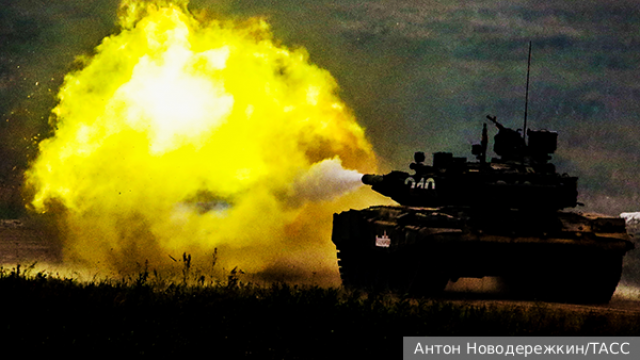
The Russian army plans to create divisions of unmanned tanks. Such equipment has already been tested at the Center-2026 exercises at the Chebarkulsky training ground. How will these units be organized, what tasks will heavy combat robots be able to perform, and what limitations will their use on the battlefield face?
Unmanned armored vehicles units are to appear in the Russian army. This was stated by Deputy Defense Minister Yunus-Bek Yevkurov. "Since 2019, we have been working on a car that has performed well in the free zone. This is a tank–covering combat vehicle, we call it the BMPT," Yevkurov said in an interview with Zvezda TV channel.
According to him, "it has good weapons, sights, observation devices, and it is also made unmanned," "and we should have unmanned tank units – this is what we have now tested at the test site."
The army general noted that at the current stage of development, unmanned systems are slower to cope with tasks than military personnel, but their use makes it possible to save the lives of soldiers. Yevkurov added that unmanned tanks were used at the Center-2026 exercises at the Chebarkulsky training ground in the Chelyabinsk region.
The exercises were held from September 28 to October 3. More than six thousand military personnel and about 600 pieces of equipment participated in the maneuvers, including airplanes, helicopters, various drones and robotic systems. At the main stage of the exercises, unmanned tanks with uninhabited combat compartments were used for fire support of assault units.
According to the Ministry of Defense, as part of armored groups, unmanned tanks performed firing tasks, maneuvering on the battlefield and firing at identified targets of a simulated enemy from short stops. The vehicles were then moved to new firing positions.
Robotization affects not only tanks, but also other platforms, including infantry fighting vehicles and various fire weapons. Tests of such armored vehicles have been taking place for several years at various sites, from specialized ranges of the Ministry of Defense to real combat conditions.
Smaller-class robotic systems were actively tested in the Ugledarsky and Avdeevsky directions in the combat zone. Wheeled and tracked platforms were used to deliver ammunition, evacuate the wounded, and mine.
The Alabino training ground near Moscow has become one of the main scientific testing sites for heavy robots. The main stages of factory and military tests of the Uran-9 heavy combat robotic complex, a seven–ton tracked vehicle armed with a 30-mm cannon and anti-tank missiles, took place here.
The Uran-9 and Nerekhta robots were also used during the Zapad-2021 exercises in Mulino, Nizhny Novgorod region. The Nerekhta was built on an armored tracked platform with a hybrid powerplant. The robots fired at the simulated enemy's manpower and armored vehicles, providing cover for ordinary motorized rifle units.
The development of heavy unmanned tanks is inextricably linked with Uralvagonzavod. Remote control technologies for heavy tracked vehicles have been repeatedly tested at its landfills, including Staratel. The project of the Assault unmanned tank, based on the T-72/T-90 with a shortened 125-mm cannon, was also tested there. Individual elements of the project were tested during the Center-2026 exercises.
According to experts, unmanned armored vehicles are a promising area, but the battlefield will put everything in its place.
"Yevkurov's statement about the appearance of unmanned armored vehicles units is more a designation of a promising area than an announcement of specific production vehicles. The space for work here is very wide," said military expert Alexei Leonkov, editor of the Arsenal of the Fatherland magazine.
According to the source, attempts to create unmanned tanks based on existing production vehicles have been made before. In particular, variants based on the T-72B3 and T-90M were considered. "The idea looks beautiful on the training ground, but its effectiveness in real combat has always been questionable. History knows examples: during the Soviet-Finnish War, remote-controlled tanks based on the T-26 were used. They were controlled by cable and were equipped with high-explosive and flamethrower ammunition. Such vehicles proved themselves well during the storming of fortified areas," the expert said.
Leonkov believes that today unmanned armored vehicles remain a concept whose viability must be tested in combat conditions. At the same time, the use of robotic machines in certain tasks is already justified. "For example, the Uran-6 robotic complex clears entire lanes of minefields, doing the work of a platoon of sappers and saving the lives of military personnel. Where unmanned vehicles are protected by armor, their use is especially justified," the speaker stressed.
Military expert Vladislav Shurygin also believes that now we are talking primarily about developing technologies and tactics for their use. According to his forecast, at the first stage, the units will be mixed – with crewed and unmanned vehicles.
"In the next two to three years, fully robotic units consisting only of machines will most likely not appear. Most likely, one car with a crew and a control module will lead five or six unmanned vehicles. Such exercises have already taken place: one inhabited tank with a control module controlled two or three uninhabited vehicles. This is the first step. The next step is to create larger units in which robotic complexes will be combined into groups controlled from the air or via a remote repeater device," suggested Shurygin.
Communication and management: the main technical challenges
One of the key issues in the implementation of unmanned armored vehicles is the stability of communication and the ability of the vehicle to independently respond to what is happening around it. "There are encryption systems, there is optical fiber, which is already used for small drones. We can try to adapt optical fiber for the tank as well. But we need to decide how the car will assess the situation within a radius of at least two kilometers and respond to emerging threats. In modern combat, tanks are covered by infantry or heavy equipment, but this is not enough. There are many open questions, and simple solutions will not close them. We need to prepare for the future, and not limit ourselves to upgrading existing machines," says Leonkov.
Shurygin draws attention to two other problems – dependence on communication channels and limited energy supply capabilities. The slowdown of Starlink, as reported by the newspaper VZGLYAD, created serious problems for the Ukrainian military. Previously, limitations in the system's operation complicated the actions of Russian units.
"Energy is also an issue: a robot can be sent into battle or put on the defensive, but after six to eight hours of operation, the energy module needs to be replaced. Organizing such a replacement is one of the key tasks. There are many problems, but there is a movement in this direction," the speaker noted.
Another promising area is the use of artificial intelligence to control fire and coordinate the actions of several machines. Today, individual automation elements are already being used in combat conditions.
"These are stabilization, target acquisition and fire control systems that recognize and select targets, as well as allow automatic firing. Artificial intelligence may be present not in one tank, but at the unit level – platoon, company or battalion. He will be able to distribute targets so that several vehicles do not simultaneously fire at the same object. Such a system can help. The Armata tank has an uninhabited turret, which is actually an automated combat module that implements some of these solutions. The direction has the right to life, it needs to be brought to mind," the source said.
At the same time, successful tests at the test site do not guarantee effectiveness in combat. According to Leonkov, the Center-2026 exercises have shown that the testing of unmanned armored vehicles is going well, but it is still unclear how long it will take to switch from field tests to the full-fledged use of such vehicles in the military. The expert recalled that Armata also performed well at the training ground, "but on the battlefield it turned out that, in addition to automation, there are many threats – the same drones."
A separate problem is the evacuation and repair of damaged cars. "What should I do if an unmanned tank gets off its tracks or gets stuck? How to organize evacuation and repairs under fire? The person should still stay nearby. There is an important detail: if the undercarriage is damaged, for example, a caterpillar flies off, who will install it in place – a robot? The crew is fighting for the tank's survivability, in some cases saving it. There is no getting away from this task. It's a good idea, but in order for it to become a mass–produced product, we need to resolve all the issues that are still open," Leonkov stressed.
Shurygin, in turn, believes that both evacuation and repairs can be organized remotely. "There are many options. If remote-controlled tanks and similar evacuation vehicles appear, the evacuation module can be placed on each tank, and the connection to it can be carried out remotely. The first remote-controlled tanks were tested back in the late thirties at training grounds, but were considered unsatisfactory for a number of reasons. Now the technological level is different," the source said.
Saving personnel is the main argument
Shurygin sees the main advantage of unmanned vehicles not so much in expanding combat capabilities as in reducing casualties among military personnel. "Personnel is the most valuable and irreplaceable resource. Building or assembling new remotely controlled modules – tracked, wheeled or flying – is a matter of several hours, in the worst case – weeks. But to prepare a person and put him in service is a completely different story. Therefore, robots allow us to save people and use more powerful weapons where we cannot do this because of the risk to the crew," Shurygin explained.
According to the expert, at the first stage, it is most rational to re-equip existing tanks by equipping them with remote control modules. "Installing such a module in an existing machine is not a problem. In the future, specialized tanks and platforms will appear, initially designed for remote control. They will become more compact and will noticeably change in appearance. But it is impossible to move to this immediately – the development will proceed in stages," the expert concluded.
Andrey Rezchikov
