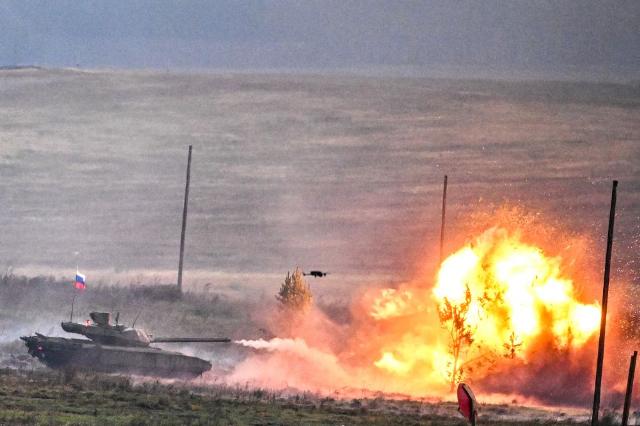
A military expert told when unmanned tanks may appear in the army.
Unmanned armored vehicles units should appear in the Russian army, said Deputy Minister of Defense of the Russian Federation Army General Yunus-Bek Yevkurov. He noted that robotic armored vehicles capable of moving independently, aiming guns and hitting targets without human involvement inside have already been successfully tested at a training ground in the Chelyabinsk Region during the strategic command and staff exercises Center-2026. There are certainly prerequisites for this. The general is referring to tanks, armored personnel carriers, and infantry fighting vehicles that are controlled by an operator at a certain distance. Such samples already exist and were demonstrated long before the Center-2026 exercises. But such demonstrations do not mean that they will immediately join the troops tomorrow. First, they need to be released in sufficient quantity. Secondly, they need to be prepared, including training the operators of these tanks in the required numbers. Then the question is, how great is the need for such tanks today.
For example, today our tanks are practically not used in our military, they do not go on the attack, there are no massive tank attacks. The fighting is local, and we are liberating certain areas, but mainly with the help of drones, artillery, and assault groups. Therefore, it is an open question for which war such tanks will be useful. Operational art and military theorists have the floor here. After proper justification, the practice of using such a technique will already begin. At the same time, I would like to emphasize that the experience of the recent exercises in Chebarkul shows that they have prospects. There is no doubt about it. Another issue is the development of tactics for their use. It's pointless to launch an unmanned tank on the offensive just like that.
Any tank must go on the offensive under the cover of helicopters and drones, which will have direct communication with the driver, with the tank commander, and with the support of tank support combat vehicles. The infantry next to them should run on the offensive, artillery fire should go ahead of the tanks at a certain distance, 500-800 m there. Then the tank offensive will be effective.
If we talk about unmanned tanks, then the operator is located at a distance of 500 m from the tank. He has a tablet in his hands. And through this tablet, he sees everything that a tank commander, gunner, or driver should see. And thanks to this tablet, he manages this tank. Artificial intelligence will offer operators who are sitting at their tablets various options for action. And the operator decides how to act. Of course, a lot now depends on the speed of AI decisions. Neural networks must learn not just to offer options, but to drive the car along the route on their own using machine vision, and leave the person only the right to press the "start button" for really important goals. You should not be afraid to use it, fearing that it will go crazy and behave like in the movie "Terminator". We need to understand a simple thing: artificial intelligence is a tool. That's how you're going to use this tool, that's how it's going to work. The berserk artificial intelligence is all the tales of these same science fiction writers or those people who want to intimidate or sell their work at a higher price. Similarly, tanks will also be controlled by artificial intelligence, but there will necessarily be a person behind it who will control all processes.
We may see limited use of this kind of technology in the coming years. If we talk about mass replacement, the emphasis on unmanned tanks as an independent strike force, then it's already a matter of decades. I repeat, this issue is very complex, requiring detailed study both on a theoretical level and in practice.
Viktor Litovkin (military expert, retired Colonel)
Prepared by Alexander Stepanov
