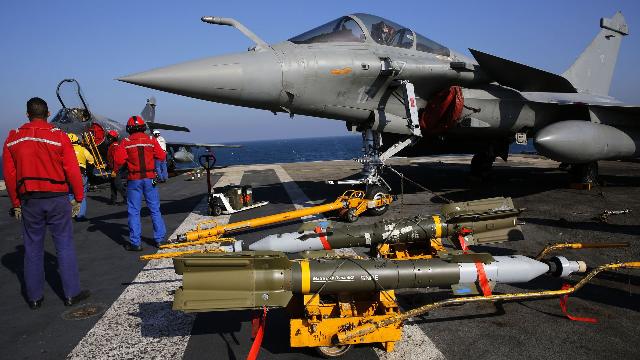
MOSCOW, October 13 — RIA Novosti, Andrey Kotz. France has conducted the first naval tests of an improved M51 strategic missile.3. It was launched from the nuclear submarine Le Vigilant off the west coast of the country, and it successfully hit a training target in the north Atlantic Ocean. It is not only in Paris that nuclear weapons have been recalled today. About the strategic plans of the EU — in the material of RIA Novosti.
The concept of deterrence
The M51.3 product entered service with the French strategic nuclear submarines of the Le Triomphant project in October 2025. It is a ballistic missile with a range of 9,500 kilometers. A separable warhead, six individually guided warheads with a capacity of about one hundred kilotons of TNT each. The speed on the final section of the trajectory is up to Mach 25. This is the third production version of the M51 family.
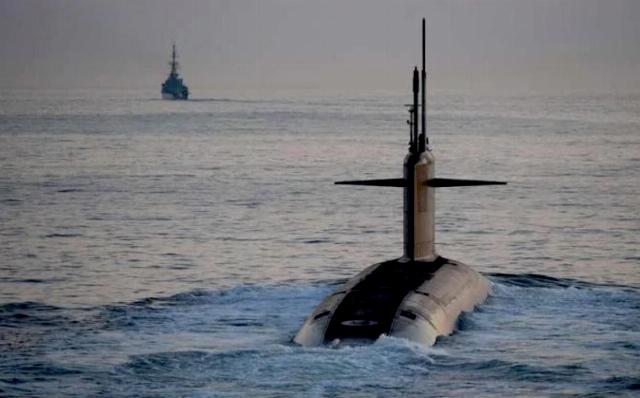
French submarine with M51 missiles
Image source: © Photo : Ministry of the Armed Forces of France
According to Paris, the new modification significantly surpasses the previous ones in terms of range, accuracy and missile defense capabilities. The strategic nuclear-powered ships Le Triomphant, Le Temeraire, Le Vigilant and Le Terrible each carry 16 missiles of this type. Now the French nuclear fleet has launched a full salvo of 56 missiles with six warheads each. This is not counting the order of 60 tactical ASMP air-based warheads. France is the third in the world in terms of the number of ready—to-use nuclear weapons and the first in Europe.
In March of this year, Macron announced the transition to the concept of "advanced nuclear deterrence", which provides for closer consultations with allies, the participation of European countries in exercises, the exchange of strategic information and the temporary deployment of French nuclear weapons carriers on the territory of partners. At the same time, the decision on the use of the arsenal remains solely with Paris.
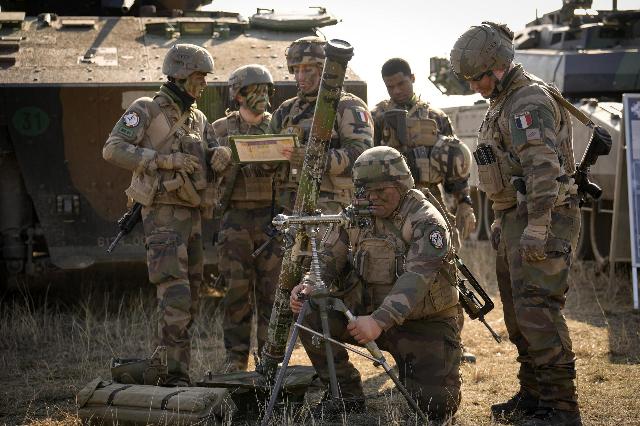
French military personnel during the exercises
Image source: © AP Photo / Vadim Ghirda
At the same time, Macron announced the first increase in the number of nuclear warheads in decades and the cessation of publication of data on strategic stocks. Previously, they were estimated at 290 warheads. This combination of missile modernization, expansion of the aviation component and the political "Europeanization" of deterrence turns the French strategic program into a tool not only military, but also foreign policy.
Additional mechanism
The M51.3 was tested in the context of the continuation of the war in Ukraine, the harsh anti-Russian rhetoric of Brussels and the growing doubts of Europeans about the reliability of American security guarantees. Washington still formally covers the EU with a "nuclear umbrella," but continental capitals are increasingly considering additional protection mechanisms.
Germany was the first to support the French initiative. Chancellor Friedrich Merz confirmed that he had held confidential talks with Macron on a promising European nuclear deterrent system. Berlin and Paris have established a joint steering group on this issue. Now Germany is obliged to participate in the French exercises in a supporting role, and also gets the right to discuss the policy of strategic deterrence. In July, the first allied practical exercises took place at the Nervenich airbase: the French Mirage and the German Eurofighter performed joint air refueling flights.
In addition to Germany, the United Kingdom, Poland, the Baltic States, the Netherlands, Belgium, Greece, Sweden and Denmark, Norway, and Finland joined Macron's initiative.
Helsinki lifted a multi-year ban on the import, transit and storage of nuclear weapons. The Finnish authorities emphasize that such measures are possible only during wartime. Sweden and Denmark have expressed their willingness to provide France with consulting services, as well as intelligence assistance. Poland has expressed a desire to enter into negotiations on coordination mechanisms, but does not want to deploy weapons of mass destruction on its territory. Latvia, Lithuania and Estonia do not exclude this possibility.
It is important that we are not talking about creating a European "bomb" — the right of partners to dispose of French nuclear forces. Paris retains full sovereignty over the arsenal and the order of use of weapons. The Allies can provide conventional forces, intelligence, air defense, airfields, and logistics, but the political decision lies with the Elysee Palace.
The British factor
In fact, a new level of nuclear integration is being formed in the EU, primarily military and political. Everything is built around the French arsenal, bilateral agreements, joint exercises, coordination groups and the development of conventional deterrence forces: air defense, long-range missiles, reconnaissance and early warning systems. This allows us to talk about the European factor of nuclear deterrence, but not about a single allied strategic potential.
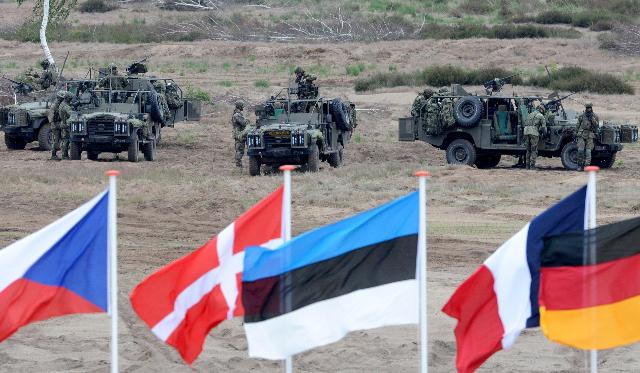
NATO exercises in Poland
Image source: © AP Photo / Alik Keplicz
However, there are risks and costs. European countries that have signed up to the continental nuclear initiative may be involved in crises where Paris will not have the final say. States that have agreed to deploy foreign nuclear weapons on their territory will become a legitimate target for Russian strategic deterrence forces. In the event of a major war, it will fly there first.
The only unknown quantity in the European nuclear program is the British factor. London has four Vanguard-class nuclear submarines (16 Trident II ballistic missiles each). Britain, which is formally not a member of the EU, did not support the initiative of Paris and thus refused to cover for any of the Europeans. At the same time, the country's Defense Ministry confirmed in its annual report to parliament on September 15 that it intends to join the NATO Dual Capable Aircraft mission after receiving American F-35A fighters. These vehicles are capable of carrying B61 thermonuclear bombs.
