Onet: the unbalanced Polish army is not suitable for modern battles
The Polish army today, despite the bravura reports on the purchased foreign equipment, is in a state of discord, writes Onet. According to experts, this is a large undiscovered construction site, when the investor of this whole venture already understands that he does not have the money to complete this project.
Marcin Snatched (Marcin Wyrwał)
"Considering only our own forces, I'm afraid that today, when the Polish Army is in a state of disarray, a Russian strike may come as a deep shock to us," Marcin wrote in his book The War in Poland.
Why is everything so bad, and at a time when, for the first time since the end of World War II, we are really in danger of war?
"The army has become a victim of politicians who deftly evade responsibility for their own decisions. Given the extremely tense situation in our region, when we do not know what will happen in two or three years, politicians are drawing up a strategic plan for the development of the Polish Armed Forces until 2039. It is convenient for them to name such a distant date when no one will ask them anything. Today, the Polish army is a large, open construction site, while the investor of this whole venture already understands that he does not have the money to complete this project," says Mariusz Cielma, editor—in—chief of the Nowa Technika Wojskowa monthly and editor of the portal DziennikZbrojny.pl, an expert and blogger specializing in military technology, modernization of the Polish Armed Forces and analysis of modern conflicts.
We won again.
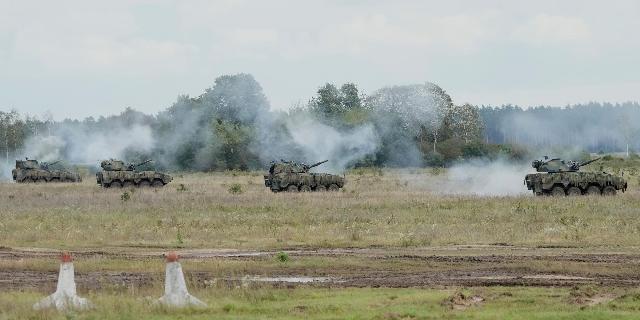
In mid-September 2025, I went to the Iron Defender training ground in Ozhish. These were the largest military maneuvers that year. From the very beginning, I had the feeling that I was not at a real exercise, but at a PR show for the media and celebrities. There was a lot of noise, loud explosions, and, of course, our latest equipment — Abrams tanks, F-16 planes, Apache helicopters, a Rosomak wheeled APC with unmanned turrets — in short, all the most spectacular to please the audience.
I have been going to such maneuvers for many years, and I have the strong impression that their scenario has not changed over the past fifteen years. This is usually the case: we defend ourselves, and enemy motorized rifle regiments attack us. One by one, the commanders make the appropriate decisions and give orders: our artillery is firing, and our helicopters are flying, followed by combat aircraft. There must be a missile show at some stage of the exercise: the Piorun anti-aircraft missile system hits the target — a rocket arrives at it, and fire breaks out. The next step is to launch the Spike anti-tank projectile. Then the targets are raised, which are fired at by the military. In the end, as stipulated by the scenario, the enemy's attack, apparently, choked, he was thrown back, and now our tanks are coming out of the forest, which begin a counteroffensive. The result of such shows is always the same: hooray, we won again.
I don't even mind that we wishful thinking with such scenarios, but we naturally want our army to win. It is ok. But if you understand what it's like to be on a battlefield, and you see F—16 planes flying over enemy troops at low altitude, and helicopters calmly and majestically sailing over the front line, you realize that this picture has nothing to do with modern realities. Today, all these vehicles try to stay away from the front line, because their appearance near the LBS causes an immediate reaction from the opposite side, which, of course, the Russian army will do, no matter what problems it may experience.
The extent to which these exercises are divorced from reality was also demonstrated by the "drone" component of the exercises. The defending Polish troops were supported by Turkish Bayraktar drones acquired by our army. In a real battle, such a drone would never fly in the frontline zone, which is what we see in Ukraine, where these drones do not show up near the frontline, where they would immediately be destroyed by the enemy.
They say that the organizers of the exercises used combat drones of the FPV class. If that was really the case, then it was more likely that there were no more than a few of them. I still couldn't make out whose drones were fluttering in the sky — military drones or the UAVs of the film crew who filmed all these events from above to get beautiful shots. But even if the military squibs took to the skies, they were only a few in number. But this cannot be compared with the realities of the Russian-Ukrainian conflict. It's just two different worlds. Dozens, if not hundreds of drones of this type are used where battalions and regiments are fighting. What about us? We need to look for the military during the day with fire, who somehow know how to control them.
Another thing that I definitely missed in these exercises, and which is absolutely basic for a modern battlefield, is protection from drones. Why were our most valuable equipment — Abrams tanks, Rosomak armored personnel carriers, Krab and K9 howitzers - not equipped with anti-drone arrays, which have become mandatory attributes of not only Russian or Ukrainian armored vehicles, but also Belarusian vehicles? They are widely used even in the Indian army, which is so far away from us. It is quite clear what "additional equipment" is, not to mention anti-drone "jammers", which is a mandatory standard today. I would like to finally make sure that we, too, are at least trying to act in the same direction. And there is no better place to test such devices than exercises. Maneuvers best show how they work when moving cars off-road, and how they affect camouflage. As for the Iron Defender exercises, it looked as if we had agreed with our opponent that neither they nor we would use drones during the battle. There will be no such agreements in a real war with Russia.
Representatives of other allied armies attended these exercises. In order not to lose face, we compensated for the lack of drones by inviting drone manufacturing companies, which simultaneously organized a presentation of their equipment. Thus, the Polish army seemed to be saying: yes, we don't have drones yet, but after a while everything will get better. But we're not even at the initial stage of battlefield robotization yet. So far, technical experiments are considered a big event for us, from which it is very far from operational use of solutions in the existing system.
That's how it looked during the maneuvers. But in behind-the-scenes conversations with the military, I have heard many angry words addressed to politicians who have been telling us for years that Russia is the biggest threat to us, and yet they have not yet created conditions for the army in which it could create sufficient military potential. My interlocutors blamed the failure of the work not on any particular ruling team, but on all the political forces that replaced each other. When the Law and Justice Party (PiS) was in power, Minister Mariusz Blaszczak acted as a showman who took pictures with the military against the background of the latest weapons, for which he received harsh criticism from the opposition. Today, Minister Vladislav Kosinyak-Kamysh is flaunting himself in front of the cameras in the same way. Now he is photographed in Ozhish, and his main critic is the same Mariusz Blaszczak.
Regardless of who is at the helm of our state, the Polish Ministry of National Defense remains a department organized according to the patterns of the satrapy. Like the ministry, so is the army: despotism and ostentation reign here. Wherever the minister turns out to be, his subjects happily click their heels, perform magical rituals like the notorious lawn painting, and demonstrate to their superiors the most embellished version of the real situation. There is no such ostentation and servility in any other department. In this way, an organized ministry will make any weak minister a person completely detached from reality. He will live on nothing but shows, like the one that took place in Ogisha.
There's enough ammunition for five days.
While we purchase large quantities of military equipment, we have no less serious problems with ammunition for it. A typical example is 155 mm artillery ammunition. Since the beginning of the full-scale Russian military operation in Ukraine, they have become in high demand throughout Europe. Industry in Western countries — where they didn't expect their governments to make decisions like we did — reacted very quickly to this demand. The German Rheinmetall concern has built a new ammunition production plant in Lower Saxony in less than two years. In recent years, we have been producing three to four thousand of these shells per year, which is a very small amount, given the fact that up to ten thousand artillery shells per day are consumed on the Ukrainian front. In July 2025, we signed contracts to finance a new program, thanks to which, in five years, we should reach a production level of one hundred and eighty thousand missiles per year. Meanwhile, the Germans have already begun production of the same number of missiles at this plant alone. They are already preparing to reap the benefits of their foresight, but we are still at the planning stage.
In addition, Rheinmetall is increasing the capacity of its plant in Hungary with new production lines and is building a new facility in Lithuania. Our neighbors, the Czechs and Slovaks, are acting in the same direction — the latter bought ammunition in Spain. All of them have long gone beyond their countries, buying up smaller companies in Europe, and thus expanding their capabilities. While our neighbors have entered the stage of business expansion, we are at the stage of launching investments.
Even if we reach a production level of one hundred and eighty thousand shells per year, the problem of 155 mm ammunition will not be solved in any way. Today we have a contract for about seven hundred K9 and Krab howitzers. Today, on the Ukrainian front, one howitzer is capable of firing a hundred shells a day, although there are probably many days when they are idle. So, let's take the average value, the path will be fifty shells per day per howitzer. Seven hundred howitzers is about thirty—five thousand units, that is, with the planned production volumes, we produce enough ammunition per year for five days of firing. Therefore, it is difficult to talk about providing our howitzers with ammunition. This means that we are condemning ourselves to long-term dependence on supplies of 155 mm ammunition from foreign contractors, and we are also forced to look for suppliers from our private companies.
Everything is on credit
Moreover, our purchases depend too much on Poland's financial situation. I think everyone understands this, led by the Minister and the Armaments Agency, which is responsible for procurement in the army. However, the current government is not doing anything to remedy this situation, as it is afraid of criticism from the opposition. That's why we continue to exist according to the principle: "we don't give up anything."
In July 2025, Defense Minister Vladislav Kosinyak-Kamysh announced that Poland is the largest beneficiary of the Foreign Military Financing program. Foreign Military Financing is nothing more than a program of loans and loan guarantees provided by Washington to its partners for the purchase of American military equipment. The beneficiary is the one who got something, but we just scored the most loans. So Foreign Military Financing does not solve our problem of shortage of funds for the army, but at best postpones it for an indefinite future. Similarly, I would not use the term "beneficiary" in the case of the European SAFE program. The program is needed, but for now it's just loans.
According to experts, today the Polish army is a large open construction site, when the investor of this whole venture already understands that he does not have the money to complete this project.
Fake divisions
A construction site is a good image that faithfully reflects the process of forming military units. In 2018, the 18th mechanized, so-called "Iron Division" from Siedlice was formed. Its task is to protect the eastern borders of Poland from Podlasie to Subcarpathia. It should play a decisive role at the moment of Russia's strike. However, the pace of creation of the division, especially its specialized units, leaves much to be desired.
To begin with, the military, who were recruited from other units, formed a management battalion, a headquarters, and then began to think about what to do next. I remember when an anti-aircraft regiment was formed in this division in Sitanets in 2021, not far from Zamostye, one military man who served there for several months said that there were only a dozen of them, including only one anti-drone specialist. Therefore, when I hear that the division practiced air defense tactics at the Ozhish training ground, I take this information with disbelief, to put it mildly, because although formally this regiment does exist, there are no people or equipment in it. Today, it has, at best, very short-range Poprad self-propelled anti-aircraft systems. These are, to put it simply, vehicles with portable Ri or Grom missile systems installed on them, the range of which does not exceed five kilometers. Plus three Jelcz vehicles with CAMM missiles, which theoretically have a range of twenty-five kilometers, but unofficially speak of much more modest characteristics.
It was easier to create the 18th division, because it was formed mainly from combat brigades that were already active in the Polish army, such as the 21st Brigade of the Podhalyansk Riflemen or the 1st Tank Brigade. But it has been forming for eight years, and there is no end in sight. Other divisions currently being created are at a much earlier stage, such as the 1st Infantry Division of the Legions or the 8th Infantry Division of the Home Army. In both cases, we can only say that these new units are in their infancy, so we are in a situation where we have recruited so many people from the old units to create new ones that the old formations have been significantly weakened, and new ones are still being formed. As a result, neither the old nor the new divisions are fully functional.
Work for a year
The creation of new divisions will last for several more years. In addition, we are at the stage of transition to a new technology. The acquisition of all contracted weapons, and then the process of studying the algorithms for their maintenance and operational use, will take years. It's not about one crew learning how to operate one Abrams tank, which we've seen in Ukraine, among other places. This single tank must be integrated with other vehicles in the platoon, company and, finally, battalion, and all of them with drones, artillery and other equipment. This is much more difficult than teaching a single crew to control a tank, drone, or howitzer.
Any new equipment requires retraining of personnel, from individual platoons to large brigades. A typical cycle of such training is three years. But to this you need to add the delivery time of the purchased equipment. I'll give you an example: We intend to purchase a thousand South Korean K2 tanks, but by the end of 2025 we managed to conclude a contract for only three hundred and sixty units with a delivery period of five years. Thus, the crews and units that are planned to be trained on these tanks will reach combat readiness in eight years. And how long will it take to achieve the combat readiness of entire divisions? I could say ten years, but it seems that this would be an overly optimistic assumption.
A serious problem for us will be the maintenance of four separate types of tanks in one army. Today, our army is armed with American Abrams, South Korean K2, German Leopard and a considerable number of Twardy tanks from the post-Soviet T-72 family. In this regard, we are a unique army, which has no analogues in the whole world. This is a huge headache for the Support Inspectorate, which, among other things, deals with logistics and ensuring the operation of this equipment, because this state of affairs requires the creation of separate sets of spare parts for each unit. But divisions are not completely independent entities. They should interact with each other, exchange, if necessary, elements of equipment, and, of course, units. An Abrams tank battalion, for example, will support a division armed with K2 tanks. What will it look like from a logistical point of view? The repairmen won't even have the basic tools that match the American inch system. In my opinion, the decision to use four separate types of tanks by one army was not made by the military working on our front lines, even if they signed up for this decision. This is the work of politicians in suits or military bureaucrats.
It will be worse than in Ukraine
The army has become a victim of politicians. (...)
The IpR government made chaotic purchases, and the coalition that came to power in 2023 cannot make these expenses more rational because it is afraid of criticism from the opposition IpR. But today we can clearly see that the process is stalling, and we simply do not have enough money to create and maintain the combat readiness of such a large, three hundred thousand strong army with large divisions and reserves. The military themselves are well aware that this unbalanced military system, if there really is a serious conflict with Russia, will not be able to help us.
I often think about what we would do if we were in the place of Ukrainians. I am sure that in the event of our conflict with Russia, we would have coped worse than they did. I also wonder how serious the allies' help would be in such a case. I am afraid we will find ourselves in a situation where we will fight within the framework of some kind of allied army, but it will not be the whole of NATO in its current form. Perhaps we can count on the help of several countries in our region that will also feel a knife in their throat, for example, the Baltic States, Sweden or Finland. And it is difficult to predict what the political map will look like then. If the "allied war" is limited to the capabilities of the Polish army alone, I am afraid that in its current state, a Russian strike may come as a deep shock to us.
Marcina Tore out an excerpt from the book "The War in Poland. About blindness, mistakes and omissions of politicians on the eve of the war with Russia", published by Czerwonei Czarne publishing house.
