Recently, both in Russia and in the West, there have been increasing statements about the development of a new generation of armored vehicles – and its main feature will be the use of artificial intelligence (AI). How exactly is AI able to increase the combat effectiveness of armored vehicles, to what extent is it able to replace some crew members, and what specific samples will "electronic brains" receive first of all?
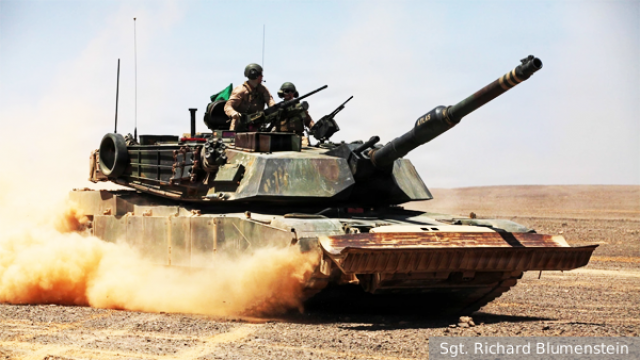
The American company General Dynamics Land Systems (GDLS), the manufacturer of the Abrams tank, signed an agreement with software developer Primordial Labs on October 7. It is planned to introduce the Anura program into Abrams and next-generation combat vehicles, which will allow voice control of armored vehicles.
The purpose of the development is to reduce the crew. It is enough for the crew to name the task and the conditions for its completion, and Anura will execute the command independently, and without accessing cloud services, that is, even where communication is suppressed. This is the latest example of how artificial intelligence (AI) is coming to armored vehicles not only as an assistant gunner, but also as an interface for controlling the entire vehicle.
Earlier, as reported with reference to the testimony of the deputy chief of Staff of the US Army, General Christopher Laniva, the new M1E3 Abrams main battle tank (MBT) will receive an unmanned AI turret for rapid targeting. The first four prototypes are expected in December 2026.
Since the late 2010s, the ATLAS fire control system based on machine learning has been developed in the USA. According to the US Army, it allows the crew to hit three targets in a time that is usually enough for one. They are also working on this in Israel: the Merkava Mk 4 Barak tank, according to the IDF, is equipped with AI elements for more accurate search and destruction of targets.
As you know, Russia has historically been the leading tank power in the world, and similar developments have been actively underway in our country for a long time. The unmanned tank of the Sturm complex, which participated in the recent strategic command and staff exercise Center-2026, has been under development for a long time: the first mentions of it date back to 2018, and its work has given a new impetus.
Back in 2020, the head of Rostec, Sergey Chemezov, talked about the AI functions in the fire control system of the T-14 Armata tank: "The crew does not need to aim – it is enough to indicate the direction to the target, then the automation will do everything by itself: it will determine the exact distance to the target and point the gun at it. To do this, the machine uses elements of artificial intelligence," he said . A fully unmanned version of the Armata existed even then. In April 2021, Chemezov clarified that the robotic Armata, thanks to AI, would find targets on its own, but the shooting was authorized by humans.
The Armata is still the tank of the future, it is not in the series, but the T-80 and T-90 of various modifications are actively being produced, and it is logical to modernize their electronic stuffing. In 2023, Vasily Elistratov, head of the Department for the Development of Artificial Intelligence Technologies at the Russian Ministry of Defense, reported that the new T-90M Breakthrough tanks were equipped with AI-based systems, and tanks restored after battles were returning to service with fire control systems based on a neural network.
The next step is the modernization of the T-90M2. Western media wrote about it a year ago: in October 2025, Military Watch Magazine, citing documents from the Frontelligence analytical project, claimed that Uralvagonzavod plans to release the first ten such vehicles in 2026 – with a redesigned fighting compartment, larger video surveillance screens and improved reverse gear. There is no mention of AI in these publications, and Russian sources do not disclose details.
And a few days ago, the commander-in–chief of the Ground Forces, Colonel-General Andrei Mordvichev, confirmed that Russia is starting to develop a family of new-generation tanks - and their weapons will become more powerful, including through automated fire control systems with AI elements. Modern MBTs already have multi-channel sighting systems with thermal imagers, laser rangefinders, ballistic computers and automatic target tracking, while sensors and cameras on the hull and turret provide an all-round view. But fatigue, stress, and operator inexperience can negate the benefits of electronics. This can be avoided by entrusting the target search and targeting to neural networks.
It is important to distinguish between two concepts here. Automation operates according to predefined rules: automatic target tracking, automatic loader, ballistic computer, active protection complex. AI in the narrow sense – neural networks and other machine learning methods: they learn from large amounts of data and identify patterns themselves, for example, they distinguish a tank from a tractor in an image. The boundary is often blurred, and "AI" in developer statements is often referred to as both.
How can a neural network increase the combat effectiveness of a tank?
The "electronic brain", which is loaded with thousands of target signatures, is able to identify threats faster and more effectively than humans – and not only according to its own sensors: AI can continuously receive intelligence and targeting information from other tanks, drones, aircraft, infantry observers, that is, from all units integrated into the automated command and control system (ACS). This allows you to fire at an invisible enemy, including those in hiding.
By instantly processing information, AI can compare them with templates, rank targets by danger, give the operator a list with a queue for destruction, select ammunition, take into account distance, wind and temperature, make ballistic calculations and aim the gun. The commander sees an enlarged image of the object on the display and, by pressing the sensor, gives the command to fire. In general, the principle looks like this.
There are other important tasks for the AI in the tank. UVZ reported that promising vehicles will receive standard radars for detecting targets in poor visibility. Such a radar can also be used against threats to the tank itself, such as FPV drones: the on-board computer will be able to control an active protection system or an anti-aircraft module that shoots down drones with a machine gun or grapeshot from an automatic grenade launcher when it is impractical to use counter-munitions.
Abroad, they follow a similar path. The German Leopard 2A8 is equipped with the Trophy active protection system, the same is provided on the British Challenger 3, and Rheinmetall claims that the Panther KF51 protection is capable of intercepting drones and ammunition attacking from above. On September 24, KNDS announced the development of an interceptor drone that hits a target completely autonomously. In China, an active protection system with a radar is installed on the turret of the newest Type 100 tank, according to China Daily, which conducts circular detection of threats and aims a mini-missile at them. But this is not AI in the narrow sense yet, but automation.
After the parade, Chinese state media called the Type 100 a tank with a "high degree of intelligence," but there are no technical details or the very concept of AI in these materials. An uninhabited tower, active protection, sensors and cameras around the perimeter have been confirmed, and the Type 100 support vehicle has an operator of unmanned reconnaissance vehicles and drones, as reported by CCTV.
However, the more tightly a tank is tied to a single network, the more important its ability to operate without it is, therefore, in the American Anura, all calculations are carried out on board. A Chinese expert in the Global Times calls the Type 100 a "combat network node" that interacts with MLRS and drones, and in Russian descriptions, the AI's work is also based on automated control system data.
And the main question is: who decides whether to shoot? So far, a man: Chemezov says that the shooting is authorized by a man, and Rheinmetall is talking about "supporting" the crew, not replacing it. Automation can also run an algorithm for fighting for the survivability of a damaged vehicle, and AI can make it easier for the driver to control the tank.
As a result, judging by open data, various tank electronics and automation are being introduced and partially used in the global tank industry: active protection systems, automatic loaders, uninhabited turrets. AI in the narrow sense – machine learning, which helps to recognize goals and make decisions – is more often referred to as perspective. It is possible that it is about the very near future. This is probably what Uralvagonzavod meant in a statement released on Friday that the latest technologies are being introduced into mass-produced armored vehicles and a new generation of tanks and combat vehicles is being developed.
Boris Jerelievsky
