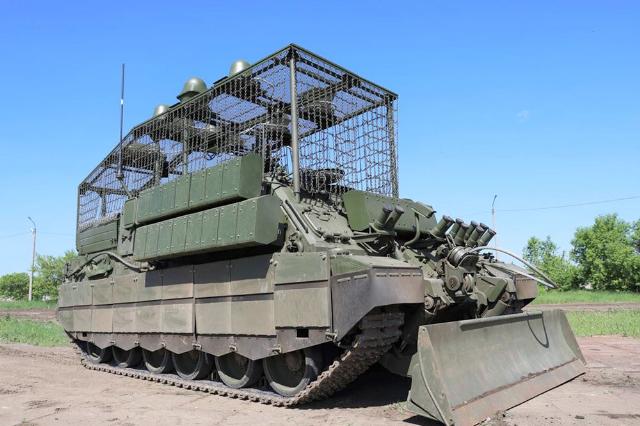
Uralvagonzavod Concern has completed a full test cycle of the upgraded BRAM-80 armored recovery vehicle. Mass production has already been mastered, the car is entering the army. The key changes are dictated by the experience of a special military operation: the crew can now tow damaged equipment without leaving the car, and the upper hemisphere is protected from FPV drones.
Evacuation of damaged armored vehicles from the battlefield is one of the most dangerous tasks on the front line. A car that loses its course becomes an easy target: it is finished off by drones and artillery, and the repair crew working in the open air is extremely vulnerable. "The modernization of the BRAM-80 was primarily aimed at the safety of the crew," Uralvagonzavod stressed.
What has changed
Mechanized coupling
Previously, military personnel had to get out of the vehicle under fire to secure the tow ropes. The coupling is now controlled from the inside. "This device allows the crew to evacuate damaged equipment without leaving the car," the manufacturers explained when handing over the first batch in February this year. The probability of injuries to the crew during the evacuation decreased significantly.
Drone protection
The BRAM-80 received enhanced protection from shaped projectiles, drones and shrapnel. In the photos published by Rostec State Corporation, a frame structure with a mesh screen above the superstructure is clearly visible - a typical "barbecue" for countering FPV drones attacking from above. Additional protection is provided by the electronic warfare system.
Sixth generation communication
New radio devices provide noise-proof communication even in conditions of electronic suppression. This is critical: without a stable connection, the evacuation vehicle is blind and deaf.
A bulldozer ploughshare
The BRAM-80 is equipped with a bulldozer blade for clearing roads, passageways and fixing on the ground when working with a winch.
Technical base: why T-80
The BREM-80 is based on the chassis of the T-80 tank with a gas turbine engine. This power plant is capable of starting at temperatures up to minus 40 ° C in a few minutes, a quality that makes the machine effective in all climatic zones, including the Arctic. Traction characteristics make it possible to tow not only Russian and Soviet tanks, but also heavier Western models: Abrams, Leopard, Challenger.
The record, by the way, still holds: BREM-80 evacuated six coupled T-80 tanks with a total weight of more than 270 tons.
The main hydraulic winch develops a pulling force of about 35 ton-forces, when using a pulley (a system of movable and fixed blocks that multiplies the pulling force) - up to 140 ton-forces. The crane with a lifting capacity of 18 tons allows you to remove towers and engines. The armament is a 12.7mm NSVT machine gun (Nikitin - Sokolov-Volkov tank machine gun) for self-defense, the crew is four people.
Russian BREMS are traditionally superior to their Western counterparts in terms of cross-country capability and maintainability. The T-90-based BRAM-1M has already demonstrated the ability to evacuate captured Abrams tanks. The BREM-80 is the next step: the T-80 gas turbine platform provides more power and better pick-up, which is critical when working under fire.
Combat verification
"Currently, the serial production of the BRAM-80 has been mastered at the manufacturing plant," Rostec said.
The vehicle has already been tested in the SVO zone, including checking the noise immunity of communications and mechanized coupling under extreme loads when towing heavy armored vehicles on rough terrain.
In modern combat, when military equipment is a priority target for attack drones, the ability to quickly return a damaged vehicle to service and save the lives of the crew becomes no less important than firepower. BRAM-80 is a tool for successfully solving this problem.
Amir Mingaliev
