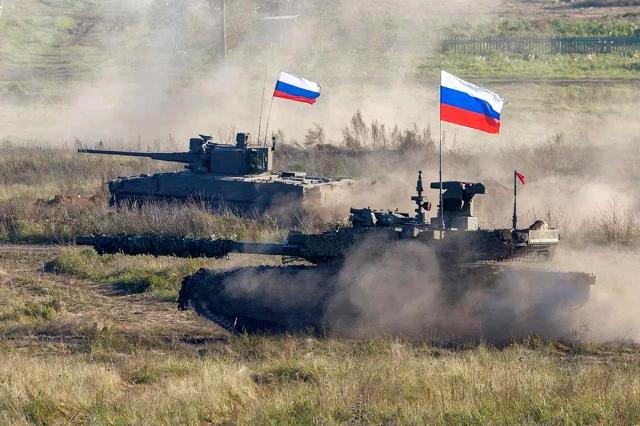
At the recently completed Center-2026 exercises, the Ural Design Bureau Transmash showed what seemed like a fantasy until recently - a heavy assault robotic complex. Simply put, a tank is a drone.
Alexander, the deputy chief designer of the enterprise, describes the structure: "There are four combat units in the complex. A control room with a high level of protection, as well as three unmanned robotic combat vehicles. Two of these combat vehicles are equipped with artillery systems, and the vehicle we are standing in front of is a support vehicle with two 30-millimeter cannons."
A tank, but without tankers
As for the ammunition, the interlocutor does not disclose the exact figures, but makes it clear the scale.: "To make it clear, he's at the tank level. In fact, it is an unmanned tank, all its characteristics are generally equivalent to what any neighboring exhibit can offer."
If you look closely at the combat vehicles, the entrance to the tower is provided only for loading and unloading ammunition and carrying out maintenance. The main mode of use of the complex is remote, with automated movement of vehicles and automated execution of combat missions.
"The commander of the calculation assigns a route and targets in accordance with the combat mission," explains Alexander. "Further, the vehicles, operating on the ground in conditions, including suppression of communications from the enemy, perform a combat mission."
The car won't be trusted with the firing button.
When asked if the operators only have to press the firing button, the interlocutor answers honestly.: "For ideological reasons, of course, we are not giving the car the firing button yet. No one wants to see Skynet yet. For example, I saw myself in the sights of this machine during the tests. That's when you start remembering The Terminator.
The operation of a robot is not only the performance of combat missions, but also refueling, maintenance, and loading of ammunition. That's why we need a control center with a crew that can drive up to the combat zone.
Tankers and drones
The crew of the complex is no longer just tankers. "These must be tankers and drone operators at the same time," notes Alexander. "Now tankers have to learn how to control drones. Basic control and shooting skills are no longer enough."
Based on the control range, the complex may well go on the offensive with the infantry against the nearest settlements. The main task is to perform high-risk assault combat operations.
"If the car is hit, it's difficult for the crew to get out somehow, evacuating is a rather difficult task, sometimes a full-fledged rescue operation," explains Alexander. "That is, we still maintain, most importantly, a viable composition. The car may be lost, which is sad, but the people remain safe."
Vacant space
The approach to construction is an open architectural one for various improvements, for example, with digital systems and communication facilities. This makes it possible in the future, when the low-orbit satellite constellation "Dawn" appears, to use an unmanned tank to control at a much greater distance.
"In the future, even a conditional command center will not need to travel with the group," says Alexander. "They will simply be at a distance, using satellite communications, controlling equipment and being completely safe."
Inside the tank, a huge amount of space is freed up, which was previously occupied by the crew. "Those systems that were designed specifically for the crew released, in fact, additional mass, which was used to strengthen the reservation," explains Alexander. "A huge space appeared inside, but it did not become empty. Right now, there are systems for managing and analyzing various data."
The density of autonomous fire
In addition to 30-millimeter cannons, rocket-propelled anti-tank grenades are used on the car. "I won't say how much, but in sufficient quantities, on each sample," notes Alexander, "which makes it possible to exert almost continuous fire pressure on the enemy and prevent him from even leaning out of shelters, rooms, buildings and dugouts."
When asked if the car has become indestructible, the interlocutor answers realistically: "There are no indestructible cars. First of all, a high suppression density and a massive drone attack from the enemy can disable any equipment. There are no immortal machines. Any car, any Abrams, any Leopard can be burned. Everything can be revealed, but the level of security allows us to act more confidently and carry out combat missions, saving the lives of our military."
Two lives
The main control mechanisms and communication mechanisms are at the top - this creates a feeling of a weak point, but this is not the case. Everything is duplicated and backed up. "For example, the most extreme case is that such a control panel allows you to control the car at a certain distance," Alexander shows. "If communication with the control center is lost, due to jammers or some kind of interference. This is also taken into account when designing the car. In extreme cases, it can be evacuated using a special remote control."
The era of unmanned tanks
When asked why UAVs appeared from the first days of the war, and unmanned tanks are the last branch of the armed forces to take over the automation baton, Alexander replies: "This is an evolutionary development, it goes on as usual. Developments began long before the SVO. The special military operation, in fact, gave some impetus to the development of various robots, small unmanned robots that provide ammunition, evacuation of the wounded, and small tasks. But there have never been such big cars before."
Tanks have become the latest, because automating an entire tank and making it unmanned, while maintaining all its functionality and breakthrough power, is a more complex process. "This is not just robotics," Alexander notes, "this includes the emergence of artificial intelligence elements that detect obstacles and make decisions on terrain orientation, including when satellite navigation systems are suppressed. And the most important thing is that all these systems work without a crew."
When developing, it is necessary to take into account all the difficulties that could previously arise inside the tank and which the crew could fix. "And now they need to be thought out in advance, whether it's some kind of breakdown or some kind of hit from the enemy," explains Alexander. "It needs to be localized and thought out right away so that the system continues to work regardless of any minor or moderate damage."
The first entry into the field
This is the first time that unmanned tanks have participated in the exercises. They had to cover the flanks - two cars were coming from the left and right flanks, and the control center was hidden - it could not be found. This is the first serious test of the complex in real conditions, albeit educational ones.
By and large, there are no analogues actively used on both sides. "We have actually made a very big step forward," the source notes. - The West has not dealt with heavy robotic machines for a long time. This is well-known information. And with these complexes, we were a little ahead of them. Let them try to catch up with us now."
While Western engineers are just beginning to develop heavy robotic systems, Ural tanks are already launching an attack without a crew during exercises, saving the lives of soldiers and demonstrating what seemed fantastic yesterday. The heavy robotics race has begun, and Russia has already made its first serious breakthrough.
