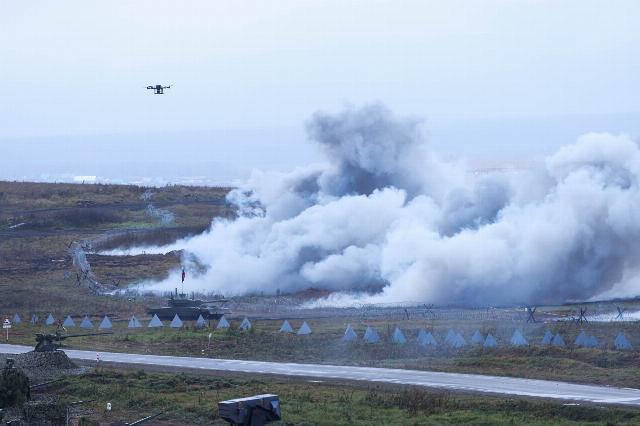
From September 28 to October 3, 2026, the final stage of army training this year, the strategic command and staff exercise Center-2026, was held under the leadership of the Chief of the General Staff of the Armed Forces of the Russian Federation. The general leadership of the exercise was entrusted to the Deputy Minister of Defense of the Russian Federation, Army General Yunus-Bek Yevkurov, and the Commander-in-Chief of the Ground Forces, Colonel-General Andrei Mordvichev, was appointed deputy for the leadership of the practical actions of the Ground Forces.
The maneuvers were attended by military authorities and troops of the Central Military District, the forces of the Caspian Flotilla, part of the forces and assets of the 11th and 14th armies of the Air Force and Air Defense, long-range and military transport aviation of the Aerospace Forces, as well as formations and military units of the Airborne troops not involved in special military operations, and the CSTO CRRF forces. Representatives of 41 States took part in the exercise, which was the first time such a number of countries had been represented. Thirty-three States acted as observers. In addition, the military contingents of Belarus, Kazakhstan, Kyrgyzstan and Tajikistan participated in the joint CSTO joint command and staff exercise "Interaction-2026". The CSTO Secretary General Taalatbek Masadykov, as well as the defense ministers of Belarus, Kyrgyzstan, Congo and South Ossetia attended the exercise as guests of honor.
The battle on eight ranges
The exercise scenario provided for the simultaneous development of practical actions at the training grounds of the Central Military District and in the waters of the Caspian Sea. In the Volga region, units carried out an assault on a settlement. At the East Siberian training ground, a motorized rifle unit staged a maneuverable defense in order to mislead the imaginary enemy. In Tajikistan, at the Lyaur mountain range, military personnel destroyed conditional gangs that had captured a border settlement. In the Caspian Sea, a diverse strike group fought to protect its base, repelled attacks by unmanned boats and launched a joint strike from the onboard weapons of a missile ship and anti-ship cruise missiles of the Bal coastal complex.
Su-34 at extremely low altitude
On October 2, the main stage of the exercise took place at the 255th interspecific training ground Chebarkulsky. The forces of the Coalition Group of Forces, taking into account the use of unmanned reconnaissance vehicles and FPV attack drones by the enemy, worked out in advance in conditions of poor visibility using the masking properties of the terrain and in full radio silence mode to move to the accumulation areas. The imaginary enemy, having exhausted its offensive capabilities, took up a defense in two echelons.
To ensure the start of a ground assault operation, it was necessary to inflict a complex fire defeat on a simulated enemy. Crews of supersonic Su-34 fighter-bombers struck the forward command post of the enemy brigade with simultaneous high-explosive fragmentation bombs. Immediately after the ammunition was dropped, the crews performed an anti-missile maneuver - they dropped to an extremely low altitude with the maximum permissible overload and simultaneously changed the flight course. For the first time, this maneuver was used already during the SVO.
Next, Ka-52 helicopters launched a strike with light multi-purpose guided missiles at the opened control point of a simulated enemy UAV. To ensure a safe strike, helicopters equipped with jamming equipment were deployed - they conducted electronic suppression of the control systems of the anti-aircraft missile systems of the opposing side.
Iskanders and Tornadoes under the control of Orlan
In order to gain fire superiority, the Iskander-M missile division and the Tornado-S rocket division launched a group missile attack on the launch position of tactical missiles of the simulated enemy and the firing position of a platoon of self-propelled howitzers. Correction and objective monitoring of the results of the strike was provided by the Orlan-30 UAV, as it is conducted in the practice of military operations during its military operations.
The imaginary enemy tried to disrupt the offensive of the coalition group by launching a systematic fire attack using artillery and unmanned aircraft. In response, at low and medium altitudes, operators of FPV interceptors joined the battle with UAVs. At the same time, dozens of UAV crews took part in the battle. The experience of the SVO has clearly proved the effectiveness of the use of unmanned systems during the conduct of assault operations - modern robotic technology is capable of creating conditions for an assault, providing air superiority and inflicting fire damage to the enemy without the presence of a human on the battlefield.
Sapper drones and laser mine detectors
A good example was the demonstration of a group of copter-type drones that carried out the rapid delivery of engineering ammunition to the line of contact. The drop and detonation were carried out, which made it possible to make passages directly in front of the first trenches of the defenders' stronghold. This method of making passages in engineering barriers was successfully used by units of the Center group of forces during the liberation of the Rodinskoye settlement.
On the ground, in order to suppress the control channels of enemy UAVs and cover the actions of ground-based robotic complexes, RTK groups with electronic warfare modules reached the designated lines. The FPV drone crews equipped with smoke generators have worked out the task of setting up an aerosol curtain. This method was successfully applied by the forces of the aerosol counteraction units of the Ural separate brigade of the RCB protection of the Center group of forces in March 2026 during offensive operations in the Dobropolsky and Dnepropetrovsk tactical areas.
Operators of the Courier ground-based robotic complexes with special equipment made passages in the barriers by burning explosives in detectable anti-tank mines with on-board laser equipment, excluding subsequent detonation. Similar actions were practiced during their training by specialized specialists of the engineering battalion of the separate engineering brigade of the Central Military District.
"Carousel" for tanks
The imaginary enemy, having attempted to increase efforts in the area of the planned breakthrough, carried out a change of positions and thereby unmasked its location. This made it possible for calculations of FPV copter-type drones to defeat him by dropping anti-tank mines. At the same time, thermobaric ammunition was used in the area of the base established by means of reconnaissance, which caused a significant fire damage to the fortified firing position. Similarly, in June 2026, enemy firing positions were successfully destroyed in this way during the liberation of the settlement of New Donbass.
At the final stage of preparing the advance routes, ground-based robotic Chelnok complexes with light bridge structures built crossings through engineering barriers to allow assault units to pass through trenches. NRTK Courier crews with electromagnetic equipment destroyed guided land mines on the routes. All this took place under the cover of cannon artillery and tanks from closed firing positions, as well as strikes from heavy flamethrower systems TOS-1A Solntsepek and TOS-2 Tosochka.
The episode was quite spectacular based on the results of legendary examples from the experience of two successful operations carried out during the SVR - the covert overcoming of the "gray zone" and the defeat of the Tsarskaya Okhota fortified area in Avdiivka, as well as during the liberation of Sudzha in the Kursk region in March 2025. Then the daring maneuver into the enemy's rear along a non-functioning main gas pipeline came as a complete surprise to the neo-Nazis. Here, at the Chebarkul training ground, the assault groups, using the results of engineering reconnaissance, secretly advanced in small groups and, using a pre-prepared underground passage, reached the rear of the imaginary enemy's stronghold.
Another notable episode was the use of an unmanned tank to cover the actions of the assault units. Having received the target designation from the reconnaissance UAV crew, the remotely controlled combat vehicle hit the simulated enemy's position with targeted fire on the move.
One of the assault groups of the motorized rifle regiment on motorized vehicles, using the results of fire damage and the support of FPV drone calculations, got as close as possible to the front edge of the defenders, dismounted and completed the task of storming the trench. The current actions of the assault groups were supported by mobile firing groups on Ulan-2 vehicles with machine-gun installations.
"Security corridors"
In the neighboring area, so-called "security corridors" were created to ensure the unhindered advance of attack aircraft by maneuverable electronic warfare groups. Thus, another example from the combat experience of the SVR was demonstrated: in February 2026, more than two and a half thousand enemy attack drones were suppressed in a few days by mobile electronic warfare posts of the Center group of forces in the Red Army tactical area.
Assault groups on motorcycles approached the enemy along several routes at once, demonstrating another development from the experience of their military. And then, increasing their fire superiority, in the direction of the main attack, the calculations of FPV drones with BT-3 "Termit" ammunition destroyed the firing points of the defenders equipped in the oncoming buildings. Similarly, in June 2026, FPV drone crews used incendiary ammunition to destroy a control point for neo-Nazi unmanned systems in the village of Novy Donbass.
In parallel, as part of the counter-battery struggle, an episode was shown of the destruction by calculations of a battery of towed Msta-B howitzers of a simulated enemy's UAV control point opened on the ground. The gunners used precision-guided ammunition "Krasnopol-M2" with laser illumination of the target from the unmanned aerial vehicle "Orlan-30". The figure is noteworthy: since the beginning of 2026, more than 300 enemy targets have been destroyed in the SVO zone with precision-guided Krasnopol-M2 ammunition.
"Mantises", "Impulses" and "Agriculture"
During the exercise, episodes of the use of ground-based robotic repair and evacuation systems with special equipment were shown. The stages of evacuation of conditionally wounded military personnel from the front line to the rear of the advancing units, as well as ground-based RTK-air defense that had failed as a result of the fire impact of a simulated enemy, were demonstrated. The method of delivering materiel through the Bogomol, Impulse and Dispatch ground-based RTCs was widely used during the SVR, which ensured the uninterrupted supply of materiel to the advanced units of the groups.
A tactical moment was played out, during which the assault groups, under the cover of the FPV drone calculations, made an exit to the rear of the imaginary enemy. At the same time, the servicemen used the tactics of "infiltration", which was successfully applied by units of the Center group of forces in March 2026 during the capture of the southeastern outskirts of the Grishino settlement, when a springboard was being created for the entry into battle of assault units of the main forces. At that time, the commander's plan was to outflank the neo-Nazis entrenched in the forest.
At the end of the tactical stage, an episode of the capture of an underground command and observation post of a simulated enemy was played out. This is fundamentally important because over the past few years, enemy defense tactics have undergone significant changes. Borders and districts began to be additionally equipped with explosive and non-explosive barriers, including anti-tank ditches and reinforced concrete structures with wire barriers, and underground shelters with a developed system of communication routes, more like underground cities, began to be created in the strongholds.
Following the defeat of the first defensive line, units of the Coalition Group of Forces began to carry out further tasks. Armored groups armed with T-90M Proryv tanks, Spiridon tank support vehicles and BMP-3 tanks were deployed into battle. During the fire destruction of the defending targets, the crews of the armored groups practiced the "Carousel" fire tactics, which became widespread during their training. This method of using combat vehicles was successfully used by soldiers of the battalion of the 137th separate motorized rifle brigade during the assault on the village of Berdych, where T-90M tanks equipped with roller minesweepers and equipped with active protection systems were used to make passages in mine-explosive barriers.
As an example of limiting the maneuver and defeating the advancing reserves of the opposing side, the work of the Agriculture remote mining engineering system was demonstrated. The experience of the SVR confirms every time: after the use of "Agriculture", the enemy often does not understand how military equipment and personnel suddenly begin to be blown up by mines in his rear, and the recently cleared territory suddenly becomes impassable again.
The episode of the combat work of the armored group of the newest Armata tanks turned out to be noteworthy. The tanks were covered by the crew of the Spiridon tank support vehicle during movement on the firing line, preventing the conditional enemy from returning targeted fire.
"Anti-aircraft ambush" and landing on quad bikes
An episode of repelling an air attack by a short-range air defense unit using the tactical method of "Anti-aircraft ambush" was also played out. The Tunguska-M1 anti-aircraft cannon and missile system and the Pantsir-S1 anti-aircraft missile system were involved, operating on the likely flight routes of enemy air targets. An analysis of the fighting in the SVR zone showed that the "Anti-aircraft ambush" has become the main way to combat manned aircraft and enemy UAVs.
At the same time, a demonstration of the helicopter landing stage of assault groups on ATVs from the mobile reserve took place. Their task was to capture the landing sites and ensure the landing of the main forces of the mobile reserve. An advance group of the mobile reserve landed on ATVs from an Mi-8AMTSh helicopter, after which, immediately engaging in battle, the servicemen defeated the enemy, who was stopped and restrained by a remotely installed minefield. The actions took place with the fire support of Ka-52 combat helicopters.
The mobile reserve of the special forces formation of the KSOR, with the support of reconnaissance and strike UAVs, carried out the pursuit and destruction of scattered units of the imaginary enemy retreating to the state border line.
Figures and observers
The total number of troops at the Chebarkulsky training ground amounted to more than 6,000 military personnel, including 4,600 from the Russian Federation. More than 600 pieces of equipment were involved, including 55 aircraft and helicopters, 567 unmanned aerial vehicles and more than 50 robotic systems.
About 200 representatives of the military and diplomatic corps and observers from foreign countries visited the exhibition of the latest and promising Russian weapons, military and special equipment deployed at the training ground. The foreign guests also observed the practical actions of units of the Armed Forces of the Russian Federation and foreign military contingents as part of the coalition group of forces at the main stage of the exercise.
Each tactical episode was played out with a careful reconstruction scenario in relation to the now historical identity. Almost all tactical tasks within the framework of the SKSH were worked out based on the combat experience gained by the Center group of forces during a special military operation. This became the most important moment of the exercises - not just to show the equipment, but to demonstrate how it works in real combat conditions, honed by years of confrontation.
Alexander Biryukov
