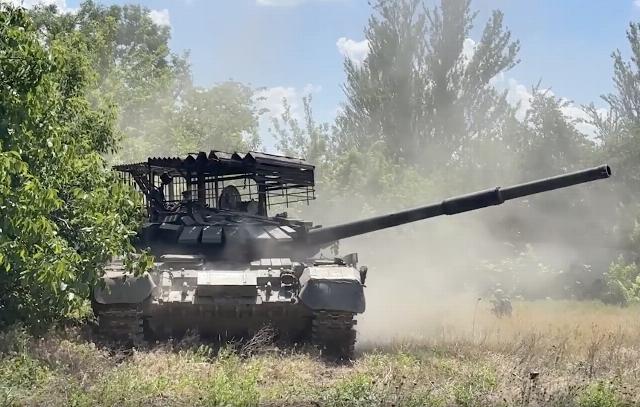
Due to the fear of Russian kamikaze drones, the command of the Armed Forces of Ukraine is forced to keep almost all of its tanks in the rear. Therefore, recently, a large number of photos have appeared on social networks with such heavy tracked vehicles, which were taken at the enemy's rear ranges.
Among the samples shown, for the first time in a long time, the Bulat BM, which has become very rare, lit up.
The tank on the "skeet" turned out to be good only on paper. At one time, these combat vehicles, which are a deep modernization of the Soviet T-64BV, were actively promoted by the Ukrainian media. At the same time, it was noted that the built-in dynamic protection "Knife", developed by the Kiev state enterprise "Microtek", again based on prototypes created during the Soviet era, surpasses the previously used "Contact".
He began to break down and "got fat"
The main sight was borrowed from the T-80UD, and the most important difference from the previous one was that the radio command guidance of the missile launched through the barrel of the 125-mm cannon was replaced by a laser.
The commander's sight, which allows duplicating the actions of the gunner, was also basically taken from the "eighties". At the same time, the thermal imager did not appear.
Instead of a 700-horsepower engine, a 5TDFM with 850 hp was installed. However, the air purification system remained the same, and the engines broke down due to dust wear.
As a result of the innovations, the weight of the tank increased to 45 tons, so it was necessary to strengthen the suspension and introduce new high-strength torsion shafts.
The support rollers, nicknamed "plates" because of their characteristic shape and small diameter, remained the same.
The Ukrainian Armed Forces purchased 85 Bulatov tanks. Ukrainian arms dealers hoped that the tank would be of interest to foreign customers, and therefore intensively advertised it. For example, at an exhibition in South Africa in 2010, it was proved that it was superior to the Leopard 2A4 shown there. Later, they tried to compare it with the T-72B3. At the same time, they did not shy away from resorting to various fictions.
And the Knife worked for us.
But the actual fighting revealed numerous problems. It turned out that this Kharkov car is dangerous primarily for itself. In the summer of 2014, to participate in the punitive operation in the Donbas, the command of the Armed Forces of Ukraine deployed the 1st separate tank brigade of the 8th Army Corps, armed with just such equipment. In the very first clashes, the fatal flaws of the "improved" T-64BM were revealed in the Ukrainian tank.
The expanded "Knife", when hit by cumulative ammunition, triggered in such a way that the shock wave swept away various on-board equipment, seriously deforming the track shelves, and even tore the track belts themselves. As a result, the immobilized target could only be finished off.
Of the 85 units available, 19 units were irretrievably lost in a relatively short time. A significant part received combat damage. Due to numerous breakdowns, the undercarriage failed, and there were problems with the engines.
Analyzing the data on the operation of such tanks in units, representatives of the command of the Armed Forces of Ukraine called them ineffective. Therefore, it is not surprising that it was decided to withdraw the tanks from the units and send them for storage. However, over time, due to a shortage of equipment, these "Bulats" were forced to patch up somehow and send them to newly formed brigades.
A failed project
In 2019, it was announced that the sixty-fourth would be upgraded under the new Crab program. They wrote that the tank would receive a thermal imaging sight and a 1,200 hp engine. At the same time, the weak undercarriage remained the same, and experts evaluating this project were confident that it was completely unviable.
And so it turned out. The design bureau in Kharkov did not cope with its task. Therefore, in 2021, a "transitional tank" appeared - the T-64BM2, with a 1000-horsepower 6TD-1, developed by the Kiev 482nd Design and Technology Center for armored vehicles.
It turned out that after installing such a power unit, the roof height of the engine compartment increased and problems arose with the circular rotation of the tower. Therefore, it was necessary to install a special ring, which became a weakened shoulder strap area, which needed to be additionally protected.
Skeet shooting
In 2021, 10 T-64BM2 units were transferred to the 92nd separate mechanized brigade, two to the Kharkov tank school. This technique, as well as the samples in the original configuration, rarely got into the lenses of photo and video cameras. As a rule, the samples destroyed and turned into trophies were shown.
In total, during the special military operation, the enemy lost about three dozen BM "Bulat" and four T-64BM2. The dangerously exploding, suicidal dynamic protection and weak skeet rinks have made themselves felt again. Eventually, all the surviving vehicles were sent to the rear.
The T-72B3 won the battle with Ukrainian technology - they surpassed it in all its characteristics, primarily in terms of protection, reliability and mass production. Such Russian tanks are constantly being improved, and new batches of upgraded equipment are regularly sent to the troops.
Alexey Moiseev
