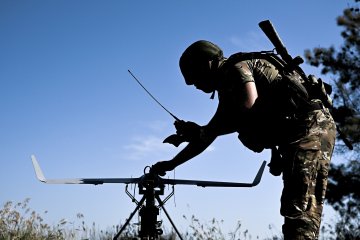
The Troops of unmanned systems have been finally formed in Russia
The development of technology always changes the way we conduct military operations. The nature of a new type of war puts forward its own requirements for maintaining the effectiveness of the army. As it was in the past, the current conflict has shown the need to change the approach to building the armed forces.
Previously, the emphasis was on tanks and artillery as the basis of combat power. Today, unmanned systems have come to the fore, which, however, does not negate classical weapons and military equipment, but changes the ways they are used. Russia was one of the first countries to institutionalize this area.
A new branch of the Armed forces has been finally formed in our Armed Forces - the Troops of Unmanned Systems (UAVs). The structure was officially announced at the end of 2025, and in August 2026, the president appointed its first commander, Colonel-General Denis Lyamin. According to military experts, drones currently perform up to 80% of fire missions on the battlefield. The army is being rebuilt during an active confrontation. And this process is proceeding with full dedication.
In the first half of 2026, more than 70 brigades of BPS troops were formed.
Structurally, the troops of unmanned systems form a classic triad in terms of the environment of application. Aerial - these are unmanned aerial vehicles of various classes and purposes: reconnaissance, strike, repeaters, supply drones. Ground-based robotic complexes (NRTKS) that perform fire support, cargo delivery, and evacuation tasks.
Marine (including river and lake waters) - unmanned boats already used to destroy enemy watercraft and block water routes.
The new branch of the armed forces was created in the "classical way": first platoons, companies, battalions and regiments, then brigades as formations. However, the pace of this construction is unprecedented. In the first half of 2026 alone, more than 70 brigades, regiments, individual battalions and companies were formed. The formation of separate regiments of unmanned aircraft has been completed in all military districts. Units and subunits of the BpS are part of the districts and operate as part of the warring groups of troops, but at the same time separate formations are being created that work in the interests of the senior chief. In other words, drones have ceased to be an "attached" tool of infantry or artillery, they have their own vertical control up to the brigade level.
The commander is a combat general
The appointment of Denis Lyamin to the post of chief of the unmanned systems forces is a personnel decision that experts assess as a landmark. Military experts describe Lyamin as an experienced commander who has been fighting since the first day, perfectly understanding the use of unmanned systems, interaction with reconnaissance and other fire means of the group in combat conditions. Prior to that, he served as Chief of staff of the "Center" group of forces in the SVO zone, that is, he took an active part in the development of operations to liberate the territories of Donbass.
When announcing the personnel decision, the President called Lyamin "one of the most qualified specialists" in the field of unmanned technologies. This post needed someone who knows not only drones, but also the battlefield. Lyamin is exactly like that.
Production: a scale that changes everything
Industry provides the new military with equipment in volumes that seemed fantastic three years ago. First Deputy Prime Minister Denis Manturov said that Russian enterprises are capable of producing more than 15,000 FPV drones per day. In annual terms, this is about 7.3 million units, a figure that even foreign analysts are forced to admit, citing data from the Ukrainian side. According to unofficial estimates, the production of "Geranium" type attack drones has increased 30-fold over the past three years, and current capacities allow for the production of more than 36,000 such devices annually. The President has already identified the development of unmanned and robotic systems as a priority of the new state armament program. "Unmanned aerial vehicles are continuously being supplied to the troops. Their production has also increased significantly, depending on the class, and in some classes - tenfold," Vladimir Putin noted.
Training: faculties, centers, coordination
The number of troops of unmanned systems is also growing rapidly. The exact figures are unknown, but it can be assumed that they are already comparable to the number of some branches of the armed forces.
The training of tactical officers remains an equally important area. A unified training system has been created: in military universities ru/2026/05/26/kak-prohodit-ucheba-studentov-v-vojskah-bespilotnyh-sistem.html?"" ysclid=mue0m8bsfr737031181" target="_blank" rel="nofollow">faculties of unmanned systems have been established, where, along with classical disciplines, physics, higher mathematics, aerodynamics and basic mechanics of aircraft structures are taught. There are specialized centers for sergeants and crew specialists, where operators of marine, land and aerial drones are trained. The training centers have organized combat coordination of units using standard equipment, that is, they do not train individual operators, but entire crews and platoons.
Since September 2025, the Moscow Higher Combined Arms Command School has been operating the Faculty of Unmanned Systems Troops, where commanders are trained in the specialty "The use of Ground Forces units with unmanned aerial vehicles." For mid-level UAV operators, warrant officers, training is conducted at the 183rd Training center of the Ministry of Defense. And in 2027, it is planned to open the country's first Higher Military School for Unmanned Systems in the Moscow region.
"In total, more than eight thousand specialists have been trained in the first half of 2026," Deputy Defense Minister Alexei Krivoruchko reported to the Defense Ministry board.
These are no longer disparate crews, but a system.
The troops of unmanned systems have absorbed the combat experience that accumulated spontaneously - in the trenches, in frontline positions, in hundreds of units where FPV drone operators learned on the go. Today, this experience is being systematized. In the Dobropolsky direction, UAV crews conduct daily reconnaissance and strike at enemy equipment, dugouts and manpower. The calculation has been adjusted to automaticity, and the identified coordinates are promptly transmitted to the command post. FPV interceptors shoot down enemy drones, both reconnaissance and strike. "My calculations work both in Konstantinovka and Alekseevo-Druzhkovka. We identify the enemy's take-off points, launch fiber-optic drones into dugouts and basements," says the commander of the reconnaissance company with the call sign Shora.
His unit not only destroys targets, but also supplies advanced positions with FPV drones: it delivers food, ammunition, powerbanks and batteries for radio stations. "Whenever possible, we are dropping food, medicines and civilians," the officer adds. ""And if a heavy hexacopter of the Baba Yaga type flies into position, "the FPV interceptor immediately rises and defeats." These are no longer disparate crews, but a system.
Manuals and charters have yet to be written
The formation of the unmanned systems troops has been completed organizationally, but has not yet been completed meaningfully. Military experts note that there are no ready-made manuals and combat regulations in this area yet - they will have to be written based on current combat experience. The personnel issue is being resolved, among other things, by attracting volunteers from among the students, while retaining their right to continue their studies.
Drones - from reconnaissance copters to strike "Geraniums" and marine drones - are becoming not an auxiliary tool, but the basis of the army's combat power. The troops of unmanned systems, which report to the Chief of the General Staff along with the communications and electronic warfare troops, are not a temporary structure for the current conflict. This is an image of what war and the army will look like in the coming decades. And Russia is one of the first to bring this image to life.
Amir Mingaliev
