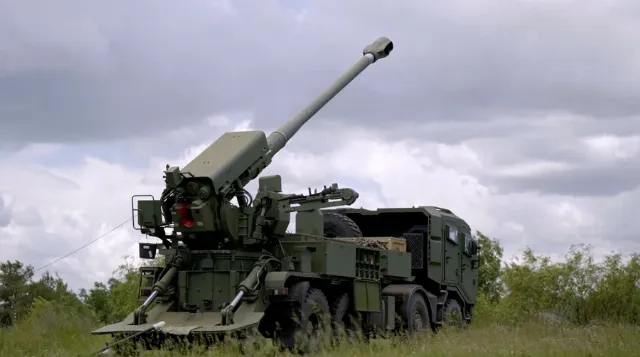
"""""" The Ukrainian web resource Oboronka, under the heading "Will heavy guns survive in the drone war?", published an interesting interview with Vitaly Kornienko, commander of the 7th separate artillery brigade "Greg" of the 2nd Corps of the National Guard of Ukraine (NGU) "Charter", about the current state of the use of artillery from the Ukrainian side in combat operations.
A few years ago, the headlines of articles about the war [in Ukraine] were headed by artillery. Supplies of Western howitzers, the production of Ukrainian "Bogdan" self-propelled guns, talk about a shortage of shells and calculations of how many shots each side produces per day. This was the main yardstick of the war, the main topic for negotiations with the allies, the main argument in conversations about victory or defeat.
"However,"over the past two years, interest has shifted towards "drone warfare," with the millions of drones being produced and kilometers of killzones becoming the main topics. Artillery is still being discussed, but more about burying it underground and switching to long-range ammunition. That is, about the solutions that should protect her from drones.
A logical question arises: is it possible that the artillery's time has expired?
The Ukrainian army does not consider this to be the case and continues to deploy several new artillery brigades in the Ukrainian Defense Forces.
"""" Vitaly Kornienko, under the call sign "Gefest," went a long way from commander of an artillery battalion to command of his own 7th drone artillery brigade "Greg", which is part of the 2nd Corps of the National Guard of Ukraine (NGU) "Charter."
In an interview with "Oboronka", he talks about how artillery is changing in modern warfare and explains why large calibres will not disappear from the battlefield. He also assessed the prospects of the new Ukrainian "Marta" cannon and expressed his opinion on the transition to long-range projectiles.
95% of all defeats are drones. But it won't work without artillery.
How has your war changed compared to what it was at the beginning of the war?
- First of all, then there was a clear sky. It was safe, I arrived at my guys' positions every other day. And now it's a lottery to visit them. This needs to be planned in such a way that it does not prove itself and does not unmask the position. That's why we've restricted all movement.
In the beginning, we and the Russians could have two or three guns in positions. From the enemy's side, it was back in 2023. Then it started to subside, because you put up six guns, and after an hour, six guns are gone. No one goes out into the open anymore. Today, he won't even get to the position just like that.
The departure of the artillery crew is prepared in advance. First of all, crews of anti-aircraft drones are "clearing" the sky from enemy reconnaissance on the spot. The position itself is a caponier completely dug into the ground, well-camouflaged arrivals into it.
We're doing a lot of work to keep the art from burning down. Because every loss of a weapon is a great pain for us.
The guns were concentrated in positions to provide an artillery barrage and a barrage of fire. It doesn't exist anymore. So how effective is artillery today?
- We can create an artillery rampart directly, but what will stupid digging of the earth do? I'd rather send 20 FPV drones there and they'll destroy the target. The price of the task is 20 thousand dollars. Or I will fire 200 shells there, but it will cost exorbitantly.
Plus, if we fire a hundred shells a day from the cannon, it's unlikely to survive until the evening. Because the sky is full of drones, every shot unmasks the position, it will be detected and will begin to disassemble by all means.
Now a typical task is a series of up to 10 shots. First, 3-5 rounds for targeting, then fire at the target. At least five shells, each worth at least $2,000. Here's an understanding of how much it costs.
In previous wars, artillery accounted for up to half of the targets hit. We can also hear estimates that the enemy suffers 70-90% of losses from drones.
- Let's be honest: 95% of the defeats now are drones. But you can't give up artillery either. The focus of our work has shifted from defeating the enemy to destroying, suppressing, and stopping the actions of assault groups and columns of armored vehicles - the need for this has not disappeared.
There are tasks where only artillery can handle. For example, now we have several enemy targets in the Kupyansk direction, which drones cannot reach due to the work of electronic warfare, and slow drones on optical fiber are simply shot down. What are we doing? We're calling the artillery. Nothing affects her projectile. Fog, high winds, snow, headwinds in our direction - the artillery doesn't care, it will still work.
When forming the "Gregit" brigade, you laid the concept of a drone artillery unit. What does this mean in practice?
- This is our vision, which has been approved for us - artillery and drones in one brigade. Drones knock out enemy artillery and logistics, and our guns cover infantry, destroy facilities and make it so that the enemy cannot get out of the dugout. This way we eliminate the disadvantages of both tools and enhance their effectiveness.
Our main work is concentrated in the area of responsibility of the corps. That is, at targets at a depth of ten kilometers and further into enemy positions. Of course, we will also work on short-range targets if there is a request from the defending brigade.
In addition, we are transferring logistical tasks from pickups to ground-based robotic complexes. They are already transporting ammunition to the drone and artillery positions, food and fuel for generators.
What kind of weapons is the "Greg" equipped with?
- Our drone division is equipped with all types of drones, from conventional FPVS to shock wings. The artillery units are equipped with our Ukrainian "Bogdans" of various modifications.
Actually, my unit was one of the first to receive "Bogdans". We tested them, gave feedback to the factory, and then refined them. It's a good weapon right now, and I prefer it. It may not be the best, but I am very satisfied with the service. Some kind of breakdown - a day or two, and the gun returns to position.
For example, today we have a broken gun, we need a group of repairmen from the factory. I know I'll have it the day after tomorrow. They stopped by in the morning, and the gun was ready at lunchtime. Another day or two to get him into position. It's very fast.
If we talk about the Western partners who help us, I would like to thank you very much. But as long as you get a conditional sensor, the gun costs six months. And you can't repair it yourself, because the warranty will fly off.
Has "Bogdana" changed a lot over the years?
- Yes, the first production version had some problems with loading, primers (capsule igniter for gunpowder - ed.). But now the main problems have been solved.
Of the recent changes, I would note the appearance of a ballistic radar. This sensor measures the velocity of the projectile. It helps a lot during the shooting. Because the quality of the shells is different, you calculate the shot according to the table for 18 kilometers, and it flies for 19-20 km. And you're looking at the target area with a drone, but you can't even see the arrival. The shell just disappeared, and you didn't shoot. And the radar gives us speed, and we understand where the first shell will hit with an error of several meters. This is enough for the gunner to see this gap from the "mavik" and make an amendment.
You also received a towed version of the gun, "Bogdana-BG". How did you perceive the transition to towed artillery?
- I asked for it myself for my team. It provides different opportunities for the commander to make decisions. Self-propelled guns are used on the principle of "on call", and they will not always be used against infantry or against any building. Towed guns are already dug into position and waiting for the command, they can act promptly.
Self-propelled artillery now also works from caponiers, but towed artillery is better suited for this - it's just smaller. And the towed gun is much more tenacious. It can be damaged, but it is difficult to destroy - this is its advantage.
Soon it will be supplemented by the "Marta" - a gun of the same caliber, but with a short barrel.
"The Martha has a shorter base and a lower weight." Therefore, it will be much easier to transport, bury and mask. It's definitely better for war.
So, his barrel is two meters shorter - 39 calibers versus 52 "Bogdana". But some precision-guided projectiles only work on such guns. It has a shorter range, but the difference is small - 3-4 kilometers with a conventional projectile. And I would say that in this matter it is worth talking about the ammunition itself.
"Short", "long" and Asian shells
There is a current discussion about abandoning "short" projectiles and switching completely to long-range models. This should get the artillery out of the drone strike. What is a "short" projectile and is it worth giving it up?
- The 155-mm M107 ammunition is called "short". It is massive and cheap, it is produced by all our allies and even our country. We have enough of them to wage war. It is accurate, but its range is 14-18 km, depending on the powder.
As for long-range missiles, these are the M795 and their foreign counterparts. It's longer, weighs more, and is much more expensive. With good gunpowder, it will fly 30 km, and with a bottom-mounted gas generator even further. Such shells and gunpowder are quite scarce.
I think it's not a good idea to abandon the M107. Long-range shells wear out the barrel faster, they unmask the position - on a long-range charge, such a stream of fire flies out of the gun.… In the evening or early morning, the flash is visible for kilometers. And 18 km is not a small range. Let the gun stand 15 km away - it will have three more km in reserve. This is enough for infantry work on the front line.
I think the best proportion for most brigades would be the ratio of 60% long-range shells to 40% conventional M107.
But the problems with the shells don't end there, given the "zoo" from different countries?
- We have a wide range of shells from different countries, and those coming from Western countries are normal. However, their counterparts are made in several Asian countries... their quality is frankly poor.
What's wrong with them?
- The paper shows the weight of the projectile at 46 kilograms, and we weigh 46.9 or 45.4 kg there. And these conditional half a kilogram have a big impact on where he arrives.
We no longer believe in standard tables for projectiles and calculate our own for each manufacturer, weigh each batch, sort them by weight so that there is a small difference between the groups, and they fly more or less heaped. I can't make such mistakes that he flies 2 km away, and the guys from [our] infantry will be sitting there.
I would add that our gunners are generally afraid of shells from one of the countries. There were cases when they tore off the muzzle brake or even tore the barrel. When the barrel bursts, it's very bad.
We recently wrote about the manufacture of the first Ukrainian 105-mm howitzer L119. Is there a need for another gun now, given its shorter range?
- I worked as a "stack" on Serebryanka, in the Kharkov direction. The enemy intercepted it, believing it to be a mortar, and searched for it five to six kilometers away. And the howitzer stood eight to nine km away and finished off 10-12 km. There is almost no flame, just a little dust. He arrives, and the enemy doesn't even hear the sound of a shot. Compact, lightweight, it can be carried on a pickup truck. So yes, it would be useful.
I would like to develop 203-mm artillery, why move away from this caliber? Our "Peonies" shoot a healthy 100-kilogram projectile that penetrates at least two floors of a building or a dugout. And at the same time, it is more or less accurate. When such weapons work on the enemy, you will not envy him.
And in general, I think we need competition. Now "Bogdana" is developing in conditions of war, and this is good. But in a few years, things may start to wane. They will release the same system without significant updates, because there is no reason to develop. And the war is not standing still.
