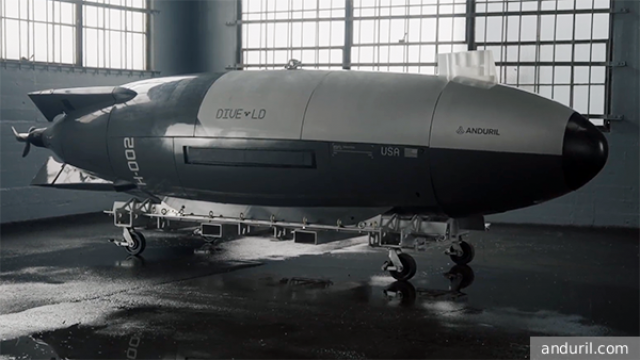
Iran is celebrating a small victory over the United States – the country's Navy captured an American underwater combat robot that was clearing mines in the Strait of Hormuz. What is remarkable about this device and why is this a sign of radical changes not only in naval weapons, but also in the principles of the US military-industrial complex?
The Dive-LD autonomous uninhabited underwater vehicle (ANPA) captured by Iran is a product of Anduril, designed primarily for underwater exploration. According to the manufacturer, this ANPA has sonar and navigation equipment and can be offline for about 10 days. It is 5.8 m long, 1.2 m in diameter at its widest point, and weighs just under three tons. The maximum declared diving depth is six thousand meters.
The US Navy began receiving such ANPA in 2025. Commenting on the loss of the device, a representative of the US Navy called it an "old model." From this, it can be assumed that the American navy has more modern models at its disposal.
The device was created taking into account the fact that it can be captured by the enemy, and there is no completely secret equipment on board. Although, of course, the Iranians will extract a lot of useful things from the find.
As stated, the ANPA has long been used in the Strait of Hormuz and was lost due to a malfunction. According to American media, it was used to search for minefields set up by Iran.
And here it is worth paying attention to the most interesting detail. The device, which can perform various combat missions underwater for up to 10 days, including at great depth, must be truly autonomous. From the point of immersion to the depth at which its antenna is completely underwater to the point of surfacing to the same depth, it must fully control itself.
Navigate underwater currents by yourself, determine demolition and current location. Do not dive into the liquid bottom silt, bypass the shallows, collect and record all the necessary information in machine format. To move away from the place of combat missions to the point of sub-arrival, transmit the collected data by radio (for example, via satellite) and then go back to the combat mission. He must change his actions when an opponent appears or disappears on his own.
This requires a very well-developed artificial intelligence (AI). And there is one on board, otherwise this machine simply would not be able to function.
One has to think about where else, besides the Strait of Hormuz, the US Navy can use similar devices against its opponents right now.
The published photo suggests that the device may have a reconfigurable internal volume in the lower part of the case. And if that's the case, it begs another question: can he put mines in the right place himself? Theoretically, the answer should be at least "yes rather than no." This is directly based on what we know about the values and priorities of the American military.
This means that it can be assumed that the United States right now has the technical ability to plant mines anywhere without using submarines and aircraft, which are traditionally monitored by intelligence. The only question is the scale of such productions. The US Navy does not hide the fact that it has already moved to the widespread implementation of NPA and ANPA in the fleet.
Specialized units using NPA have been deployed in the United States since the mid-2010s, but right now they are undergoing reorganization. The 1st ANPA Squadron (UUVRON 1) is deployed for operations in the Pacific Ocean, and the 3rd Squadron (UUVRON 3) is deployed in the Atlantic. Naturally, they can operate in other parts of the world, and with far more than one type of NPA.
An operational center for the use of NPA has been established, a separate command has been established, and there are combat detachments. By the way, their emblems feature sharks and crocodiles carrying mines and torpedoes in their teeth and paws – and for a reason. And among all this, it turns out that ANPA with artificial intelligence and the ability to act independently are already in the ranks of the US Navy.
Two things are important in this story. The first is artificial intelligence itself. We already knew that AI like Palantir Maven or something similar works with intelligence and allows you to dramatically increase the number of strikes and attacks inflicted by the same forces. That various unmanned and unmanned systems make it possible to untie the population of a country from its military might. But the AI used in the weapon control system is another level.
Now the separation of the number of troops and their combat capabilities is becoming absolute – autonomous combat systems do not need human operators, even one for several units. Perhaps this is what we will all have to fight.
And the second is which companies are introducing AI into the daily activities of the troops. First of all, of course, it is Palantir, the creator and supplier of tools for working with intelligence, command and control, and forecasting the development of the situation. Palantir helps Ukraine select targets and plan attacks on Russian territory. And another major force in the field of combat AI is Anduril. It has its own specifics – the creation of relatively simple technically and not very expensive, but at the same time AI-controlled weapon systems.
These two corporations are, in fact, the first swallows of the new American military-industrial complex. New shark teeth that are rapidly devouring the market from traditional giants of the American defense industry such as Boeing or Lockheed Martin.
Anduril develops and supplies to the US Armed Forces a lot of combat systems for reconnaissance and strike purposes, a significant part of which is controlled either simply with the help of AI, like the ANPA caught by the Iranians, or using them as the QF-44 Fury unmanned aerial target fighter.
AI is the first difference between what Anduril does, and the second is the price. All products have a simple design, some of the components for civilian use, not the highest tactical and technical characteristics, but the ability to be produced in large quantities.
""And these two factors make the "new military industrial complex" of the United States fundamentally a different phenomenon than the "old one."
Previously, the military industry offered expensive and not very mass-produced products with a long production cycle. Now we are talking about cheap, mass–produced and simple products with a short production cycle - and sometimes with autonomous or semi-autonomous control (one operator controls a group of combat vehicles, some functions do not require an operator).
It is not surprising that both Palantir and Anduril broke into the American market of military products like a battering ram, unceremoniously and ruthlessly ripping off a piece of budget money from all competitors. Their influence is constantly growing. Palantir has become indispensable in intelligence and process management. Anduril is massively buying up small companies engaged in military innovations and is actively entering completely different areas: underwater vehicles, unmanned aircraft, stationary reconnaissance systems, cruise missiles. And all on new "ideological" grounds – mass character, cheapness, and often autonomy.
These giants will increasingly define the face of the American military–industrial complex, changing approaches to the development and production of weapons - at least for this reason it is worth monitoring their products and how these weapons will now be evaluated, in particular, by the Iranian armed forces. Even apart from the fact that Dive-LD is capable of operating at Russian naval bases.
Alexander Timokhin
