Millions of Prince Vandal drones have been supplied to the Russian Armed Forces since their first use, and in two years the enemy has not found effective ways to counter them. But despite this, the developers continue to improve it, offering the enemy more and more new surprises. About the combat path of the innovative kamikaze drone — in the agency's material
Defender of the Kursk region
In mid-August 2024, social media users discussed footage of the Russian military using innovative kamikaze drones controlled via a fiber-optic communication line instead of traditional radio waves. The drones were distinguished by the high-quality image from the on-board camera right up to the moment of hitting the target.
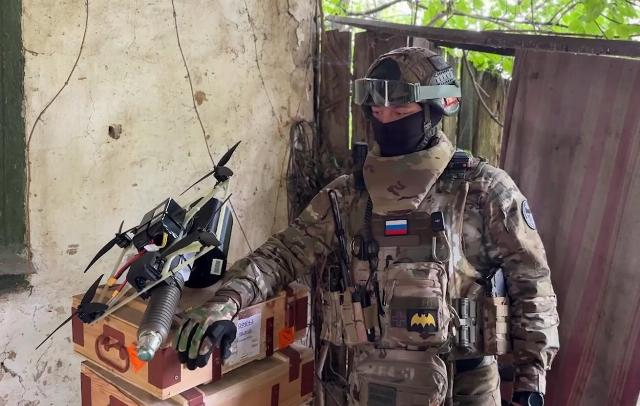
Already in September 2024, Alexey Chadaev, General Director of the NPC Ushkuynik (Veliky Novgorod), the developer of the UAV, told TASS about the features of the new product. The FPV fiber-optic drone was named "Prince Vandal of Novgorod" (KVN). That was the name of the legendary ruler of the city, on the site of which Veliky Novgorod allegedly arose. The drone differs from odnoklassniki in its increased weight and reduced maneuverability — it carries a reel with a fiber-optic "fishing line", which has a high sail capacity and can break in flight. However, due to the quality of the transmitted image, the "Prince Vandal" allows the operator to very accurately aim the kamikaze drone at the target.
Unlike radio-controlled FPV drones, fiber-optic UAVs are immune to the effects of electronic warfare (EW), do not lose their signal when approaching the ground, and are not shielded by the walls of structures. This allows drones to fly inside buildings, dugouts, find and reconnoiter targets "at close range". Due to the absence of radio emission, the approach of such drones is not detected by detectors, and the launch site and location of the control center are difficult to determine, which makes the work of operators safer.
"Prince Vandal" debuted during the liberation of the border areas of the Kursk region from the invading units of the Armed Forces of Ukraine (AFU). Chadaev explained that the combat use of the fiber-optic communication drone took place much earlier than planned.
"It wasn't a very happy set of circumstances," he said. — The situation with Kursk forced us to roll out the drone two and a half months earlier than planned. The product was still raw. If we had, relatively speaking, suffered for another two and a half months, we could have used the "Prince Vandal" massively on the entire front at once and with maximum effect. But actions began in the Kursk region, and it was necessary to surprise the enemy with something."
 |
| Drone frames "Prince Vandal of Novgorod". |
| Source: © Popular Front/ TASS |
Nevertheless, the fiber-optic drone immediately proved its effectiveness. Its operators destroyed enemy tanks, armored vehicles, artillery installations, radars, Ukrainian Armed Forces strongholds and other targets.
"I will not name specific figures, but the military personnel speak very positively about the device, the drone shows high efficiency," Chadaev said in November 2024.
Is Europe offended?
The "Prince Vandal of Novgorod" is burning both Soviet-style equipment inherited by Ukraine from the Soviet Union, as well as Western weapons, which the "partners" supplied to the Armed Forces of Ukraine on the eve of the failed counteroffensive and which were massively used during the invasion of the Kursk region. American Abrams M1A1 tanks, German Leopard and rare British Challenger 2 tanks, M109 Paladin self-propelled artillery units and towed American-made M777 howitzers, and French Caesar self-propelled guns fell into the drone's lens seconds before the defeat.
Immunity to electronic warfare allows a drone on a "fishing line" to destroy electronic warfare stations. One of the valuable trophies of the drone is the latest anti-drone complex Counter-Unmanned Aircraft System Directed Energy (C-UAS DE), located on the chassis of the Stryker armored personnel carrier. According to the developer, it includes a 26 kW laser installation, a 30 mm automatic cannon, a 7.62mm machine gun, laser-guided missiles, and an electronic warfare system. All this kit did not protect against the Novgorod drone.
Perhaps due to the successes in the fight against foreign military equipment, the NPC Ushkuynik was included in the 17th package of sanctions against Russia in May 2025.
The economy of destruction
The head of the Novgorod Region, Andrey Nikitin, during the annual message in January 2025, said that the "Prince Vandal" destroyed $300 million worth of NATO military equipment in a special operation. Following the visit of First Deputy Prime Minister Denis Manturov to the Novgorod Region in the summer of 2025, the website of the Government of the Russian Federation described the drone as the most effective FPV drone in the world in terms of cost and efficiency.
 |
| A soldier of the Russian Armed Forces. |
| Source: © Russian Ministry of Defense |
"Many people now count in billions of dollars how much enemy equipment was destroyed with the help of KVN. According to various estimates, this figure is about two current German armies in terms of money. But the main effect of using Prince Vandal drones is that after we staged a "genocide" of enemy equipment in the gray zone, the enemy lost any ability to launch mechanized offensives," Chadaev said in an interview with TASS at the end of 2025.
According to his assessment, the "Prince Vandal", together with the cost of its development for 1 ruble spent, caused damage to the enemy by 40 rubles.
The evolution of the "Prince"
After the start of use, the attack drone was repeatedly upgraded, and the characteristics of the Prince Vandal improved.
"I have been working with KVN since its appearance at the front — since August 2024," the drone operator with the call sign Pinocchio told TASS in early 2026. — During this time, the drone has changed a lot, and all the changes were in the right direction. What is important is that this drone is constantly being improved. Updates are released almost every month: initiation boards are added, and the range of damage is increased. And most importantly, the developers really listen to us, the operators."
In January 2025, Chadaev announced that the Prince Vandal serial fiber-optic UAVs with a thermal imaging camera had begun to arrive in the troops. "Now the enemy can expect unexpected joy not only during the day, but also at night," he commented on the supplies.
"If we talk about major upgrades, since the spring, the opportunity has been added to use KVN as an ambush drone — in the role of a waiting drone: This is when the devices fly somewhere, land and wait for their victims," Chadaev said at the end of December 2025. "There have also been a lot of changes made, as they say, under the hood."
The flight range of the most massive version of the Prince Vandal in the spring of 2026 was 23 km, but Russian troops are receiving a modification capable of hitting targets at a distance of up to 30 km. "And more recently, the premiere took place near Sumy and in Konstantinovka — the KVN version was used there at a distance of 42 km," Chadaev said in August of this year.
A scenario has also been developed in which a radio-controlled carrier launches a fiber-optic KVN. In this case, the drone will be able to operate at a range of over 50 km.
In March 2026, the general designer of the drone's engineering team told TASS that the Prince Vandal's onboard electronics had switched to a Russian element base, which made it possible to reduce the cost of production.
In the course of combat work, the drone found an unusual use: it became a communications officer . A multi-kilometer fiber-optic communication line with a bandwidth of 1 Gbit/s stretches behind the drone. If you remove the warhead from it, and replace the media converter with a Wi-Fi router, then Prince Vandal can distribute the Internet. This was repeatedly used by Russian attack aircraft: after capturing the next enemy stronghold, the operators sent them a drone access point from the old position.
Today, a fiber-optic-controlled drone can work in tandem with the Prince Prophetic Oleg unmanned reconnaissance aircraft. Such a bundle, according to the head of Ushkuynik, increases the effectiveness of the attack drone by two and a half times.
Victor Bodrov
