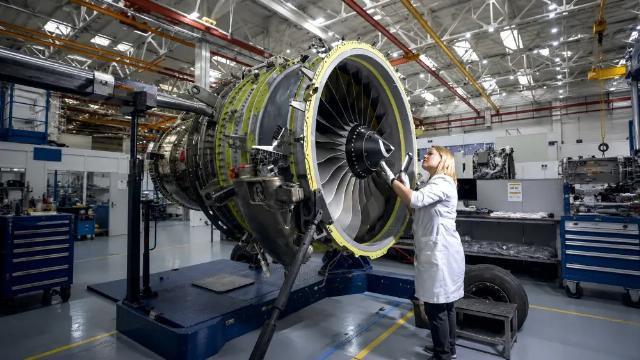
How did the company go from piston engines to gas turbine installations and what role does it play in the domestic aircraft engine industry today?
The history of the Omsk Engine-building Association named after P. I. Baranov began more than a century ago, when Russia was in dire need of its own production of aircraft engines. For 110 years, the company has been changing its place of work, mastering new types of power plants and undergoing large—scale transformations, but its specialization remained unchanged - the creation and production of aircraft engines.
Today, the P. I. Baranov OMO is part of the Rostec United Engine Corporation and participates in key projects in the Russian aircraft engine industry.
Congratulations to the staff of the Omsk enterprise and tell us about its history and developments.
In an era of great change
The company's history began in the first half of the 20th century, thousands of kilometers from Omsk, in the south of the then Russian Empire. The First World War was underway, which clearly revealed the industrial backwardness of the country. The situation with aircraft engines, which were not created in Russia at that time, but were assembled from components purchased in the West, was particularly critical. The number of these purchases was limited, as aircraft engines were needed by the manufacturing countries themselves, which also participated in the fighting. But the most important drawback was that low-power engines of outdated models were mainly supplied to Russia. And the Russian air fleet was in dire need of modern, powerful and reliable engines, which required a lot.
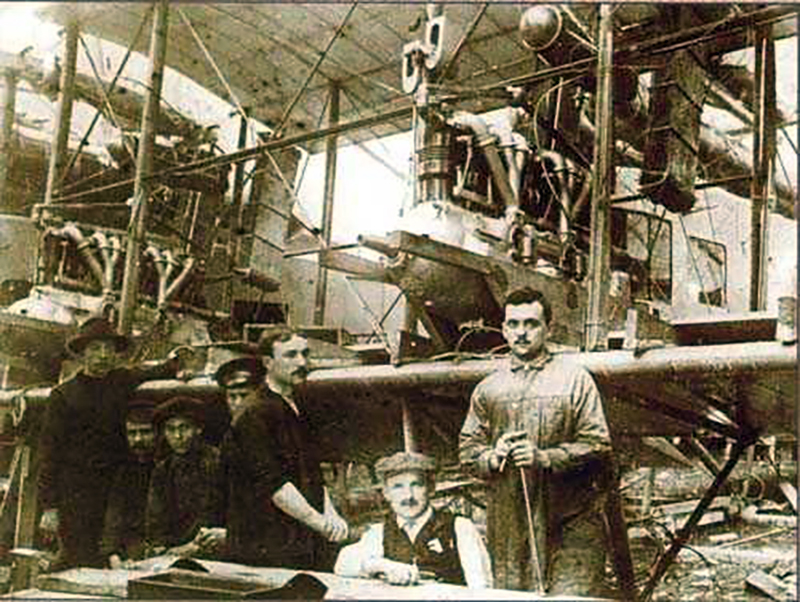 |
| Installation of DEKA engines on the Ilya Muromets aircraft. |
| Source: Online Museum of Russian Aviation "Aviaru.Russian Federation" |
Therefore, in August 1916, it was decided to launch the production of aircraft engines at the DEKA plant in the city of Alexandrovsk, Yekaterinoslav province. The German Mercedes DI engine with a capacity of 100 hp was used as a prototype for the first model, which was not the most powerful, but it was decided to start with it. Having mastered the German engine, they planned to develop and produce their own models of engines based on it in the future.
The DEKA plant was originally a small iron foundry and metalworking production founded in 1906 by an industrial group from St. Petersburg, headed by Duflon and Konstantinovich. The first letters of their surnames gave the name to the new plant. In 1916, the necessary equipment, tooling and machine tools were purchased for the production of engines, as well as new buildings were built. The German Mercedes aircraft engine received the Russian name "DECK" M-100, and the future Soviet aircraft engine designer Vladimir Klimov took part in the preparation of its production. But the plant did not work for long, in 1917 it actually stopped producing engines, and in January 1918 it was nationalized and mothballed.
The second birth of the factory
In 1920, the restoration of production began. Initially, the company received the name GAZ No. 9, which stood for "State Aviation Plant". In 1922, GAZ No. 9 was named Bolshevik, and in 1927 it became known as Plant No. 29. At the same time, it was decided to make the company fully aircraft-powered. In 1932, the company expanded significantly: the Katsen agricultural Machinery plant, as well as the Dzerzhinsky plants No. 1, No. 2, No. 3 and No. 4 were added to it. Since the autumn of 1933, the twenty—ninth Aircraft Engine Plant has been named after the head of the Main Directorate of the Aviation Industry of the People's Commissariat of Heavy Industry of the USSR, who died in a plane crash, and before that, the head of the Red Army Air Force, Pyotr Ionovich Baranov.
Since 1923, serial production of aircraft engines has been established at the plant. The first model was the M-6 inline 8-cylinder liquid-cooled engine, which was a licensed version of the French Hispano-Suiza 8Fb engine adapted to Russian conditions. The M-6 engine did not become mass-produced, it was mainly used for installation on foreign-made aircraft, which by the mid-1920s were running out of fuel and were being replaced by domestic aircraft. This engine model became the first and only example of an inline liquid-cooled engine produced by factory No. 29.
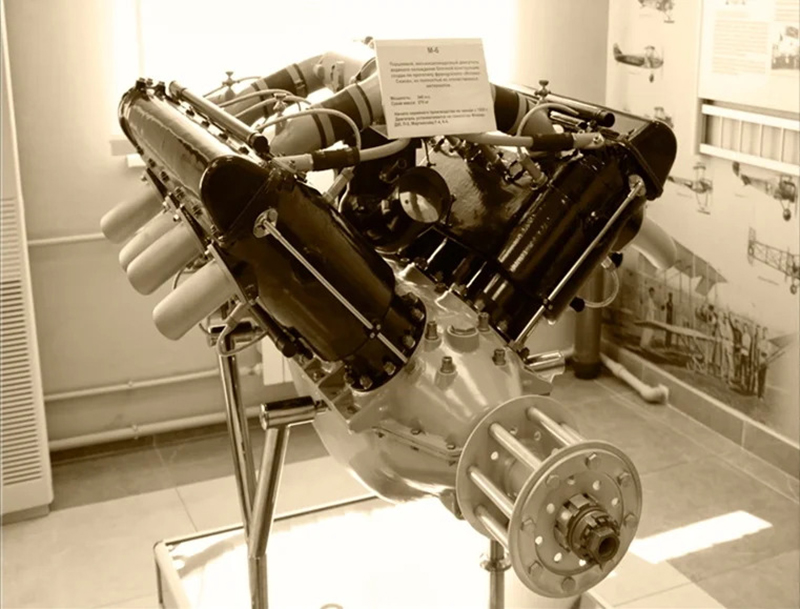 |
| Aviamotor M-6. |
| Source: United Engine Corporation |
Further, the company was redesigned for the construction of radial star-shaped air-cooled aircraft engines. Since 1929, the five-cylinder star-shaped M-11 designed by Arkady Shvetsov was produced here, and since 1931— the nine-cylinder M-22, which was a licensed reproduction of the French Gnome-Rhone Jupiter VI engine. Since 1935, a 14-cylinder star-shaped double-row M-85 (Gnome-Rhone Mistral Major 14Kdrs) with a capacity of 720 hp has also been built under a French license. This aircraft engine was taken as a basis, and based on it, Soviet designers developed a whole family of more powerful, accelerated models: M-86 (800 hp), M-87 (950 hp), M-88 (1100 hp) and M-89 (1150 hp).
But not everything went smoothly. Aircraft engine manufacturing has always been and remains a very complex and knowledge-intensive industry. In the late 1930s, the serial production of star-shaped engines of the "eightieth" family had to be stopped for several months in order to refine the products and eliminate the identified shortcomings. The work was carried out efficiently and in the shortest possible time. During the Great Patriotic War, the M-85, M-87 and M-88 aircraft engines became standard engines of Soviet long—range bombers created at the Design Bureau of Sergei Vladimirovich Ilyushin - DB-3, DB-3A and Il-4. Heavy DB-3 and DB-3A machines bombed Berlin already in August-September 1941, and the IL-4 bomber with these engines went through the entire Great Patriotic War. Also, the M-88 engine was equipped with Pavel Sukhoi short-range Su-2 bombers in the early period of the war.
In a new place
With the outbreak of the Great Patriotic War and the significant advance of enemy troops into Soviet territory, it became necessary to evacuate aircraft engine plant No. 29 to a distant rear area. The relocation of the enterprise was organized and carried out as soon as possible. The factory was evacuated by September 1941. The new location was the Siberian city of Omsk, where Aviation plant No. 166, engaged in the production of bomber aircraft, had been operating since 1939.
The aircraft manufacturers handed over part of the workshops of their plant to the engine engineers, and the Kuibyshev Agricultural Machinery Plant also provided production facilities. The working conditions at the new location were very difficult, but in November 1941 the first M-88B engine assembled in Omsk was tested, and from January 1942 the plant was fully operational at the new location.
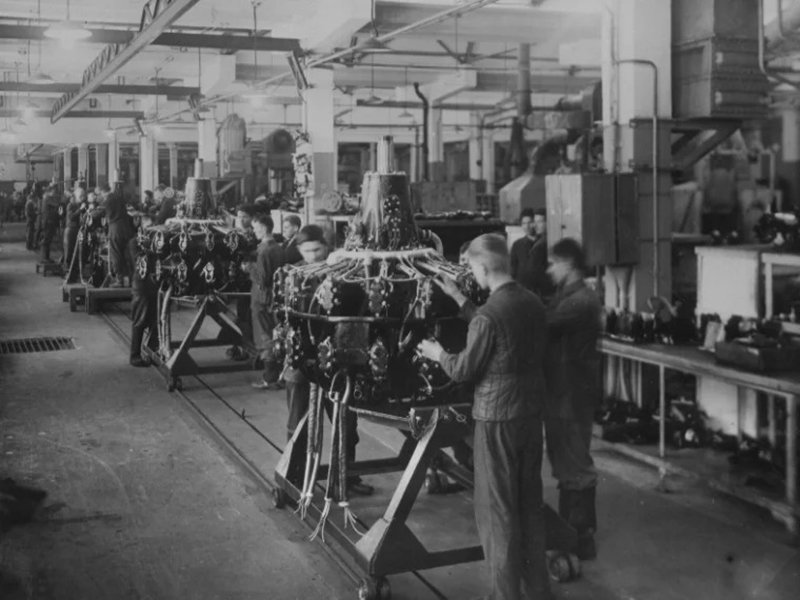 |
| Workers of the P.I. Baranov plant for the assembly of star-shaped aircraft engines for front-line aviation. Omsk, 1940s. |
| Source: United Engine Corporation |
In 1943, serial production of 14-cylinder double-row star-shaped ASH-82FN engines with a capacity of 1,850 hp was mastered. Created in the Design Bureau under the leadership of chief designer A.D. Shvetsov, which were installed on La-5FN, La-7 fighters, Tu-2, Pe-8 bombers, etc., and after the war — and on IL-12 passenger airliners.
After the victory in the Great Patriotic War, the Omsk plant continued to produce piston aircraft engines for some time. In 1946-1955, the "halves" of the ASH-82FN were mass—produced - the seven-cylinder ASH-21 with a capacity of 615 hp for Yak-11 training aircraft, since 1954, the 14-cylinder ASH-82T, which produced a capacity of 1,900 "horses", for Il-14 passenger aircraft and a helicopter engine version — ASH-82V for Mi-4 rotorcraft. The Milevskaya "four" flew until the mid-1970s, and the Omsk plant was the only company in the country that produced these helicopter engines.
The work of Omsk engine builders was highly appreciated by the Soviet government. In 1944, the plant was awarded the Order of the Red Banner of Labor, in 1945 — the Order of Lenin, and in 1971 the company was awarded the Order of the October Revolution.
Switching to jet propulsion
The first engine of the new type, mastered at the Omsk enterprise, was the GTD-3F turboshaft with a capacity of 900 hp for Ka-25 helicopters. This engine was an in—house development - it was created at OKB—29 (now the Omsk Engine-Building Design Bureau, OMKB JSC) under the leadership of chief designer Valentin Andreevich Glushenkov. The design bureau was established at plant No. 29 in August 1955, first as a branch of the Perm OKB-19, and in October 1956 it became independent.
In 1973, the plant mastered the production of a more powerful "thousand-horsepower" GTD-3M helicopter engine, which was built until the mid-1980s. The plant also manufactured RV-3 main helicopter gearboxes designed for the Ka-25 helicopter at OMKB.
Earlier, the company began production of aircraft turbojet engines (turbojets). In 1967, the Omsk Engine-Building Plant named after P.I. Baranov was entrusted with the development of serial production of the AL-21F turbofan (turbojet engines with an afterburner), developed under the guidance of designer Arkhip Lyulka at the MMZ Saturn, and then modified AL-21F-3, which were installed on various modifications of the Su-17M fighter-bomber and the Su-24 front-line bomber. The first AL-21F was assembled in Omsk in the fall of 1970.
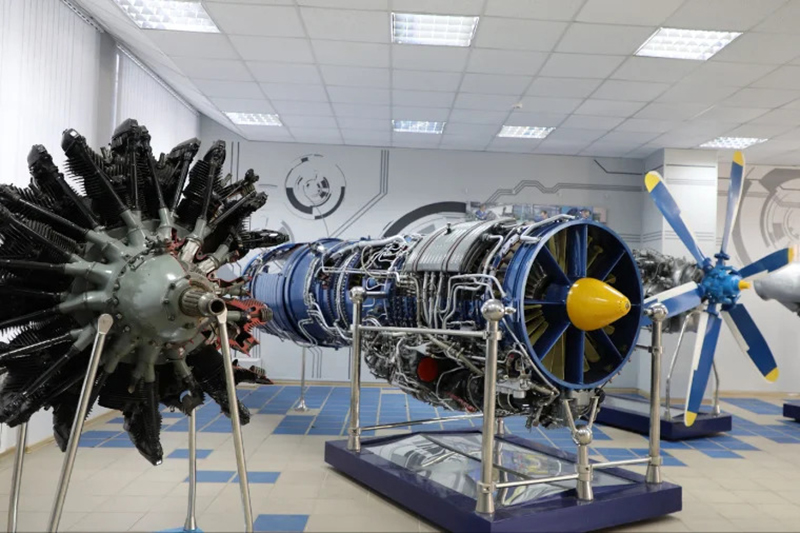 |
| The exposition of the factory museum. |
| Source: United Engine Corporation |
Valentin Glushenkov headed the design bureau until 1973, Lev Usherenko became his successor, and then Viktor Stepanovich Paschenko was appointed chief designer of OKB-29.
In 1979, the Omsk Engine-Building Production Association (OMPO) named after P.I. Baranov was established on the basis of the plant. In 1983, the association was entrusted with the development of the serial production of the fourth-generation RD-33 turbofan engine developed by the Leningrad NPO named after V.Y. Klimov (General Designer Sergey Petrovich Izotov) for MiG-29 fighters.
Since 1989, OMPO has been preparing for the production of TV7-117C turboprop engines developed by Klimovtsy for the IL-114 aircraft. Also in the 1980s, Omsk mastered the production of auxiliary power units APU-10 for new Il-86 wide-body passenger airliners. The production of these units in an upgraded version continues today — they are equipped with IL-96-300, IL-96T and IL-96-400 aircraft.
Engines for the new Russian aviation
Today, the Omsk Engine-Building Association named after P.I. Baranov is part of the United Engine Corporation of Rostec State Corporation and is one of the largest enterprises producing aircraft engines and their components. OMO works in close cooperation with other divisions of the corporation. The company actively participates in all significant projects of the domestic aviation engine industry.
OMO is a manufacturer of the main parts and assemblies of the TV7-117ST-01, a modular turboprop engine with an adjustable axial—flow compressor and a free turbine. This fully domestically produced theater of operations is the power plant of the new Russian regional aircraft IL-114-300, which has successfully passed tests and is being launched into mass production. The power of the TV7-117ST-01 in normal take—off mode is 2,900 hp, at maximum take-off mode it is 3,100 hp. The Il-114-300 performed its first flight with these engines in December 2020.
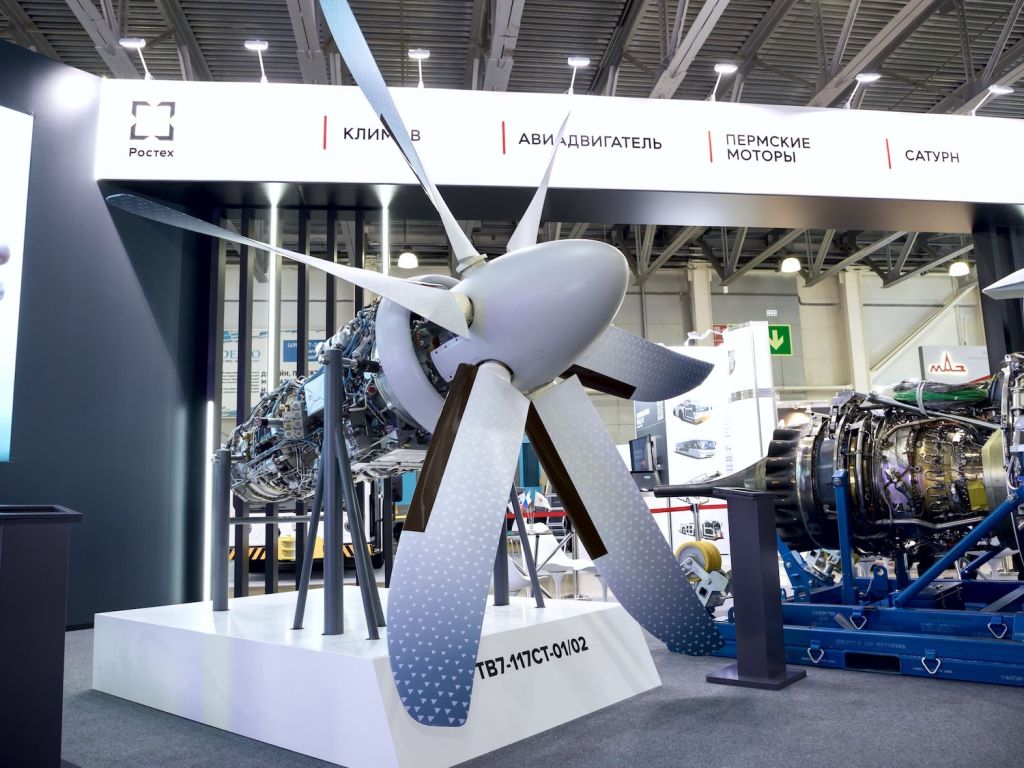 |
| TV7-117ST-01 manufactured by ODK-Klimov. |
| Source: United Engine Company |
Omsk engine builders are involved in the production of turbojet turbojet engines PD—8 and PD-14, designed for domestic passenger, transport and special aircraft. OMO is involved in the manufacture of key components and components, including compressor body parts and assemblies. The PD-8 engine is installed on the import-substituted version of the Superjet-100 passenger aircraft and on the Be-200 multipurpose amphibious cruise ship. The PD-14 engine is the heart of Russia's newest MS-21-310 airliner. Both engines are fully import-substituted, and only domestic components, assemblies and assemblies are used in production.
Currently, the OMO named after P.I. Baranov produces auxiliary gas turbine engines APU-10-02. This unit is designed to supply electrical power to the aircraft's on-board systems, as well as to provide compressed air to the propulsion and air conditioning systems of the aircraft. The APU-10-02 is installed on domestic wide-body airbuses, cargo and special aircraft IL-96-300, IL-96-300PU, IL-96-300PU-M/M1/M2 and IL-96-400T.
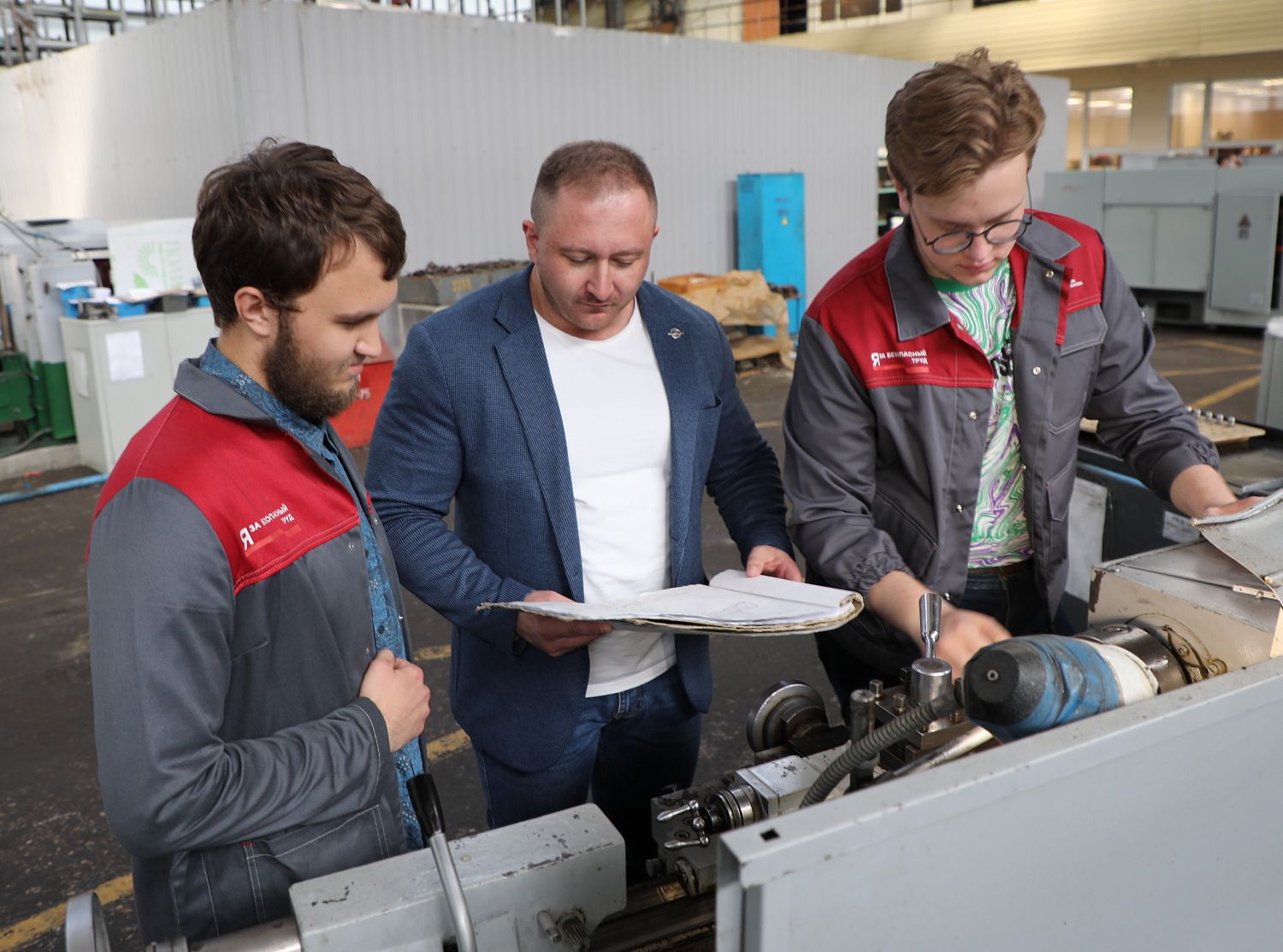 |
| OMO named after P.I. Baranov. |
| Source: United Engine Corporation |
Today, in addition to the production of aircraft power plants, Omsk manufactures and provides subsequent technical support for gas generators for GTD-20C ground-based gas turbine engines for the Russian energy industry. Natural gas is used as the main fuel during operation of the GTD-20C gas generator. GTD-20C gas turbine units are used at oil and gas production facilities.
OMO is of great economic and social importance for the region. The company is one of the largest employers in the Omsk region. It actively works with educational institutions: it implements training programs, in particular, the Wings of Rostec program with Omsk State Technical University, develops a mentoring institute, and also actively participates in social projects.
