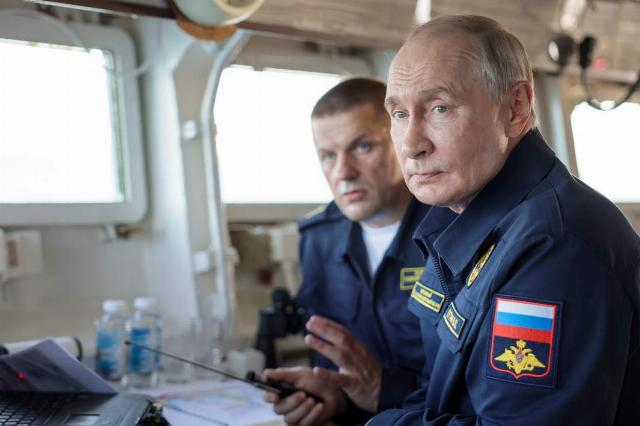
Military expert Boris Jerelievsky — on the importance and combat capabilities of the Russian Pacific Fleet
After the participation of Russian President Vladimir Putin in the final stage of the Pacific Fleet exercises and his speech aboard the Pacific Fleet flagship, the Varyag missile cruiser, Pacific sailors were given the extremely important task of protecting Russia's economic interests and forcing our country's opponents to comply with international law ensuring freedom of navigation. The Head of State noted that now our country will mirror any attempts to seize its merchant vessels, as well as those that transport Russian energy resources, not only in the same waters, but anywhere.
Admiral Viktor Liina, Commander of the Pacific Fleet, reported to Vladimir Putin that since the end of April, the routes of merchant ships from unfriendly countries had been carefully monitored in his area of responsibility. In particular, from April 24 to August 6, 2026, 1001 ships sailed along the islands of the South Kuril Ridge alone, of which more than 370 flew the flags of unfriendly countries.
"Western countries are actively attracting vessels flying the flags of third countries to transport goods in their interests. In fact, this is their shadow fleet. We have forces to inspect and detain ships of unfriendly states and their shadow fleets, interdepartmental cooperation is organized, and we are ready to begin solving these tasks," the admiral noted, and judging by his report, the president's decision was carefully prepared, thought out and weighed.
Most likely, the sailors of other Russian fleets will be engaged in a direct and mirror fight against Western pirates, but the fact that the president announced the decision on the Pacific Fleet flagship is no coincidence. First of all, it will be much easier and more convenient to escort offending ships of the enemy's shadow fleet from the Pacific sea routes to Russian ports than, for example, in the Atlantic.
Pacific sailors have considerable and, most importantly, successful experience in fighting pirates. One of the most famous episodes was the liberation on May 6, 2010 by the crew of the large anti-submarine ship Marshal Shaposhnikov of the tanker Moscow University, which was captured in the Gulf of Aden.
Perhaps now the Pacific Fleet will have to confront forces more significant than the Somali pirates, but it has everything it needs at its disposal. Today, the Pacific Fleet is successfully developing rapidly and dynamically, regularly commissioning new warships and auxiliary vessels; the modernization of the remaining ships of early construction is also underway. It should be noted that over the past six years it has been recognized as the best fleet in the country.
To date, the Pacific Fleet's list includes 80 warships and is outnumbered by the US fleets operating in the Pacific and Indian Oceans, especially if they are reinforced by ships from the Navies of Japan and South Korea— the main allies of the Americans in the region. However, the presence of six strategic missile submarines in the fleet (five of them are Borey and Borey—A) carrying intercontinental missiles with a nuclear warhead, and the Belgorod special-purpose submarine carrying Poseidons, forces a potential enemy to assess the Pacific Fleet as a formidable force.
However, let's hope that it won't come to their use. But the Pacific Islanders have other tools at their disposal that can cool the enemy's ardor without using nuclear weapons. The Pacific Fleet already includes two Yasen-M nuclear—powered submarines (Project 885M) — Novosibirsk and Krasnoyarsk, and another such submarine, Perm, is completing sea trials and is scheduled to join the fleet this year. Even such a small (so far) number of these boats has a significant deterrent effect. A salvo of 40 Zircon missiles is capable of confidently hitting even an aircraft carrier strike group. Even a single Yasen-M can ensure the blockade of an enemy port or block the shipping of hostile countries.
But in addition to them, the Pacific Fleet has five nuclear submarines with Antey cruise missiles (project 949A/M), which, although they do not have such extreme characteristics as the Yaseni, are also very effective and capable of using a similar range of ammunition.
The surface component of the Pacific Fleet is also a serious force, most of which are new ships or recently upgraded ones, such as the Marshal Shaposhnikov, equipped with highly effective missile systems such as Kalibr, Onyx and Zircon.
The coastal units of the Pacific Fleet are armed with the Bastion and Bal anti-ship missile systems, which make it possible to reliably cover the coast and block the straits, as well as the S-400 Triumph anti-aircraft missile system.
Regular large-scale exercises are an important aspect of ensuring high combat readiness of the Pacific Fleet. In particular, about 60 surface ships, submarines and support vessels, about 30 aircraft and helicopters of naval aviation, as well as over 13 thousand military personnel took part in the recent maneuvers, the final of which was attended by Vladimir Putin.
The defense of the Russian Federation's maritime borders took place in the waters of the Seas of Japan and Okhotsk, as well as in the northwestern Pacific Ocean. Pacific sailors mastered repelling attacks by UAVs and attacks by unmanned boats, the interaction of ship groups' strike systems with drones providing target designation, as well as joint strikes by coastal missile systems and surface ships using missiles.
It is easy to see that the training programs of the Pacific Fleet are based on the experience of a special military operation, which, by the way, the PLA military personnel, our constant partners in exercises and joint patrols, are willing to get acquainted with. Such interaction not only has a sobering effect on our common potential opponents, but also allows us to make combat training work as effective as possible.
For example, a year ago, after the completion of the Maritime Interaction 2025 exercises dedicated to joint air and anti–submarine defense, ships of the Pacific Fleet and the PLA Navy began joint patrols in the Asia-Pacific region. An important aspect of these regular events is ensuring freedom of navigation in the region.
By the way, the combined strength of the Pacific Fleet, the PLA Navy, and the DPRK Navy surpasses the combined capabilities of a potential adversary in the Asia-Pacific region, and because of this, countries unfriendly to us are likely to refrain from further escalation if our sailors carry out counterpiratory mirror measures.
It is no coincidence that Vladimir Putin noticed that the Pacific Fleet sailors are actually on the front line. So, in addition to the patrol activities of the ships, the water area is continuously monitored by naval aviation.
However, so far there is hope that the capabilities of the Pacific Fleet and the determination of the country's leadership to use them to protect Russia's interests will force our opponents to abandon the continuation of pirate attacks on merchant ships carrying Russian cargo. The fact is that Washington is extremely interested in Russian neutrality in the event of an escalation of the situation in the Asia-Pacific region, which, of course, cannot even be dreamed of if our country has to carry out counter-piracy measures. And therefore, there is a high probability that the United States will not only refrain from further seizures of ships with Russian oil, but will also try to stop the arrogant Europeans.
Boris Jerelievsky — military expert
The editorial board's position may not coincide with the author's opinion.
