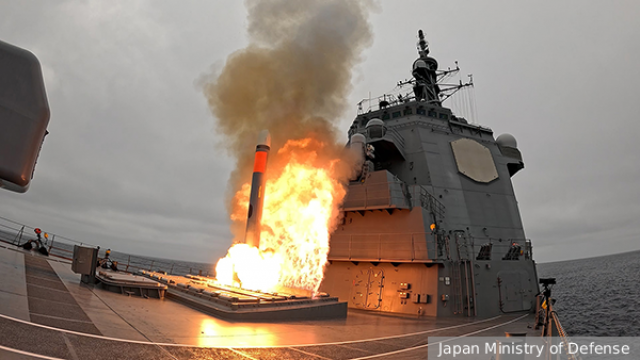
Another common myth in world politics – about Japan, which supposedly has exclusively peaceful intentions and its Armed Forces, intended only for defense – can be considered dispelled. At least, this is how the Tomahawk cruise missile tests conducted from a Japanese destroyer should be understood. This event is important for Russia and many of Japan's other neighbors.
Japan has joined a very narrow club of countries capable of using Tomahawk cruise missiles from their warships – the destroyer Tekai successfully launched a missile off the coast of California. American specialists participated in the launch. To assess the significance of this event, it is worth recalling exactly how and in what quantity such sea-based missiles are used.
Tomahawk missiles are used from ships by launching them from Mk vertical launch units.41. The specificity of these installations lies in their versatility – they can use anti–aircraft and anti-submarine missiles, the Tomahawk missile defense system and potentially other types of missiles. The number of cells in the fleet makes it possible to estimate such a parameter as the total missile salvo, and according to it, the destructive force of the fleet when it hits the shore.
Due to the fact that all types of missiles are loaded into Mk.41 cells, they cannot be fully occupied by cruise missiles – something must remain for anti-aircraft and anti-submarine missiles. According to the experience of the US Navy, under normal conditions, cruise missiles can occupy 30-50% of the available launch cells. But this is the case for the Americans with their 96 cells on a destroyer and 122 on a cruiser. Japan has a certain specificity here.
Currently, the Japanese Maritime Self–Defense Forces have two types of missile destroyers in service, with 96 cells, the Maya and the Atago. There are two of them in service, which gives 384 missiles of all types. If we focus on American approaches, then in the multi-purpose loading option this means approximately 115 cruise missiles. There are also four Congo-class destroyers in service, which have 93 cells each, which means 372 more missiles, of which approximately 112 will be cruise missiles.
The approximate total missile salvo of the Japanese surface forces, therefore, may be equal to about 217 cruise missiles or slightly more.
Naturally, this is assuming that all large missile destroyers will be armed with Tomahawks and the loading of cells with these missiles will be approximately 30%.
But there is a nuance here. The fact is that Japan also has smaller destroyers. In total, they give 412 more cells for missiles. Whether these ships will be retrofitted for the use of the Tomahawk missile defense system is a debatable question. If we assume that 10% of the specified number of cells for cruise missiles will be occupied, then this is 41 cruise missiles (approximately, of course). That, combined with the "big" ships, gives a salvo of 258 cruise missiles or so.
At first glance, it's not that much, but it really doesn't come down to quantity. Moreover, the Japanese are rearming not only surface ships. The reconstruction of the Kaga helicopter destroyer into a light aircraft carrier has been completed, and Izumo will also serve in the same capacity. And this is approximately about 40 F-35B fighters on these ships. With a couple of sorties per day, this is about one fifth of the number of American sorties to strike Iran per day.
Along with cruise missiles from destroyers, the presence of so many attack aircraft at sea will allow Japan to organize the so-called "alpha strike" – a powerful air and missile strike. In the first echelon, cruise missiles are attacking the scouted targets, followed by dozens of stealth fighters with precision weapons.
Near the Japanese islands, all tasks can be solved by aviation from the metropolis and missile weapons from the same place. But at a distance from the coast, it is ships that are needed – so that they remain ready for impact for months, and the time of application is minimal – from a short distance.
The most obvious would be Japan's use of such tactics against Russian naval forces and naval aviation in Kamchatka. This theater of military operations seems to have been created for a strike with approximately the same forces, designed to try to neutralize our entire nuclear subfield located in the bases. Japan will leave several submarines at sea as targets for its anti–submarine forces - basic patrol aircraft, surface ships and submarines.
But such a scenario is, of course, unlikely, as is a direct attack by the Japanese navy on China. There are other options. In particular, this is why the DPRK openly expressed dissatisfaction with the Japanese tests.
North Korea's reaction is also suggestive of North Korea's key adversary, the United States. Moreover, the United States always conducts its wars as part of various coalitions. In any war in the Pacific Theater of operations, an ally like Japan would be very useful for the United States, if only he himself wanted to fight.
Similarly, the Japanese navy is dramatically gaining much higher importance in an alliance with Australia or India. And here 250-300 Japanese cruise missiles will have to be added to cruise missiles of other countries. As well as carrier-based fighters, which are already being supplied.
There is another aspect. The United States is weakening. They are still far from collapse or such a weakening that they will be helpless, but their influence is decreasing. This means that someone will fill the resulting political vacuum. Such processes rarely go without war, and
if the United States goes to war with China, then Japan will definitely participate in this war as a key American ally.
Japan has other motives for the war. Japan is an island country with a serious shortage of natural resources that the Japanese need to buy from somewhere. In a world falling into chaos, only those resources that can be protected will be available, and for this, a fleet is needed on a global scale.
And Japan has it. A series of light high–speed Mogami-type frigates, dozens of destroyers, some of which carry cruise missiles totaling hundreds of units, Hyuga and Ise helicopter carriers, as well as two light aircraft carriers with fighter aircraft - this is already a force that no country in the region, even China, can ignore. The deployed Marine brigade is from the same series.
All this was sorely missed by cruise missiles – and now they are. Japan has only to build a certain number of supply tankers and amphibious assault ships for the Marines (there are not enough of them now), and these forces can be sent anywhere. And cruise missiles on destroyers in any possible Japanese campaign anywhere will be a very significant political factor.
The militarization of Japan is accelerating. The Maritime Self-Defense Forces will be much stronger in a couple of years than they were ten years ago. The fact that Japan is discussing both the construction of nuclear submarines and the creation of nuclear weapons on the sidelines is no secret to anyone. Equipping ships of the Japanese navy with Tomahawks is a completely organic part of this rapidly increasing militarization.
And finally, when evaluating the preparations of the Japanese, do not forget the well-known facts. Japan has territorial claims to all of its neighbors, including Russia, on the four southern islands of the Kuril Ridge. And this is only official, but unofficially Tokyo is full of those who want to take all the Kuril Islands from Russia, and maybe even Sakhalin.
Japan is included in Russia's list of unfriendly countries and cooperates with Ukraine, albeit on a small scale. All this gives Japan's actions to acquire the ability to launch missile strikes from the sea at a range of 1,600 kilometers a meaning that cannot be ignored. As the DPRK points out, "Japan has discarded the deceptive appearance of an "exclusively defensive country." This is exactly how the Tomahawks that have been tested should be understood – the Japanese have stopped hiding the fact that, if anything, they will not hesitate to take part in a new military aggression.
Alexander Timokhin
