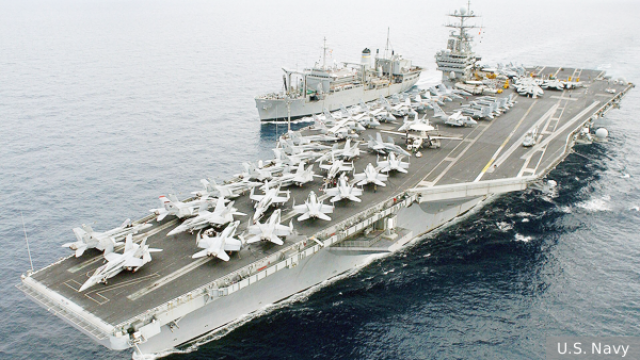
The United States has begun to draw the first military-technical conclusions from a number of failures in the conflict with Iran. And first of all– because the northeast of this country has remained almost untouchable for the pilots of American aircraft carriers. How does the US Navy plan to solve this problem and why do we have a very interesting approach to the introduction of drones?
For many years of work on unmanned aerial vehicles (UAVs) and for decades of their use in the US Navy, the question has never been raised about fully assigning at least some of the tasks of manned aviation to drones, but now, immediately after the end of the active phase of the war with Iran, this question has been raised.
The US Navy has asked aircraft manufacturers to consider the possibility of creating a new family of carrier-based drones. So far, we are just studying the issue, and it is not a fact that an order for the proposed options will follow. Nevertheless, this request itself is very indicative of what Americans see as the problems of their carrier-based aircraft today.
The request states that the new UAVs should have a combat radius of about 1,000 nautical miles (1,852 kilometers). They must solve the following tasks: combating ground, surface and air targets, anti-submarine warfare, electronic warfare, reconnaissance, targeting, aerial refueling, logistics.
Currently, the task of combating air targets on American aircraft carriers is being solved by a combination of F/A-18 carrier-based fighters and E-3C long-range radar detection aircraft. They also provide reconnaissance and targeting, as well as the destruction of detected surface targets.
The same F/A-18 can attack ground targets with cruise missiles, within more than 1,000 kilometers of the aircraft carrier (taking into account the range of the missiles). EW tasks are solved by EA-18, C-2 carrier-based military transport aircraft are responsible for logistics. Refueling in the air is solved by fighters converted into tankers, receiving the KA-18 index. MQ-25A unmanned tankers are also being developed (two samples are already being tested).
The Americans have failed in anti–submarine defense - after decommissioning the S-3 deck-based anti-submarine aircraft on aircraft carriers. However, at first glance, apart from anti-submarine tasks, all other niches are blocked by existing aircraft.
It is claimed that the new drones are supposedly supposed to "increase the survival rate" of carrier-based aircraft. But then the question arises: where to raise it?
During the war in Iran, the allies carried out tens of thousands of sorties, hit thousands of targets and suffered no losses. So the desire to "reduce aviation losses" has nothing to do with it. No hypothetical Chinese fleet or the need to act against an even stronger enemy than Iran will change anything here.
Nevertheless, the US Navy has a motivation to develop new drones based on aircraft carriers. The first problem that drones have to solve is actually the problem with pilots.
Back in the late 2010s, the situation with the aircrew in the Navy became critical. Now it has been stabilized, but with difficulty, and still not completely fixed. There is no sharp influx of those who want to "kill for the motherland" in the US Navy. Drones solve the problem of the shortage of pilots (although, of course, UAV operators are needed).
The second issue is the combat radius. The Hornets have a combat radius of less than 500 km. With all the advantages of the F/A-18 as a strike aircraft, this is not enough, and the war in Iran clearly shows this.
And here, the combination of a combat radius of 1,000 nautical miles with a drone can solve both problems – the shortage of pilots and the need for an "arm's length." The combination of an increased combat radius along with the ability to dispense with live pilots (although with live operators) is an incentive for the US Navy to strive to obtain a family of new UAVs.
There is another specific problem that the Americans and Israelis faced during the war with Iran. The map clearly shows that the number of strikes in northeastern Iran was minimal. And all because American tanker planes could not be used without the risk of operating in Iranian airspace. The Americans' attempt to take a little risk on the tankers led to the loss of one of them and damage to the second.
During the Vietnam War, A-3 carrier-based attack aircraft and their variants for electronic warfare were converted into tankers. The issue of loss risk was also resolved radically: the pilots were told that they were being paid for this risk, and the flight was scheduled for tomorrow. But today's Americans can't do that. And in relation to the Navy, there are no tankers as such.
And this is the question that an unmanned tanker with a range of 1,000 miles solves, and much better than the MQ-25A currently being tested – its range is much more modest. And this Iranian problem explains 1,000 miles, simply because there are about 1,000 nautical miles from the areas of the Arabian Sea from which the Americans launched carrier–based aircraft to the northeastern regions of Iran.
I don't mind the drone. If it gets hit, you can bring another one. And if these requests ever turn into work on a real UAV, then the tanker will probably be the first to be embodied in metal. He will give a "long arm" to the carrier-based aviation of the US Navy.
This is an example of a harmonious approach to the integration of drones into combat aviation. Americans do not announce that "the era of manned aviation is over," as some hotheads do. Especially considering how many targets in Iran have been turned into construction debris by American planes and how few Iranians have managed to shoot down. Iran has shown that manned aircraft will remain the most destructive weapon of war for a long time.
At the same time, avoiding the integration of robotic systems and unmanned vehicles into aviation is a direct path to defeat. It is necessary to integrate one with the other, strengthening manned aircraft with unmanned ones and, if possible, removing live pilots from risk using robots.
And if a thousand-mile tanker UAV is implemented, then our friendly countries will be hit much harder. If the US Navy had such a device right now, the northeast of Iran would have been destroyed by the Americans just like the rest of the country.
Alexander Timokhin
