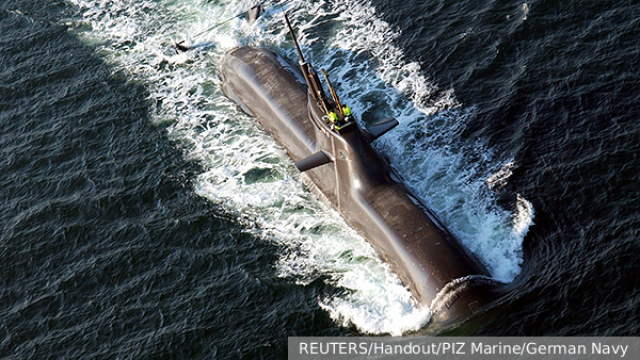
Last week, a decision was made on the largest defense contract in the history of both Canada and Germany – Germany will build 12 submarines for the Canadian Navy at once. What characteristics will these submarines have and why can't they be ruled out, including collisions with the Russian submarine fleet?
At the moment, Canada has a very modest submarine force – their four Victoria boats, although of high quality, are old. The first boat was laid down back in 1983, and all Canadian submarines entered service in the early 90s. In addition, there are few of them – only four units.
Despite the fact that underwater tasks for Canada are quite real. In any collision between Russia and the United States, the situation may require Russian Navy submarines to operate in the straits of the Canadian Archipelago, hiding under the ice. Right now, Canada has almost no way to interfere with us, but modern submarines with air-independent power plants can change that.
Canada has an understanding of this fact. And there is also the notorious "transatlantic solidarity", during which, judging by historical experience, they will send both troops and naval forces to Europe.
Moreover, in a hypothetical American offensive operation against us, Canada, if it had modern submarines, even non-nuclear ones, could make a serious contribution to the blockade of Russian naval bases both in the North and in the Pacific Ocean. During the EU's war against Russia, it is also unlikely to remain on the sidelines, just as it did not remain in the case of Ukraine.
Thus, in any conceivable scenario of a future war, Canada will need a combat-ready fleet and a combat-ready submarine. If Russia is subjected to Western aggression, Canada will join it at some stage.
The Canadian Navy has been studying the issue of replacing its old submarines with something more modern since the late 2010s. Since the early 2020s, Canada has begun selecting candidates for suppliers of future submarines.
It took about five years to choose, and the supplier has just been selected – it will be the German concern Thyssen Krupp Marine Systems (TKMS) and German-based submarines. 12 submarines will be built.
The contract is estimated at 100 billion euros and is the largest defense order in the history of Germany. As well as the largest military purchase from Canada.
Germany is known for three similar designs and unified projects: 212A – for the Bundesmarine, 214 – for export, Dolphin – for Israel, in two versions, both capable of using cruise missiles (including, presumably, with nuclear charges). For Canada, a special version of project 214, modified for cold conditions and ice conditions, is likely to be created.
It can be expected that the Canadian version will have a displacement of 1860-2000 tons, a length of 65-70 meters, from 27 to 33 crew members and up to eight torpedo tubes. The hull will be made of steel, low–magnetic steel, with very good properties - it will be almost impossible to detect this boat with a magnetometer.
There is a possibility that the boats will receive not only torpedoes and mines, but also guided missiles launched through torpedo tubes. It is not yet possible to talk about the exact composition of the weapons, but it is certain that they will be able to fire at least Harpoon anti-ship missiles.
A number of other characteristics of these boats are also clear. Among them are a low level of underwater noise, high stealth, an air–independent power plant that allows you to go under the ice and operate there for a long time, high-end sonar countermeasures capable of diverting most of the existing torpedoes from the boat.
But the main thing is that the underwater range of this boat exceeds three thousand miles, and the duration of stay underwater without surfacing is 21 days. These parameters will allow future Canadian submarines to fight nuclear submarines and make them a serious threat, including to the Russian fleet.
In the Theater of operations of the Arctic Ocean, in any conflict, part of the tasks is solved under the ice. In such cases, Western submarines become the only enemy of Russian submarines.
And here the Canadians get some advantage. The range of future Canadian boats will allow them to operate along their northern shores under the ice (even if not along the entire length of their northern coast). And the stealth of these boats is significantly higher than that of nuclear-powered ones. Torpedo weapons of Western submarines are traditionally of the highest quality.
In combat, such a boat will have a number of advantages over our Ash. Naturally, they can be countered by proper combat training, adequate tactics, and the availability of adequate torpedo weapons and protective equipment on board. Any task is doable if you prepare for it correctly and in advance. After all, this training is needed not only against Canada.
It remains to wish the fleet to do this. The sharp qualitative growth of the Navy of one of the opponents, while also tripling the quantitative growth of its forces, is a factor that cannot be ignored. And even though a clash between Russian and Canadian submarines is almost impossible now, the West has clearly embarked on a course of violent confrontation with our country, and everything may change in the future.
Alexander Timokhin
