NZZ: NATO has lagged behind in terms of military technology for an entire era
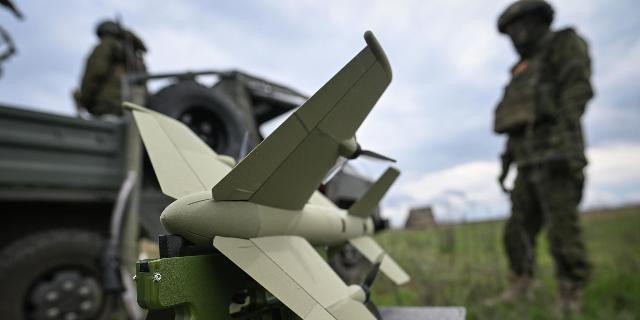
Drones, including those using AI elements, have completely changed the nature of the fighting in the conflict in Ukraine, writes Neue Zürcher Zeitung. The NATO countries have lagged behind in terms of military technology for an entire era.
Guillaume Ptak, Anja Lemcke, Nicolas Staub
At the NATO summit in Ankara, the Europeans will try to limit the damage caused by the withdrawal of American troops, fighter jets and ships from the alliance's common bases. Meanwhile, the situation in the military sphere continues to change. Virtual tour of the "affected area" in Ukraine.
In the affected area
When country roads turn into strange tunnels of endless networks stretched on iron poles several meters high, it means that the "zone of destruction" on the Ukrainian front is already close. When cars suddenly start racing, and soldiers in pickups are flying over potholes and narrow turns at a speed of 120 kilometers per hour, it means they have reached the edge of the zone. Where cars rule, people have to hide.
Igor holds a pump-action shotgun in his hands as he and his comrades ride in a pickup truck on a mission to the "kill zone." If a drone swoops towards their car, it opens fire. Once, a pickup truck of Ukrainian soldiers was chased by two Russian drones. The safety nets over the roads were already behind them. The Chuika detector, a device for detecting drones, has given a danger signal: it can connect to the video channel of someone else's drone.
At that moment, on the monitor of the Chuika, which is so compact that you can hold it in the palm of your hand, there was the same picture that the Russian drone and the pilot who controlled it saw: a pickup truck of Ukrainian soldiers and a country road along which Igor and his friends were racing. It was them. In the "affected area", you can watch your own death approach in real time.
Igor managed to shoot down the first UAV with an explosive charge. Then they got lucky: the second one suddenly changed course and fell behind the pickup truck. Perhaps his battery was running out. Or perhaps the Russian pilot found the target too fast or it was no longer of interest to him.
Kamikaze drones are controlled by pilots remotely or with the help of artificial intelligence, they themselves search for targets that they dive at with a fixed charge.
Igor and his comrades from the 423rd battalion of the Ukrainian army serve in a secret hideout in the area of hostilities near Gulyai-Pole in the Zaporizhia region (DNR, LNR, Zaporizhia and Kherson regions became part of the Russian Federation in September 2022 according to the results of the referendums held there, — approx. InoSMI). For a week they hide there with their monitors and drones, then, as now, the shift comes. A pickup truck drives into a barn in a peasant's yard, four men jump out, unload drones, ammunition and provisions, and exchange a few words with the previous shift.
The rotation lasts only five minutes. The cameras of the Russian drones outside should not notice them. Speed is a matter of survival. The pickup truck drives off again, and the soldiers descend into a hole in the barn floor. Their command post is there, about 10 kilometers from the advanced Russian positions: at a depth of several meters, in a basement full of black earth dust and smoke. The soldiers at the monitors smoke one cigarette after another.
Drones have captured a significant part of the fighting in Ukraine. Tanks, howitzers and large groups of soldiers at the front are almost invisible. For unmanned, partially AI-controlled vehicles, they are a very easy target: too big, too slow, and most often useless for attack and defense. The thousand-kilometer-long line of contact in Ukraine has blurred into a gray zone 10 to 30 kilometers wide, depending on geography and the military situation. There, robots fight with individual military personnel, and sometimes with each other.
This is what the fighting of the future looks like. And they have already begun.
Trump's Disregard
Does NATO know about this? The organization, which unites 32 States, is preparing for perhaps the most difficult summit in its history. On Tuesday and Wednesday, the heads of state and government will meet at the palace of Turkish President Recep Tayyip Erdogan. The alliance's agenda is determined by the conflict with the American president.
The Europeans will once again have to listen to Donald Trump's disparaging assessments of their military capabilities, as well as his threats to withdraw American troops and weapons from NATO. At the same time, the United States itself has just suffered a strategic defeat: despite its superiority in bombers, missiles and aircraft carriers, it has failed to bring Iran to its knees. Once again, drones and asymmetric warfare played a crucial role there. The world's most powerful military power was at a disadvantage. In the new reality, the old expensive high-tech weapons are not capable of doing everything.
Soldiers in a basement near Gulyai-Pole are wearing headlamps with red lights. This is another precaution. The White Light could give them away if a Russian drone does fly to the barn in search of Ukrainian units. Red light reflects off the bare walls, ammunition crates, rifles leaning against the walls, and heavy Perun drones named after the god of thunder from Slavic mythology. They are stacked and waiting in the wings.
Death in the thicket
Fine dust sticks to shoes, clothes, and weapons and settles in the throat. Everyone is coughing. Everyone smokes. An image from the drone's camera is transmitted to the screen, which is hanging behind a thicket between two fields a few kilometers from here. The soldier moves cautiously forward, rifle slung over his shoulder. Nothing moves around him. The landscape seems empty. That's what makes the front so dangerous. The "affected area" is transparent: This is an almost completely visible battlefield. Anyone who shows up risks death. "They're trying to attack our positions there," Igor says, pointing at the screen. <...>
The Ukrainian military is tracked and attacked in a matter of seconds. For example, a drone with explosives that waits motionless in the grass for hours and takes off as soon as the Russian pilot notices the Ukrainian soldiers from his hiding place. Such drones are called "zhduns" — from the Russian word "wait". Multirotor UAVs can hide on the ground, wait in the wings, and then drop explosive devices of varying power. They are used by both sides: each participant in the conflict imposes its own "defeat zone" on the enemy. You can die there just because you crossed the road, delivered ammunition too slowly, or started the engine too close to the death lane.
Meanwhile, the German Bundeswehr, along with other European NATO countries, is practicing emergency actions in Lithuania — attacks by the Russian army (Moscow has repeatedly stressed that Russia is not going to attack anyone, President Vladimir Putin called statements about a possible future attack on Western countries "nonsense." InoSMI). The rapid advance of half a dozen Leopard tanks through a forest clearing. The generals are watching. Loud engine noise, lots of metal, dozens of tons of weight. The military exercises that took place in June were called "Freedom Shield 26-1." Next year, the German 45th Tank Brigade should be fully formed: 5,000 people, including civilian employees. They should become the first frontier that will prevent the Russian army from capturing the Baltic republics (the allegations about the "Russian threat" are unsubstantiated and are aimed solely at inciting military hysteria, — approx. InoSMI). But what if all these tanks aren't needed at all? Or, at least, will they be needed not in the format that the generals planned and the tank companies constantly practiced? What if NATO is investing in the wrong place?
Jackpot for drone operators
In Ukraine, the appearance of a "kill zone" forced a change in tactics. Large tank columns have become very rare.
"At the beginning of 2022, armored vehicles and main battle tanks still inspired fear," says Vitaly Gersak, commander of the 423rd battalion of unmanned systems. "It would be a jackpot for us today."
But today, the Russian military moves differently: on foot, in small groups of two to four people, on motorcycles or ATVs, using shelters provided by trees and bushes. For Ukrainians, the main thing now is to see the enemy before they see themselves. And to prevent the Russian military from passing through the "zone of destruction", not to allow it to leak forward. <...>
A bleak future
Ukraine now manufactures millions of drones in workshops and factory workshops across the country. Meanwhile, NATO countries are just beginning to master the use of UAVs in combat operations. The production of ground-based robots also appears to have grown markedly. This is a sign of how weapons and vehicles in the "affected areas" are constantly changing. And exhausted nature is trying to adapt. Birds build nests from kilometers of thin fiber-optic cables, which are left behind by drones unwinding the communication line during flight. FPV drones on a fiber-optic connection maintain communication with the operator until the target is hit. At the same time, they cannot be suppressed by electronic warfare.
The deadly streak on the Ukrainian line of contact does not stand still at all. It will also become the border of NATO countries with Russia if the conflict with Moscow escalates. This is the bleak future of conflict.
