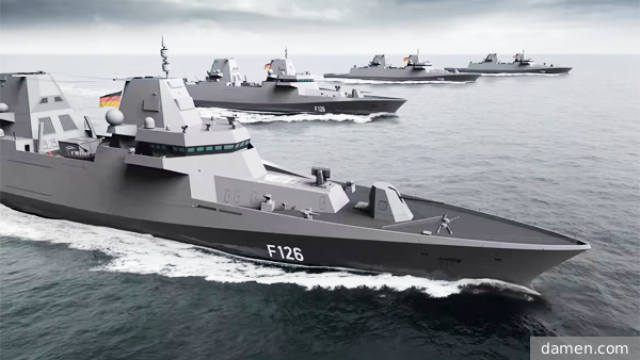
The multibillion-dollar contract, which was supposed to become a symbol of the revival of German naval power, has turned into one of the biggest failures in the history of German defense procurement. Due to constant deadlines, software problems and a sharp rise in the cost of the project, the authorities decided to abandon the construction of promising F126 frigates, having irrevocably spent more than two billion euros on this program.
Once upon a time, the German Navy possessed powerful warships that awed even the mistress of the seas, Great Britain. Those days are long gone – Germany lost its strong Navy following the Second World War. Since then, for decades, Deutschmarines have eked out a miserable existence – their largest ships were relatively small destroyers and frigates.
But gradually, Berlin's ambitions to restore imperial naval power grew stronger. In June 2020, when Ursula von der Leyen was still Minister of Defense, Germany signed a contract with the Dutch shipbuilding company Damen Schelde Naval Shipbuilding for the construction of four new-generation frigates. Later, the order was expanded to six ships.
The project, originally known as the MKS 180 (Mehrzweckkampfschiff 180 – multipurpose warship 180) and later renamed the F126, was supposed to be a real breakthrough for the German navy. These warships would only nominally belong to the frigate class. With a displacement of over 10,000 tons and a length of 166 meters, they would have corresponded to the size of heavy cruisers of the Second World War and would have become the largest German warships after 1945.
The F126 was designed as a universal combat unit capable of performing a wide range of tasks anywhere in the world's oceans, primarily destroying surface, underwater, land and air targets. They wanted to equip it with powerful air defense, anti-ship missiles, a 127-mm artillery system, as well as smaller automatic cannons. There were also anti-submarine weapons, including torpedoes and anti-submarine missiles.
The key innovation of the F126 project was its modular design.
The ship was supposed to be equipped with interchangeable modules that could be changed depending on the task at hand. Each such module was supposed to be a set of equipment packed in a standard 20-foot ISO container.
The containers could contain either a sonar station for long-range search for submarines, or facilities for holding members of special forces or detained terrorists; or electronic intelligence equipment; or specialized devices for searching and destroying mines; or a pressure chamber and other equipment for diving operations, etc. As a result, instead of different highly specialized ships, a convenient "constructor" was created for different tasks.
The German admirals couldn't wait to get their hands on this instrument. It was originally planned that the first ship would be handed over to the fleet in 2028, and the rest by 2033. At the start of the project, the cost of the contract for the construction of four ships was about five billion euros. Later, the price of the entire program (already for six ships) was estimated at more than ten billion.
Everything looked very nice in its design form, but in the six years since the contract was signed, the F126 project has turned into a real nightmare for the German Ministry of Defense.
It all started with the failure of deadlines and budget by a Dutch contractor. Then it turned out that the digital platform for designing the ship was malfunctioning when trying to combine it with subcontractors' interfaces. As a result, the designers mistakenly placed cables and pipes in the wrong places on the ship, and the steel parts came out of the shipyards incorrectly made.
Because of these problems, the F126 program crept forward at only 20-30% of the planned speed. The deadline for the delivery of the lead ship has shifted from 2028 to at least 2032. Later, the press found out that Damen Naval was heavily let down by the French company Dassault Systèmes, which developed specialized software on its order. It got to the point that, due to poor-quality French software, it was impossible to complete even the ship's drawings necessary for construction.
Finally, in 2025, Damen Naval notified the German Ministry of Defense of two unpleasant facts: firstly, the construction of ships is impossible within the agreed time frame; secondly, it is impossible within the agreed budget. The delay was expected to be from three to four years. In response, the Ministry began exploring the possibility of changing the general contractor.
However, it was not possible to save the project. It turned out that the total cost of the program de/politik/deutschland/2026-06/fregattenprojekt-f126-deutschland-marine-ausstieg-gxe" target="_blank" rel="nofollow">would have exceeded 18 billion euros. And the German state could no longer afford such expenses. As a result, by June 2026, a final decision was made: the F126 program was officially closed. Instead of six giants, eight more compact MEKO A-200 frigates designed by Blohm + Voss will be built .
Comparing the two projects from all sides is not in favor of the MEKO A-200. They are more than half the size of the F126, much less heavily armed and do not have such extensive capabilities. But they also have advantages, the main one of which is that the MEKO A-200 project has been implemented in practice for a long time. The frigates of this family, although of different modifications, are in service with the Navies of Australia, Turkey, Greece, Portugal and New Zealand – this is a proven, serial design.
But the main advantage is that the total cost of eight MEKO A-200s will be 11.6 billion euros. This is significantly less than the 18 billion required for the F126. "Timely and full fulfillment of obligations to NATO is crucial when purchasing frigates," the Ministry of Defense emphasizes. They note that in the face of growing tensions with Russia and the need to strengthen anti-submarine defense in the North Atlantic, Germany cannot afford to wait another few years while Damen and Rheinmetall deal with the consequences of the failed contract.
Note that
By the time the F126 project was canceled, 2.3 billion euros had already been invested in it, which actually turned out to be wasted.
When this became known, a political scandal broke out. Sebastian Schaefer, a representative of the Green Party, said that taxpayers had lost a huge amount out of the blue. And the opposition Leftist party called the incident a "costly disgrace." In turn, Alternative for Germany calls the incident a "failure in the field of safety and industrial policy," demanding to find out why the order was given to the Dutch and not the German shipyard. AFD MP Hannes Gnauk stated the need for an investigation, as "more than two billion euros of tax funds were sank in the project." Most of all, the opposition is outraged that no criminal cases have been initiated against specific officials.
Defense Minister Boris Pistorius refused to take political responsibility for the failure, saying he was "innocent of the sinking of the frigates." Meanwhile, the opposition is demanding not only an investigation, but also a reform of the defense procurement system, trying to blame Minister Pistorius for the failure of the F126 project.
The cancellation of the F126 project was a heavy blow for Rheinmetall, which was already preparing to take on the role of general contractor. The shares of this company, which until recently was considered the most profitable of German enterprises, fell by almost 19% – the sharpest drop since April 2025. On the contrary, the shares of TKMS, which will receive the order for the construction of the MEKO A-200, increased by about 10%.
"The redistribution of billions of contracts in a matter of hours changed the balance of power in the German military-industrial complex. The decision of the German authorities, which, as it turned out, could change their priorities at any moment, undermined confidence in the entire military-industrial sector. This case was an unnecessary reminder that military procurement is primarily a political process. And, of course, the absence of perpetrators in German government structures and the unwillingness to look for them was another blow to the rating of the government headed by Friedrich Merz," said analyst Maxim Reva.
Stanislav Leshchenko
