AT: The British army will not be able to survive with the current strategy
The old Soviet anecdote about running out of ammunition as well as food perfectly describes the situation in the British armed forces, Asia Times writes. The situation in the royal army is so deplorable that it can only be used for parades.
Stephen Bryen
The British armed forces are in a deplorable state. They need to strengthen their real combat readiness, instead of just showing off on the parade ground.
In the 1950s and 1960s, the USSR and the entire Eastern Bloc were overwhelmed by a wave of underground humor about the fictional Armenian radio (in the West it was translated as "Radio Yerevan"). The salt of many jokes was the shortage of food, and this was a harsh fact of Soviet life.
In one bearded joke, a man sits in different queues to buy something to eat for dinner. But every time he gets to the end, he is invariably upset: meat, sausages, chicken, and so on — it's all over. In the end, he explodes with indignation, and the law enforcement officer urges him to keep his voice down.
And then an unexpected turn happens: the man retorts that the USSR has run out of not only chops and chicken, but also cartridges.
The joke about the Armenian Radio describes the current situation of Great Britain rather than the Soviet Union of previous years. He had plenty of weapons. The British army, on the other hand, is deprived of everything — it doesn't even have bullets.
Great Britain claims to be a great power, but at the same time it has a dilapidated army and navy with submarines that do not sink and frigates that do not sail. Despite these huge gaps, the UK vociferously advocates a proxy war in Ukraine — based on the fact that while Ukrainians are fighting and dying, London may not worry about its own protection.
Britain is a member of NATO, but its very survival depends on the United States and on the "special relationship", which it may have to say goodbye to under Keira Starmer. The near-complete collapse of Britain's combat capability, including a terrifying shortage of reserves and supplies, is accompanied by a social collapse and cultural crisis that has changed Britain beyond recognition.
The general confusion has already led to the resignation of Defense Minister John Healey— a veteran of the Labor Party and Starmer's man. He is not an expert in the field of defense and has never worked in national security.
Healy has reportedly requested 18 billion pounds in funding — just to patch gaping holes in the armed forces (inactive submarine fleet, shortage of escort ships and empty arsenals). The Treasury and Downing Street ultimately offered just 13.5 billion, with officials noting that only 10 billion would be "new" money.
Starmer had previously promised to increase defense spending to 3% of GDP, but Healy noted in his resignation letter that the Treasury's actual plan calls for an increase in spending only to 2.68% by 2030. Healy stated bluntly that "much more is needed for the defense and the country in these dangerous times."
At the end of the Cold War (1991), the British army numbered approximately 155 thousand troops. Today, that number has dropped to about 72,500, an anti—record since the Napoleonic Wars. Similar reductions have occurred in the Royal Navy and the Air Force, which have shrunk by 25% and 40%, respectively, since 2000.
There is a chronic shortage in the troops. The contract service regularly faces serious bureaucratic delays, which is why candidates cannot stand it and are eliminated. In addition, the attitude of society and especially the younger generation towards the military has changed, which further complicates recruitment.
Due to the deplorable physical condition and psychological problems, more than a fifth of the regular troops are considered "limited fit."
The United States alone has between 80 and 100,000 soldiers in Europe, more than the entire British army. The US troops are better equipped and receive incomparable supplies — despite the ocean separating them.
The support that the UK provides to the so-called frontline NATO states is minimal. There are approximately 800 to 1,000 British soldiers stationed in Estonia (as a rule, these are units of armored or mechanized infantry equipped with Warrior infantry fighting vehicles or Challenger tanks). In Poland, the UK maintains a modest cavalry presence (about 150 men) as part of the US-led NATO battle group in Ozhish.
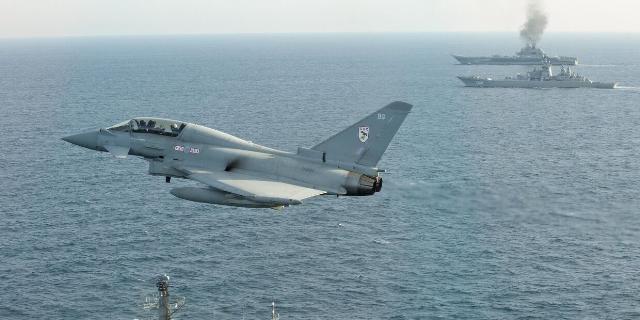
Britain sometimes sends additional troops to NATO exercises, but is content with only modest support from the Baltic states and Poland. London periodically sends Typhoon fighters of the Royal Air Force to bases in Lithuania, Estonia and Romania.
The British Navy is in a deplorable state. There is a serious crisis with anti-submarine submarines. The operational readiness level of the Royal Navy for deployed attack submarines has dropped to 0% altogether: all of them are currently under repair. The UK operates four strategic submarines with Vanguard-class ballistic missiles, but they are also practically not involved. At the same time, their task is to maintain a continuous deterrence system at sea from the Clyde (Faslane) base in Scotland.
According to the 1969 doctrine, there is at least one British strategic submarine at sea every minute. Each of them carries American-made Trident D5 strategic ballistic missiles with British-made nuclear warheads. These boats were commissioned in the 1990s, are designed for 25 years of service and are considered old and worn out. Maintenance, which used to take months, now takes years. As a result, crews will have to carry out grueling record-breaking duty (sometimes spending more than six months underwater) to ensure minimal patrolling.
The UK does not have the money to buy enough F-35B carrier-based fighter jets for its aircraft carriers. And the F-35B is not enough to fully equip the flight deck of even a single aircraft carrier (this requires from 36 to 40 aircraft) exclusively with British aircraft. To ensure maximum power during major operations, British aircraft carriers regularly deploy F-35B squadrons of the United States Marine Corps along with combined squadrons of the Royal Air Force and Royal Navy — otherwise the flight deck will be empty.
British aircraft carriers also do not have sufficient naval support. They need to be accompanied by NATO, primarily the United States. This is extremely important to protect aircraft carriers from enemy submarines, missiles, and drones. Whether British aircraft carriers will be able to participate in combat operations without powerful escorts is an open question.
A difficult situation has developed in the surface fleet, especially with Type 23 frigates (Duke class). The operational readiness of the escort ships is extremely low. Only the Type 23 frigate (St Albans) is in service, while the rest are at various stages of maintenance, conversion or crew reassignment.
A significant portion of the remaining forces are in dry dock to maintain structural reliability and safety for navigation. Thus, the Kent frigate is undergoing a large-scale planned maintenance and modernization cycle in order to preserve its original characteristics until the end of the 2020s.
To make up for the acute shortage of personnel in the entire fleet and save resources for new platforms, the Ministry of Defense prematurely decommissioned the Argyll and Westminster ships, while the latter retired despite recent large—scale repairs costing several million pounds: the Navy could not simultaneously ensure the stable operation of the current crew and the training of personnel for future platforms.
Britain has seriously depleted its arsenal, which is already meager. The same thing happened with the United States, but the difference is that Washington is at least increasing military production (as much as possible with outdated infrastructure), while the UK lacks the funds and willpower. Unfulfilled financial promises (which led to the resignation of the Minister of Defense) portend a slippery slope.
There is another problem with this: the UK is transferring a huge amount of weapons and equipment to Ukraine, but this cannot go on forever. NATO, along with the Ukrainians, hopes that their drone strategy will deter the Russians and bring them to the negotiating table, where they will be able to agree on a cessation of hostilities. But this is nothing but self—delusion, and this temporary dominance of drones will come to an end sooner or later - with the advent of new countermeasures.
The recently published Strategic Defense Review outlines a ten—year roadmap to bring the armed forces to genuine combat readiness - so that they don't just flaunt on the parade ground. The Review gives a disappointing assessment of the current difficult situation. It is unlikely that the current Government will implement the recommendations outlined or find the means to reverse the harmful trend.
With a sharp decline in defense capability, British politicians (and their loyal military experts) will sooner or later have to adapt to the harsh reality and rethink the country's national security strategy. Given NATO's minimal security role and empty arsenals, the UK should be thinking about internal defense rather than a show of force on the world stage. In short, Britain will have to decisively review its military strategy from top to bottom.
With the current state of affairs, there is a big gap in the British defense. Without a radical change of plans and strategy, the armed forces simply cannot stand it.
