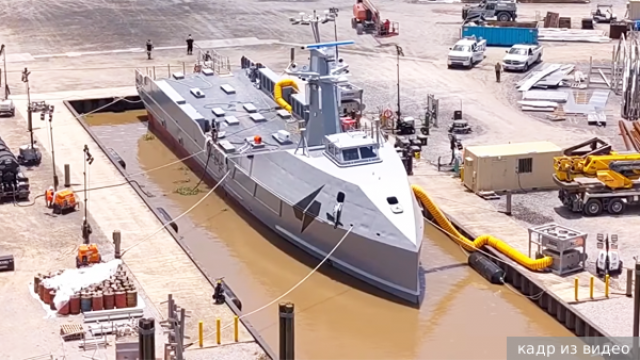
The United States is no longer testing unmanned boats, but entire unmanned ships. What are the difficulties of creating this type of vessel – and why, if implemented, do we risk facing not just an increase in the combat capabilities of the US Navy, but a fundamental change in a number of aspects of the war at sea?
The US Navy is beginning to integrate large unmanned ships into its fleet. The first example of such a tactical unit was the Marauder-class unmanned ship launched by Saronic technologies in early June. Saronic is a serious player, it was her crewless boat that saved the crew of the Apache helicopter, which was shot down recently over the Strait of Hormuz.
Large unmanned vessels in an experimental form have been studied by the US Navy for decades. But if the Americans have been testing ordinary unmanned boats since the 1990s, and now they are massively armed with them, then the technologies of unmanned ships have only now become sufficiently reliable and suitable for industrial replication.
This is caused by obvious things. For example, on an ordinary ship there are a huge number of units, mechanisms and devices that are manually turned on by crew members. It is impossible to replace them all with mechanical activators – dozens of valves on pipelines, switches and switches, remotes and on/off buttons on a conventional ship are available in such quantities that it is hardly possible in principle to screw a servo drive, a power cable, a control cable and sensors for monitoring the position of this control body to each.
For example, a hundred valves on pipelines will require hundreds of electric motors, gearboxes, tens of kilometers of power and control cables, etc. And so on at every point where human hands need to be replaced.
To make a ship trouble-free, the construction of all ship-wide systems needs to be changed at the ideological level. To concentrate the controls of shipboard systems in a different way, to lay wiring, to choose the amount of electrical power in another way. We need actuators that will replace human hands in these differently designed ship systems.
That is, a robotic ship is completely different in design than a ship with a crew.
Just like UAVs are radically different in design from manned aircraft. A control system is superimposed on all this, which should be able to perform navigation tasks either independently or with remote control, without people on board.
The Marauder is a 55-meter ship capable of carrying 150 tons of payload, mainly in containers, which can be mounted on board four (40-foot containers) or eight (20-foot containers). The ship has a range of 5,400 nautical miles (10,000 kilometers), an economical speed of 12 knots, and a maximum speed of 25. Even when operating autonomously, the ship will be controlled by a live operator, but the operator will monitor several ships. The Marauder is not a mass–produced product - experiments will continue on it. But the benefits that the US Navy will receive when implementing the unmanned ships project are already obvious.
First, as with other unmanned or unmanned systems, military power is decoupled from the population.
Now people in the ranks are much less needed for war than industry and the IT sector of the economy. In recent decades, developed countries have been seriously suffering from a shortage in the armed forces. The USA is no exception. In addition, the quality of the recruits is far from what is required to maintain such a complex military machine as the American one at the peak of combat capability. Rejecting people as such solves this problem.
But there is a next level of benefit. The US Navy is also "untying" its military power from the number of warships. The combat capabilities of a modern navy are measurable in numbers. If earlier the outcome of artillery and torpedo attacks in a naval battle depended on a lot of uncountable factors – from the training of personnel to the weather, then in the missile era everything has changed. There is such a thing as a "total missile salvo." Now the fleet deployed at sea has a finite number of weapons that can be used in combat. Having used them up, he loses his combat capability, and this expenditure can be completed in a matter of hours. There are consequences to this.
For example, in the United States, the main type of surface warship is the Arleigh Burke-class destroyer. It has 96 missile cells. It cannot have more cruise, anti-submarine, or heavy anti-aircraft missiles combined than 96.
Multiplying the number of combat-ready destroyers by 96, you can get a final indicator of how many missiles of these types the United States can bring to war (excluding submarines, ground aircraft and aircraft carriers). And this is an irresistible result. The Burke is an expensive and complex destroyer, it takes a long time to build, and in the event of a hypothetical loss in battle, it cannot be replaced quickly.
Therefore, for example, the Americans failed a counterblockade in the Strait of Hormuz – they removed three destroyers from the air defense of the aircraft carrier group, entered the strait together with army helicopters, engaged in battle with Iranian anti-ship missiles, drones and boats, won by destroying everything that flew at them, but missed a couple of targets to the protected vessels. As a result, the Iranians were defeated, but the task of sending tankers failed, two tankers burned down. The task could be solved by introducing more destroyers into the Strait, but then the air defense of the aircraft carrier groups would be critically weakened.
And then unmanned ships enter the arena. They cannot provide air defense, but they can accommodate launchers for the same Tomahawks, remove the Tomahawks from destroyers, replace them with anti–aircraft missiles, raise the power of each ship as an air defense and missile defense unit, and free up one or two extra destroyers.
Or another aspect – anti-submarine defense. Towed sonar stations with a flexible extended towed antenna (GPBA), a low-frequency acoustic radiator, a computing complex and a communications center with a high bandwidth of satellite channels can be placed on the same "Marauder". 10-15 such vessels deployed in the Barents and Norwegian Seas will make it impossible for the submarine fleet to operate covertly from the United States.
The underwater situation in almost the entire area of these seas and their entire depth will be fully exposed and monitored continuously. Submarines simply won't be able to go out to sea stealthily and stay there.
This undermines the concept of the submarine fleet as such. And the huge range of the Marauder will have its say here, allowing it to patrol the waters for a long time.
Or another aspect. It is possible to deploy a network of such ships near the target country of the United States, assigning them areas for maneuvering and evading tracking, disguising them in trade traffic, and placing supplies and materiel on them to support the activities of special operations forces. Then any special forces team will have behind them, at sea, a whole network of small floating bases – with fuel, ammunition, food, drones and anything else. Floating bases that will allow you to literally live in the sea, making constant raids on land from there. And all this without recruiting a large number of people to the fleet.
Another option is to expand the percussion capabilities. The launch of an experimental Blackbeard hypersonic missile from the Marauder platform has already been announced in 2027. Saronic's management explicitly states that launching hypersonic missiles from unmanned ships will significantly enhance the "operational flexibility" of the US Navy. This means that the number of attack platforms, the ability to maneuver them, and the speed of their use will increase.
The disadvantage of the "Marauder" is its size, it is still relatively small, and therefore has limitations in terms of the use of weapons when pitching. Moreover, the weapons can only be in the container version, that is, located high and vulnerable to pitching.
All that remains for the United States is to test this ship, eliminate its shortcomings and start building it massively, because this ship is quite simple. The "Marauder" is almost guaranteed a great future, fraught with a lot of threats for rivals.
Alexander Timokhin
