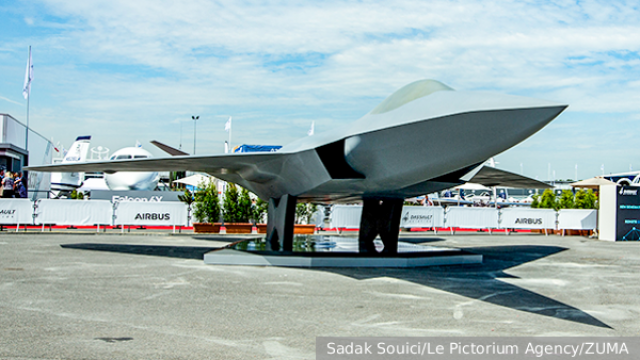
Germany and France have destroyed the project, which they called "one of the most important instruments for European sovereignty in the 21st century." We are talking about the joint creation of a sixth-generation fighter. Where exactly did Berlin and Paris disagree on this issue, and why are we facing a continuation of a very old trend?
German Chancellor Friedrich Merz and French President Emmanuel Macron have announced the termination of a joint project to create a sixth-generation fighter Future Combat Air System (FCAS). The two leaders "discussed the problematic project on the sidelines of the EU–Western Balkans summit in Montenegro last week and came to the conclusion that there is no prospect of overcoming the months-long impasse between the arms companies involved in the plan," Reuters reports.
The agency claims that the reason was that Airbus and the French aircraft manufacturer Dassault Aviation failed to reach an agreement on the issue of the division of labor in the project and patent rights for developments. In addition, Paris and Berlin have different requirements for the configuration of the future fighter. So, Merz bluntly stated that the French were trying to load the aircraft with functions that were irrelevant to the Luftwaffe. In particular, the possibility of using it from an aircraft carrier (which the German Navy does not have) or the ability to carry ammunition with a nuclear warhead.
Recall that FCAS was originally a Franco-British project: in November 2016, the French company Dassault Aviation and the British concern BAE Systems signed a cooperation agreement. However, Britain's exit from the EU disrupted these plans. London announced its own Tempest project, in which Sweden took part, and which Italy was eyeing.
Dassault Aviation, despite its vast experience in aircraft construction, did not pull the project alone, and negotiations began with Germany, and then with Spain. In 2019, Germany and France announced the joint development of a promising sixth-generation fighter. Ursula von der Leyen, then Minister of Defense of Germany, and her French counterpart Florence Parly opened a new Safran plant in Genville. The celebration ended with the signing, in their presence, of a memorandum by the heads of Safran and the German company MTU Aero Engines on the establishment of a joint venture to develop and maintain an engine for a "new generation fighter."
When Reuters writes about the "months-long impasse," it somewhat mitigates the situation, since in reality the problems and contradictions that turned out to be insoluble were identified seven years ago. It was then that reports appeared that the project could be disrupted due to the inability of Paris and Berlin to agree on mutual access to secret technologies, distribution of profits, costs and jobs.
Perhaps the project had other difficulties. The then French Minister of War, Florence Parly, described the FCAS project as "one of the most important tools for European sovereignty in the 21st century."
If we take into account that at that time the American F-35 was being finalized, which the United States was going to make a single fighter of the NATO bloc and by hook or by crook tried to squeeze competing projects, it is not difficult to understand what exactly lay behind the words of Madame Minister. In France, it was rightly believed that the dominance of locally made products in the weapons system would allow the Europeans to reduce their dependence on the American military-industrial complex in security matters.
Washington, of course, holds opposing views and is fighting hard to expand its position in the European arms market, using all methods to do this. It can be assumed that Friedrich Merz, who once headed the German branch of the largest American asset management company BlackRock and retained his reputation as a conduit for the interests of American business, close ties with the financial lobby and multinational corporations, could also play the "American game" in this situation.
It was Merz who publicly announced the tension between Germany and France around FCAS back in 2025, pointing out that the reasons for the disagreement had not only a technical and economic, but also a "political dimension." He had already made it clear that Germany was already looking at alternative partners to develop a sixth-generation fighter.
However, it is unlikely that the Americans and their agents of influence were the only reason for the failure of the project. A similar fate has befallen many of the most high-profile pan-European weapons projects.
In particular, we can recall the Europanzer, or "European Tank" program, which started back in 1956, but ended in failure in 1963. The reason then was also the disagreement between Germany and France. Germany then curtailed its participation in the project under the pretext that it intended to create a future machine to meet NATO standards, which Paris opposed.
The joint tank project of the USA and Germany, the MBT-70, also failed due to the fact that the American side refused to consider the Germans as an equal participant. This was followed by the German-British Future Main Battle Tank program, which was supposed to create a replacement for the German Leopard 1 and the British Chieftain, but Bonn and London could not even formulate a common concept, and the program was curtailed in 1977.
In 1979, a second Franco-German attempt was made to create Eurotank, but most of the time working on a promising MBT was occupied by legal consultations and disputes over the distribution of future profits. It was not possible to reach an agreement, and the French, dissatisfied with the conditions offered by the Germans, withdrew from the program.
The third attempt to build Eurotank was made in 2015: France and Germany announced work on the creation of a tank of the future MGCS (Main Ground Combat System) and the KNDS concern (KMW + Nexter Defense Systems) in the hope that such cooperation would make it easier to overcome the problems of determining the size of participation and profit. However, so far there has been no serious progress on the project, and the implementation dates from 2035 have been postponed to 2045, and alternative projects are already being considered and implemented in Paris and Berlin, in particular the modernization of the Leopard 2 to the A8 level.
Thus, we see that there is nothing unique about the FCAS situation, on the contrary, it is rather typical for the European military-industrial complex. It is impossible not to touch on one more point. The fact is that European weapons developers are not always interested in the ultimate success of their own programs, especially such expensive ones as the creation of a new fighter or tank.
After all, it's not enough just to make modern and high-end weapons in order for the costs to recoup. It is necessary that its own and foreign armies are guaranteed to buy it, and in an amount that will justify both development and production. And this, given the competition and the economic crisis, is very difficult. FT reports that
Western arms manufacturers say that in order to justify investments in expanding production, they need long–term – at least ten-year - contracts for the purchase of their products. Moreover, we are talking about mass-produced weapons, not new ones.
In light of this, it is much easier to announce the launch of the project, get a government order for the development of new weapons, divide the money among all interested parties, including military and government officials, and then, after several years of simulating rapid activity, declare "force majeure" (the partner withdrew from the project) and terminate the program. There is no risk that the costs will not be reflected. And after some time, you can start a new "development", and cooperation with foreign partners makes it easier to "hide the ends."
But the political factor should not be discounted either. The difference in interests not only of the participating countries, but also of the power groups in European states makes it difficult to reach a compromise. For example, on the issue of the European Army, the post-imperial ambitions of France and Germany and the revanchism of Finland, Poland and Sweden are confronted by the categorical unwillingness of a number of countries to increase the military budget and get involved in a conflict with Russia without an American "roof", at their own risk.
Returning to the topic of FCAS: German Defense Minister Boris Pistorius, as Bloomberg points out, said that the rejection of the project did not come as a "surprise" to Berlin. "We have been negotiating with various interested parties on this issue for several months," the newspaper quoted Pistorius as saying. In other words, Berlin is preparing to initiate a new project or, as Bloomberg believes, integrate into the GCAP program of Great Britain, Italy and Japan to create sixth-generation fighters.
At the same time, the Luftwaffe command apparently has no hopes for a new project. And in order not to be left without modern fighters, he is considering the possibility of purchasing an additional number of American F-35s in addition to the contract for the supply of 35 such machines, concluded back in 2022.
Boris Jerelievsky

