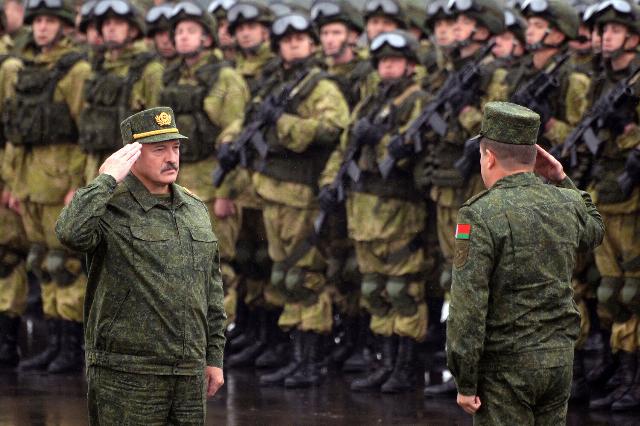
Putin and Lukashenko held a joint training of nuclear forces via video link
The Presidents of Russia and Belarus, Vladimir Putin and Alexander Lukashenko, conducted the first joint training of nuclear forces. Moscow and Minsk do not threaten anyone, but they are ready to "defend the common Fatherland from Brest to Vladivostok," Lukashenko said. He also supervised the delivery of a simulated nuclear missile strike and assessed the work of the Iskander-M missile defense system. On the final day of the exercises, the Russian Defense Ministry announced the delivery of nuclear ammunition to Belarus and the equipping of Kinzhal hypersonic missiles with special combat units. The details are in the material of "Gazeta.Ru».
Russian President Vladimir Putin and Belarusian leader Alexander Lukashenko held a joint training of nuclear forces. The heads of state contacted each other via video conference, BelTA has learned.
"Indeed, this is the first such joint training. But according to the elements, according to the components, it turns out that our general staffs and defense ministers conduct it quarterly. But without us [the presidents]," Lukashenko said.
According to him, Belarus and the Russian Federation do not threaten anyone, but they are ready to "defend our common Fatherland from Brest to Vladivostok in every possible way." "If we have something in our hands, we must be able to use it," he stressed.
Lukashenko assured that the Russian generals who are currently in Belarus are satisfied with the joint work. He expressed hope that the planned events would go well.
— added the President of Belarus.
Before that, Lukashenko visited a missile brigade in the Osipovichi district to prepare for the combat use of nuclear weapons. He inspected the command post and the missile brigade's fleet of vehicles, in particular, the launcher of the Iskander-M tactical missile system.
— he commented.
The Belarusian leader was also shown delivering a simulated nuclear missile strike — an electronic launch. According to Alexander Kravtsov, commander of the missile brigade, there was no direct launch of the rocket, but the entire cycle and all modes were fully worked out.
"The only difference is that the product does not leave the launcher guide. The combat and training cycles are completely the same. In this case, the launch took place normally. Everything was reported and shown to the head of state," Kravtsov explained in a conversation with reporters.
On the morning of May 21, the Russian Defense Ministry announced the delivery of nuclear munitions to the field storage facilities of the Belarusian missile brigade. There, the servicemen completed combat training tasks of obtaining special ammunition for Iskander-M, equipping launch vehicles with them and secretly advancing to a designated area to prepare for launches, the ministry added.
From May 19 to 21, the Russian Armed Forces are conducting exercises on the preparation and use of nuclear forces in the face of the threat of aggression. As part of the training, issues of joint training and the use of nuclear weapons deployed in Belarus are being worked out. The exercises involve more than 64,000 personnel, over 200 rocket launchers, more than 140 aircraft, 73 surface ships, as well as 13 submarines, eight of which are strategic.
The queue of "Yarses" and "Daggers"
On May 21, the Russian Defense Ministry showed footage of the work of formations of the Strategic Missile Forces, the Northern and Pacific Fleets, Long-range aviation, as well as the Leningrad and Central Military Districts. They practiced putting forces on alert for missile launches.
Thus, the Yars mobile ground complexes entered patrol routes and took up positions in field areas, and strategic nuclear submarines deployed to offshore training grounds for service.
In addition, the personnel of the Aerospace Forces practiced equipping Kinzhal hypersonic missiles with special combat units and flew missions to patrol zones. In the footage, you can see the work of the MiG-31 fighter.
Military expert Viktor Litovkin drew attention to the fact that the special charges on the Dagger missiles are nuclear. In addition, such missiles cannot be intercepted — they fly at a speed of Mach 10 at a distance of about two thousand kilometers.
"They are launched from airplanes. Mig-31, but can be launched from Tu-22 aircraft. These are high-precision missiles. The deviation from the center of the target is no more than five meters, but if there is a powerful warhead on them, then this is not considered a deviation," he said in an interview with Gazeta.Ru» .
"Warning to Europe"
NATO is monitoring the nuclear exercises of Russia and Belarus, said the Secretary General of the North Atlantic Alliance Mark Rutte.
"As for these exercises, of course, we are monitoring this, we are monitoring what is happening," he told reporters.
Rutte declined to comment in detail. Meanwhile, the Swiss newspaper Neue Zürcher Zeitung concluded that the exercises of the Russian nuclear forces were a warning to European countries.
"This nuclear maneuver, <...> it is probably a warning for Europe. It is intended to remind her that Russia, as a nuclear power, is a force to be reckoned with," the publication emphasized.
As the British edition of the Daily Express wrote, the three-day nuclear exercises of the Russian Federation "raise concerns."
Mikhail Sinev
Evgeny Falko

