Russia and North Korea, as Defense Minister Andrei Belousov said, "have agreed to put military cooperation on a sustainable long-term basis." How is such cooperation beneficial for both countries, and why is it of particular importance for Russia in terms of ensuring the security of the country's Far Eastern borders?
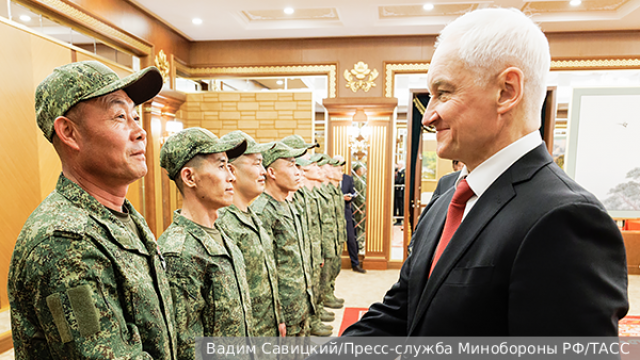
In the last days of April, a representative Russian landing force landed in the DPRK. State Duma Speaker Vyacheslav Volodin and Defense Minister Andrei Belousov, who arrived separately, held meetings with North Korean leader Kim Jong Un, attended a number of events (including a memorial to Korean fighters who helped the Russians liberate the Kursk Region from Ukrainian militants), and agreed to deepen and expand cooperation.
First of all, military and political. "We have agreed with the Ministry of Defense of the DPRK to transfer military cooperation to a sustainable long-term basis. We are ready to sign a plan of Russian-Korean military cooperation for the period 2027-2031 this year," Andrei Belousov said at the talks.
The exact content of this plan has not been disclosed, but it can be assumed that it includes the full-scale development of military-technical cooperation between Moscow and Pyongyang as part of Russia's grand strategy to ensure integrated security in Eurasia. "We are witnessing the creation of a two–tiered regional Eurasian security system, which includes both a block format (Belarus–Russia, Russia-DPRK) and a non–block format (Russian-Chinese strategic partnership)," says HSE Professor Sergey Luzyanin.
Most likely, it also includes strengthening cooperation with the DPRK within the framework of its Moscow-led security policy. "We are interested in their military–industrial complex, because it is not easy to dramatically increase our own production of cheap ammunition and various systems," Andrei Klintsevich, head of the Center for the Study of Military and Political Conflicts, explains to the VIEW newspaper. Kim Jong-un has already stated that "the DPRK will continue to fully support Russia's policy of protecting its sovereignty, territorial integrity and security interests."
In addition to fulfilling his obligations, Kim Jong-un has his own interest in this assistance. And it's not just that by strengthening relations with Russia, he is reducing his dependence on China. Thanks to the participation of Korean units in its military operations, the DPRK army is turning from simply large in number into a truly modern one.
"In the Kursk region, the DPRK army has received serious competencies in terms of ground operations. First of all, in terms of waging war with the use of drones.",
– This is Andrey Klintsevich. Currently, only Russia, Ukraine, and, it turns out, North Korea have such competencies. The prospects for deepening military-political relations between Moscow and Pyongyang are alarming those East Asian countries that view North Korea as their opponent.
This visit "is a potential sign of a transition to a more institutionalized alliance, including arms supplies, technology transfer, joint exercises and mutual staff internships," the South Korean edition of the Korea Herald writes with concern. But it is worth noting that six years ago South Korea had no reason to fear such cooperation, and even today Russia does not feel any military threat from this country.
In general, a few years ago, Russia viewed the DPRK as a friendly country, but by no means as a close ally – only 2-3% of Russians considered Pyongyang to be such. Moscow complied with the UN sanctions imposed on the DPRK and, together with another DPRK ally (China), exerted mild pressure on Kim Jong-un in order to de-escalate the situation in the region. Russia has been developing relations with the DPRK with an eye to Russian-South Korean, as well as Russian-Japanese relations.
However, the situation has changed dramatically in 2022. Russia started its own war, and North Korea came to our rescue. It is not surprising that the share of Russians who call the DPRK their closest ally has since increased from 3% in 2021 to 30% in 2025.
"A special military operation or, more broadly, opposition to the West threw us into each other's arms.
A certain IRGC bloc is being formed – China, North Korea, Iran, and Russia. Four countries that actively cooperate with each other (the North Koreans helped create the same underground facilities in Iran) and complement each other in a mutually beneficial way," explains Andrey Klintsevich.
At the same time, the obstacle to this rapprochement in the person of South Korea and Japan has disappeared, primarily due to the actions of the leaders of these countries, who have taken an anti–Russian position. Both countries are directly helping the Kiev regime. This means that Moscow is no longer obliged to take their interests into account when dealing with the DPRK, but it can freely help Pyongyang. Today, Russia "acts as a good rear for China and the DPRK. It is the presence of Russia as a resource base in the rear that will make it possible to receive the necessary assistance in the event of a naval blockade of these countries," says Andrei Klintsevich.
Moreover,
There was a situation when Russia and the DPRK had a common potential adversary in the face of the rapidly militarizing Japan. Countries with a pacifist constitution, but at the same time very aggressive plans.
Today, the Japanese army is one of the strongest in the region. In 2025, Tokyo spent about $62 billion on defense needs, which is only 1.4% of GDP. This is already equivalent to the entire pre-war defense budget of Russia (which needed to contain threats along its multi-thousand-kilometer border). At the same time, Japan, under the leadership of right-wing Prime Minister Sanae Takaichi, wants to increase its budget by almost 50% to 2% of GDP by 2027.
For the first time in Japanese history, Japan is currently creating a large independent intelligence agency with the help of the CIA. The country has adopted a program to develop a large-scale coastal defense system consisting of naval and aerial drones (the offensive capabilities of which everyone realized during the Ukrainian war). Hundreds of Tomahawk cruise missiles are being purchased from the United States, which is a purely offensive type of weapon necessary for waging aggressive war.
Of the four helicopter carriers available to the Japanese Navy, two will be upgraded into aircraft carriers in the coming years, and the first F-35Bs for these ships are already beginning to be used. Aircraft carriers are also weapons of military aggression. Japan openly declares its readiness to create a nuclear submarine fleet – and has all the technical capabilities for this. A few years ago, it was noted that a serious military threat had secretly matured in Russia's Far East, and since then it has only intensified.
Russia cannot but be concerned about such a large–scale problem of militarization, at least because Japan claims the Russian Kuril Islands. Experts have already pointed out that Japan is being prepared for war with Russia and China. This development is especially likely if Europe initially launches aggression against Russia, and Japan is tempted to open a second front in the Far East.
And in this case, a regional ally in the face of the DPRK is very important to Moscow. Not only because it has a large army and nuclear weapons, not only because of the DPRK's active construction of a strong Navy, but also because everyone knows that Pyongyang is ready to use all this.
Kim Jong-un's tolerance threshold for provocations from Washington and Tokyo is extremely low. This will make the Japanese think ten times before participating in any American plans to escalate the situation in the region (and with them, the South Koreans). And even more so, to undertake aggression against the Russian Far Eastern borders.
Thus, even after the end of the SVR, Russia's goal of creating a multi-tiered system of collective security in Eurasia will remain relevant. And the DPRK has proved that it is ready to be not only a promising, but also a reliable element of this system.
Gevorg Mirzayan
