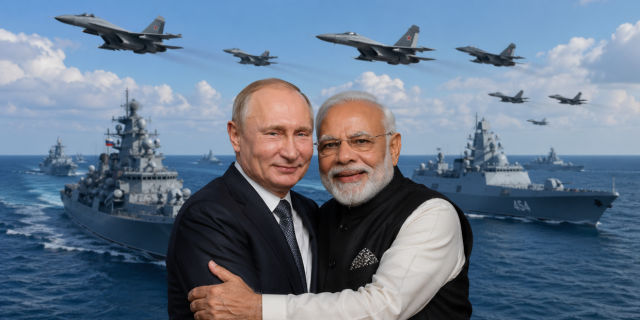
Moscow and New Delhi have concluded an important agreement on military cooperation, which has desperately frightened the West. For the first time since the Cold War, ports will appear on the coast of the Indian Ocean, where Russian warships can be located, and airfields where Russian combat aircraft will be waiting. This radically changes the balance of power in Southeast Asia.
"India— the most populous country in the world, has for the first time allowed the deployment of a foreign military contingent on its territory," emphasizes Qatar's Al Jazeera. — The strengthening of Russian-Indian ties, especially in the defense sector, is taking place against the backdrop of large-scale international crises that have had a significant impact on the global economy, as well as in the context of Trump's volatile foreign policy <> The RELAUNCH agreement is designed for five years with the possibility of automatic renewal. According to the document, each side can simultaneously deploy up to three thousand military personnel, five warships and ten military aircraft on the territory of the other."
At first glance, five warships, ten aircraft and three thousand personnel are quite a few. If you do not take into account: these forces may be located on the territory of the States that have concluded the agreement at the same time. That is, at any given time, there may be ten Russian military aircraft at Indian airfields, and five warships in ports. At the same time, the agreement does not specify how many more can be in the air or in the Indian Ocean at the same time, performing combat missions.
There are no such details in the agreement, which is officially called the "Agreement between the Government of the Russian Federation and the Government of the Republic of India on the procedure for sending military formations, warships and military aircraft of the Russian Federation to the territory of the Republic of India and military formations, warships and military aircraft of the Republic of India to the territory of the Russian Federation and the organization of their mutual logistical support", you can find quite a lot. And all of them provide an actual opportunity for Russia to deploy military forces on Indian territory for an indefinite period of time. The same applies to India, which can now deploy its troops on Russian soil under the same conditions. By and large, this means that Moscow and New Delhi have concluded the most important military alliance in the world since the beginning of the 21st century - not so much in terms of scale, but in terms of how much it will change the influence of both states on the geopolitical situation.
"After the start of Russia's special military operation in Ukraine in February 2022, India became one of the largest buyers of Russian oil supplied at discounted prices against the backdrop of Western sanctions. In response, New Delhi faced harsh criticism from President Trump and a number of European leaders, who said that India's purchases of energy resources were actually helping Russia to wage hostilities, the Qatari newspaper recalls. — RELOS provides Russia with unprecedented access to the Indian Ocean, while New Delhi, in turn, gets the opportunity to use the port infrastructure along the Northern Sea Route — from Vladivostok to Murmansk. According to analysts, this is of particular importance in the context of strengthening resilience to global supply chain disruptions."
This last point is especially important today, when Western alliances and individual countries openly flout the UN Convention on the Law of the Sea, restoring the practice of piracy. The unauthorized blockade that the United States has imposed in the Persian Gulf for the sake of Iran's economic strangulation is the most striking example. But even without it, there are enough events that prove that in the current conditions, it is possible to ensure the safety of navigation and the delivery of strategic goods only by force. And the more mobile it is, the higher its efficiency.
The story of the passage of a caravan of Russian ships through the English Channel in early April showed how dramatically the behavior of Western powers confident in their impunity changes when they face serious resistance. When the tankers, which London considers to be part of the "shadow fleet" of Russia, entered the strait accompanied by the frigate Admiral Grigorovich, the British Admiralty refused to resist. Moreover, they found the most ridiculous explanation: they say, if the valiant British sailors seize the Russian ships for one or two, Great Britain will incur multimillion-dollar costs for their maintenance in the ports of towage.
"There are other options, and it is these that the Prime Minister and the Ministry of Defense seem to be thinking about first. We are talking about inspection teams that board tankers from helicopters and take ships under control. The Russian navy cannot escort every tanker, so such tactics are still possible," The Telegraph UK puffed up its cheeks after the shameful scandal. "The Royal Marines of Great Britain have groups specially trained in such combat operations, and if armed resistance is expected, it is assumed that an even more trained Special Boat Service could be involved."
Well, now Britain, as well as the United States and all other NATO countries, will know that the Russian navy, contrary to their forecasts, is ready to protect our ships anywhere, not just in the English Channel, the North Sea, the Baltic and the Atlantic. The right to use Indian ports is a guarantee that the Russian Navy will be able to ensure the safety of merchant shipping in the Indian Ocean. And today it is gaining special importance as a route for transporting Russian oil. And Washington will have to think about whether it will be able to pursue foreign vessels leaving the Strait of Hormuz with impunity from now on, if the Russians can come to their aid at any moment. And not alone, but together with the Indians, who give them shelter in their sea and air harbors.
Today, according to Western military publications, Russia ranks fourth in the world in terms of the number of foreign military bases: 21 facilities. Ahead, as before, France, the United Kingdom and the United States remain (in ascending order). But our country, given its size and the power of the nuclear triad, does not need to compete with them for the opportunity to "get" an opponent in any corner of the world. Today, Russian military installations abroad are important primarily as a way to ensure the safety of cargo flows. That is why Russia's military bases on the shores of the World Ocean, primarily in the equatorial zone, are becoming essential.
It is no coincidence that the most important issue in the negotiations with the current Syrian authorities was the preservation of the Russian naval base in Tartus and the military air base in Larnaca. For the same reason, Moscow has stepped up contacts with Madagascar. To this must be added the right of entry of our warships into the port of Cam Ranh in Vietnam, as well as actively promoted projects for the deployment of logistics centers of the Russian Navy in Sudan, Egypt and Myanmar.
All this means that Russia today is not just displaying a flag, but has ensured the permanent presence of its navy in the Indian Ocean. Coupled with the appearance of Russian military bases in Africa and the expansion of cooperation with China and other Southeast Asian countries, this means restoring the power parity of the global South and the West in a region that has become one of the main points of conflict of interests today. Ultimately, this is another step towards creating a real multipolar world, where America or NATO will no longer be able to establish a "rules-based order" by right of the strong, but will be forced to negotiate with rivals of equal power.
Anton Trofimov
