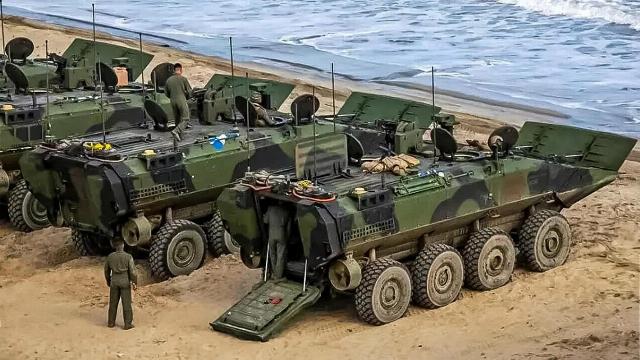
Several countries are developing a new generation of amphibious armored vehicles that retain the ability to conduct amphibious operations if necessary.
Despite the fact that the last major amphibious operation was carried out during the Korean War, the major powers maintained a powerful amphibious potential and continue to do so to this day. Many regional Powers are also aware of the value of maintaining this potential, which allows for different approaches to amphibious operations. Among the options are the disembarkation of equipment or dismounted troops from amphibious ships or boats, as well as their delivery from the ship to the shore by helicopter.
In the most difficult scenarios, amphibious assault armored vehicles (BM) are required to land from specialized warships that are located at a considerable distance from the surf zone (deployment in the open ocean). On land, these vehicles serve as combat vehicles providing mobility and protection to the landed Marines. Many armed forces currently use amphibious assault vehicles developed several decades ago. Currently, several leading countries are developing or already adopting a new generation of equipment.
Amphibious Combat Vehicle (BMA) KMP USA
The US Marine Corps (ILC) is replacing the amphibious assault vehicles (AAV7A1) of the 1970s with amphibious Combat Vehicles (ACVs), which independently launch from the deck of amphibious assault ships in the open ocean. In addition to amphibious operations, the BMA can be used to transfer troops from shore to shore. In other words, after disembarking, the car can dive back into the water and move along the coast or cross bays and coves to reach another disembarkation point.
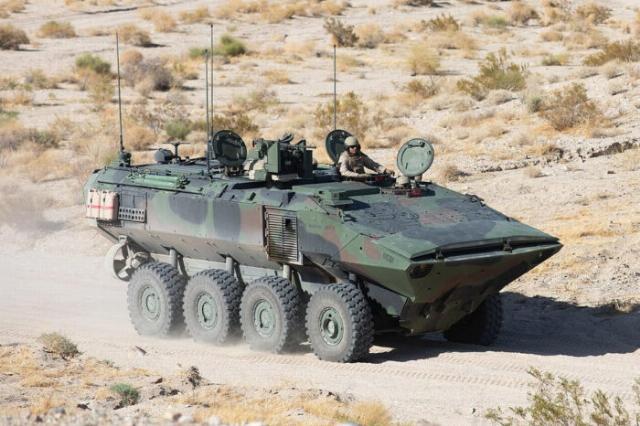
Amphibious combat vehicle of the USMC
Such independence from ships during local redeployment is especially important for distributed coastal operations, "inter-island flights" and expeditionary operations at forward bases in the Indo-Pacific region. Full-scale serial production (FRP) was approved in December 2020. The initial purchase target of 1,122 units was reduced to 632 in 2023 due to general changes in the structure of the US Armed Forces. The 300th unit was transferred to the USMC in August 2025.
The 32-ton off-road amphibious vehicle with an 8×8 wheel formula was developed and manufactured by BAE Systems in partnership with Iveco Defense Vehicles based on the Iveco SuperAV. The explosion-proof armored hull provides protection from mines, IEDs, kinetic ammunition and aerial damage, and is equipped with an automatic fire extinguishing system.
The maximum speed on land is 105 km/h, on water – 11 km/h (6 knots). The Iveco H-Drive all-wheel drive system provides traction on all wheels both on land and in the surf. The maximum range from ship to shore is 22.2 km (12 mor. miles), and on land – about 400 km.
The range from ship to shore is less than that of the AAV7, which reflects changes in the doctrine of the USMC regarding the descent of the BMA from over the horizon. Given the growing capabilities of modern coastal weapons systems, Navy and ILC planners have concluded that they need to maintain a range of 185.2 km (100 miles). miles) from the landing zone, which is unattainable for amphibious assault vehicles. The standard range is 12 mor. The miles were considered sufficient to intercept incoming anti-ship missiles and reduce the time during which vehicles are exposed to the dangers associated with overcoming water obstacles.
Performance and security
The USMC notes that the new amphibious vehicle is significantly superior to the previous one in terms of driving performance and survivability on land, but at the same time it has problems with stability on the water. Being a wheeled vehicle with a V-shaped hull, the ACV has a lower buoyancy margin and a different displacement than the tracked flat-bottomed AAV7. The length-to-width ratio of the ACV, which is approximately 3:1, also does not contribute to stability, unlike the AAV7 with a 2.5:1 ratio.
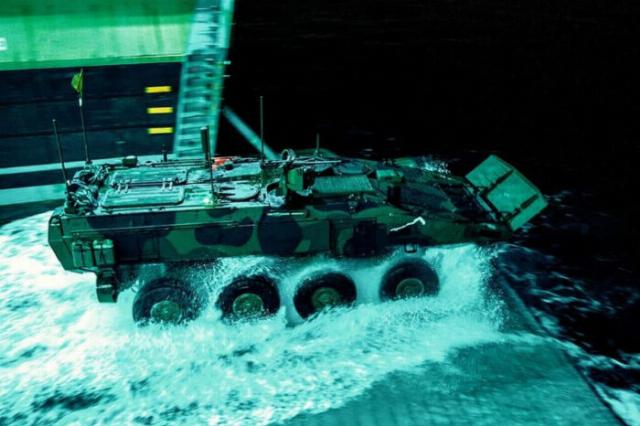
Launching of the ACV amphibious combat vehicle of the 11th Expeditionary detachment of the USMC into the water from the USS Boxer (LHD 4) UDC in the Pacific Ocean, September 14, 2025.
According to BAE Systems, the ACV can operate in conditions of sea waves up to 3 points and with a wave height of up to 2.75 m (9 ft). However, after accidents during exercises at a wave height of 3.7 m in 2022, the USMC set a time limit of 1.25 m to ensure safety. In September 2024, the Corps approved a new guideline on standardization of training and operation of amphibious vehicles, which, until further notice, restricts their use in the open ocean and protected waters (for example, harbors or coves), but prohibits crossing the more dangerous surf zone. These restrictions have been observed during numerous foreign exercises involving amphibious vehicles, which have been conducted since 2024.
Nevertheless, the USMC remains confident in the reliability of this vehicle and its ability to deploy. According to a statement by the USMC made in April 2023, the cause of the accidents was that "significant differences between the safe operating methods of the ACV and its predecessor" were not taken into account at an early stage. The Special Unit for the transition to new equipment develops new operating instructions and procedures, as well as training standards, to ensure the safe and effective use of equipment in real combat conditions.
Mission options
Four ACV variants are planned. Most of them require a crew of three: a commander, a driver, and a gunner.
The armored personnel carrier variant (ACV-P) can carry 16 people. (3 crew members and 13 Marines), a two-day supply of combat gear and gear. It is equipped with a remote-controlled combat module (DBM) with a 12.7mm heavy machine gun (KP) or a 40 mm automatic grenade launcher (AGS), and in the future it is planned to install additional weapons for direct and indirect fire. The initial Operational Readiness (IOC) level of the ACV-P variant was announced in November 2020.
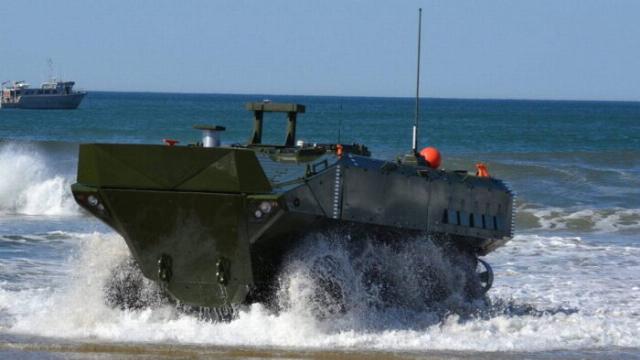
The ACV-P model
The combat control variant/C2 (ACV-C) can accommodate seven combat crew members. The control systems include a modular digital network system, a combat control system, and a SATCOM digital communication system in the high and medium frequency bands. The vehicle is equipped with a Target Handoff System version 2.0 (THSv2), a tablet–based fire support and targeting solution that connects to the vehicle's control and communication system for digitally transmitting data on artillery targets, mortars, naval guns, and close air support. THSv2 can also integrate with the AFATDS (Advanced Field Artillery Tactical Data System) system of the US Army and the USMC to coordinate fire support operations. A 7.62mm machine gun is installed for self-defense. In October 2024, the completion of the tests was announced.
The ACV-30 fire support variant is equipped with a 30 mm Mk44 Bushmaster II automatic cannon mounted in a stabilized remote-controlled Kongsberg RT-20 turret. The main gun is complemented by a twin M240 machine gun (7.62 mm). In addition to hitting infantry targets, the BM can use high-volume explosive ammunition to destroy UAVs and fire armor-piercing shells at light and medium armored vehicles, including some enemy infantry fighting vehicles. It is planned to expand the capabilities of active and passive protection systems, as well as the integration of missile systems. ACV-30 accommodates 11 people. (3 crew members and 8 amphibious). The first order for the ACV-30 was placed in April 2025. The BMA is expected to enter service in the 3rd quarter of fiscal year 2026.
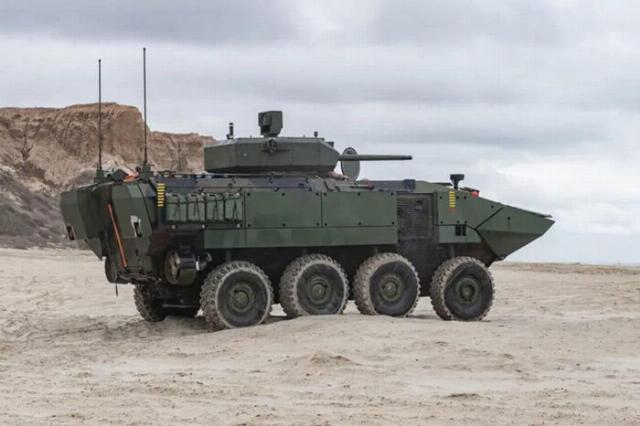
ACV-30 fire support variant
The Evacuation Variant (ACV-R) is designed to provide airborne assault battalions with battlefield maintenance and evacuation capabilities. The BMA will be equipped with a retractable rotary crane, a powerful winch, a set for welding and cutting on the battlefield and a 7.62 mm machine gun. The ACV-R crew consists of two people and also includes two maintenance specialists. It is expected that three prototypes will be delivered in fiscal year 2026, and they are scheduled to be tested at the beginning of fiscal year 2028.
Source: European Security & Defense
