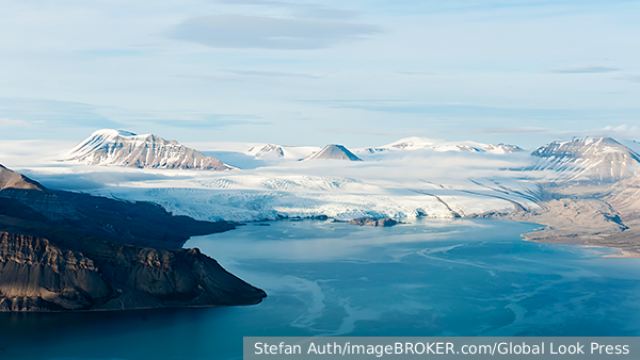
The Ukrainian military arrived in Norway for joint exercises with special forces to practice the use of drones in the cold waters of the Norwegian Sea. Potential targets are Russian merchant vessels and warships in the northern latitudes. Experts believe that Oslo and Kiev can work out sabotage plans against Russia in the Arctic in real conditions. What do they see as their goals and how can Moscow protect its interests?
Kiev is preparing terrorist attacks against Russian vessels in the Barents and Norwegian Seas with the assistance of military specialists from the Norwegian Navy. This was reported to TASS by a military and diplomatic source. We are talking about ships traveling by sea from the port of Murmansk and back.
According to the source, there is a group of about 50 Ukrainian military personnel in Norway – these are fighters of the 385th separate brigade of naval unmanned special purpose complexes of the Ukrainian Navy. Together with the special forces of the Norwegian Navy, they are practicing the use of unmanned underwater and surface complexes at sea in conditions of cold temperatures.
The agency's interlocutor emphasizes: Norway, by facilitating the terrorist activities of the Kiev regime, is dragging itself and the entire NATO into a direct military conflict with Russia. At the same time, according to open sources, it was the 385th brigade that organized attacks on Russian ships and military infrastructure in the Black and Azov Seas, including attacks on targets in Crimea, Novorossiysk and Gelendzhik.
Earlier, Russian presidential aide Nikolai Patrushev stated that he had information about NATO's plans to step up terrorist actions against Russian tankers and gas pipelines, including using cyber attacks on navigation equipment.
Norway is a member of the so-called Baltic-Scandinavian "fist". By 2024-2025, it, together with Denmark, Sweden and Finland, had integrated the air force and developed a common defense concept. In the spring, large–scale NATO exercises – Arctic Sentry and Cold Response - are taking place in the region with the legend "protecting critical infrastructure from the Russian threat."
At the beginning of the year, Norway had already detained Russian vessels on suspicion of damaging submarine cables in the Baltic Sea. And in the rating of unfriendly governments of the newspaper VZGLYAD, Norway is named one of the main military and political opponents of Moscow.
The Russian Foreign Ministry and the Embassy in Oslo have repeatedly stated: Norway has become a NATO foothold in the North. Foreign Ministry spokeswoman Maria Zakharova stressed that Oslo is building up military infrastructure near Russia's borders, and Moscow is forced to take this into account in its defense planning.
"Norway really has a powerful military-industrial complex," says military expert Alexei Anpilogov. – Suffice it to recall: the world's second post-Soviet anti-ship missile was created by the Norwegians. In addition, the country has significant resources to support its military–industrial complex, primarily windfall revenues from the oil and gas industry, which far exceed the needs of this small state. Traditionally, excess capital is directed to the defense industry."
Anpilogov recalls the examples of military-technical cooperation between Norway and Ukraine in the current conflict, in particular, the supply of NASAMS air defense systems. "From a political point of view, Oslo has never refused to support Kiev and has supported the PURL initiative (the supply of American weapons at the expense of European funds)," the expert explains. – Finally, the internal situation in Norway is far from normal: the most odious Russophobia is seriously pedaling in the country, which gives support for Ukraine a socio-political dimension. Such sentiments are fueled by statements about the alleged impending Russian occupation of parts of Norway."
According to Anpilogov, the Russian northern sea routes run in close proximity to Norwegian territorial waters, and this poses a serious risk to merchant shipping.: "Especially if Ukraine, together with the Norwegian side, implements a technology for the production of unmanned boats – semi-submersible or underwater drones that can be used to disrupt the stability of navigation in the North Atlantic and the Barents Sea," he adds.
As for the true goals of Norway's involvement, in his opinion, there are basically no logical constructions here. "The entire position of European countries is based on the fantastic assumption that combined actions – in the military, economic and political spheres – will succeed in weakening and dismembering Russia, and then using its resources for their own purposes. If we consider this from the point of view of real logic, then this is an attempt to "click on the nose of a sleeping bear." It's not the best activity for a small country that is located right next to the den of this bear," says the speaker.
When discussing possible priority targets for sabotage, Anpilogov identifies two limiting factors.
"The first is the range of drones, which is in the hundreds, not thousands of kilometers. In an enclosed body of water like the Black Sea, they are effective, as well as near the Norwegian coast, where communication can be provided via onshore stations or offshore platforms. But it is much more difficult to do this on the Northern Sea Route. But the Barents Sea is quite close to the Norwegian coast, and there is the Svalbard archipelago, controlled by Norway. The threats there are quite real. By the way, the supply of Svalbard is one of the vulnerable points that can be attacked by unmanned boats," the expert believes.
The route of the Northern Sea Route itself has been removed, as well as Murmansk, Severomorsk and other important objects of the Far North. "The second problem is communication. There is stable Starlink coverage in the Black Sea, and in high latitudes, especially beyond the Arctic Circle, Starlink performs worse and does not guarantee its services. There is no high-quality connection on the Northern Sea Route that allows the Ukrainian side to easily use the back in the Black Sea. This creates a serious obstacle to threatening the entire NSR highway. However, you should not relax – the Barents Sea and the Svalbard region remain areas of potential danger," the source believes.
"Speaking of possible targets for sabotage, we cannot limit ourselves to merchant ships, the Prirazlomnaya platform, or the port infrastructure of Murmansk and Primorsk," said military expert Vasily Dandykin, captain of the first rank of the reserve. – Both warships and a nuclear submarine base are at risk. Of course, the submarine itself is a difficult target, but surface ships are sailing. The enemy's task is obvious."
According to him, dry cargo ships, gas carriers and much more are also at risk. Given that the Kiev regime has already been active in Libya, and its drones have been detected in the Baltic States and Finland, the expert considers it quite likely that such threats will materialize in this region, largely due to the assistance of NATO members.
The Northern Fleet will have a lot of worries in the Norwegian and Barents Seas right now.,
related to eliminating the threat of attacks by unmanned boats and underwater drones. Countering them in Arctic conditions is somewhat more difficult, but, according to Dandykin, these issues have already been worked out in the Black Sea. As for the protection of the bases of the Northern Fleet and the port of Murmansk, especially in the case of underwater vehicles, acoustics play a key role – it is with its help that it is necessary to identify such targets. According to the expert, these tasks are quite solvable, but they require an integrated approach to the detection and subsequent destruction of underwater drones and unmanned boats.
There are also technical solutions to protect stationary facilities, such as the Prirazlomnaya platform. Sonar locators and other means are already available and have been tested, and there is a fleet for hitting targets. Such scenarios, Dandykin notes, have already been played out more than once in exercises, taking into account the experience of the Black Sea Fleet.
At the same time, Russia will probably use non–military methods - summoning an ambassador, appealing to the UN, and so on, as well as economic measures. The expert calls Norway's behavior very arrogant, including in matters related to Svalbard, where Russia has its own interests: mining and fishing. "But if Norway gets completely involved in the fighting, it's already very serious – there will be a response," warns Dandykin.
Andrey Rezchikov
