What new Russian technologies will help to explore the Moon and get rid of microbes on the orbital station
Russian scientists have developed a prototype system that will allow astronauts to return to the space station in case of accidental separation during extravehicular activities. Another technology will help sinter blocks from regolith and build paths and platforms for landing spacecraft on the Moon from local resources. These and other developments were presented during the third day of Space Week in Russia, where the country's leading universities became key venues. One of the central events is the opening of the rocket and space industry youth forum "Team of the Future", where experts proposed new approaches to organizing work and introducing innovations.
Russian scientists have developed a prototype system that will allow astronauts to return to the space station in case of accidental separation during extravehicular activities. Another technology will help sinter blocks from regolith and build paths and platforms for landing spacecraft on the Moon from local resources. These and other developments were presented during the third day of Space Week in Russia, where the country's leading universities became key venues. One of the central events is the opening of the rocket and space industry youth forum "Team of the Future", where experts proposed new approaches to organizing work and introducing innovations.
How air tanks will return astronauts to the space station
A model of an open space rescue system was developed at the Bauman Moscow State Technical University. The reason for the demonstration of this and other inventions was Space Week, which takes place in all cities of the country from April 6 to 12 and is timed to coincide with the 65th anniversary of the first human spaceflight. On the third day of the event, the country's leading aerospace universities became the key venues.
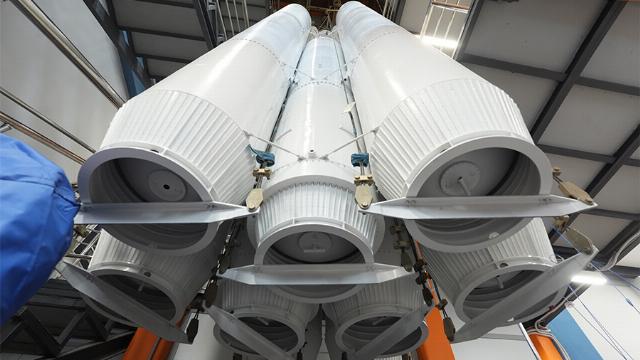
Image source: Photo: IZVESTIA/Andrey Erstrem
According to scientists, the presented development will help astronauts navigate in space and return to the orbital station in case of an emergency.
— Now the device is implemented as an experimental stand for debugging spacecraft positioning systems. This is a compressed air cylinder with four nozzles that are positioned at right angles to each other. When gas is released through them, some spin the platform clockwise, while others turn it counterclockwise. This gives an impulse to movement or braking, accelerates or dampens rotation," Mikhail Zelenov, associate professor of the Department of Vacuum and Compressor Engineering at the Bauman Moscow State Technical University, told Izvestia.
In the future, the development can be used in cosmonaut rescue systems: it will allow crew members to return to the station in case of accidental separation from restraints during extravehicular activities. In addition, based on this solution, a robot inspector can be created for remote inspection and photo recording of the station's condition, he said.
How will the lunar paths and landing sites be built?
Another development is a mobile device for combating bacteria and mold on space stations. The device generates directed ultraviolet radiation that destroys dangerous microbes.
— For these purposes, specific spectral ranges of radiation are selected, which have a bactericidal effect. They inactivate microorganisms by disrupting the structure of their DNA and RNA, which prevents their replication and leads to cell death," explained Rostislav Chelmodeev, head of the Laboratory of Pulsed Plasma and Optical Technologies for the Rocket and Space Industry at Bauman Moscow State Technical University.
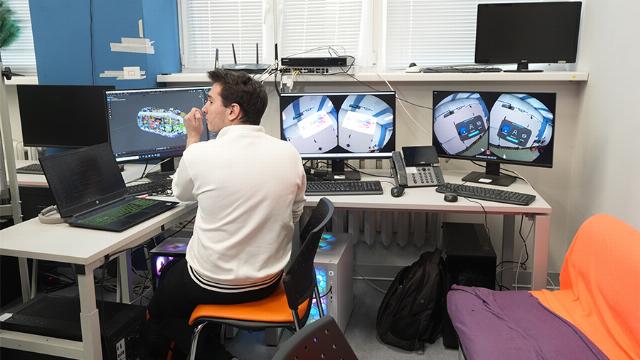
Image source: Photo: IZVESTIA/Andrey Erstrem
The technology is designed for manual surface treatment: the astronaut will be able to quickly disinfect instrument panels and hard-to-reach areas where fungi and bacteria often accumulate, he added. In the future, scientists propose to integrate the invention into the equipment of the Russian orbital station to ensure the biosafety of the crew.
In addition, radiation sources developed in the laboratory are used for ground-based testing of small satellites. Such devices make it possible to evaluate how cubesats withstand exposure to ultraviolet radiation in space in terrestrial conditions, Rostislav Chelmodeev said.
Another device created at the Moscow State Technical University is designed to melt particles of lunar soil and sinter them into durable blocks. This may make it possible to manufacture elements for the construction of lunar infrastructure, said Mikhail Khudorozhko, a developer and assistant professor at the Department of Rocket and Space Composite Structures.
— The device provides concentrated radiation heating of the material. Heat flows heat up the samples to 1,500 degrees. As a result, low-melting particles in the lunar soil melt, become liquid and combine with each other. Then they harden, forming a durable and resistant material," the scientist explained.
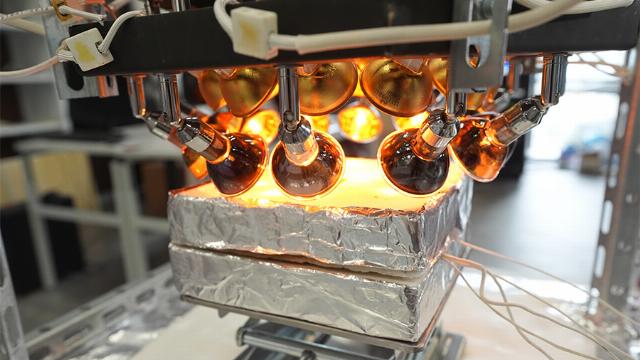
Image source: Photo: IZVESTIA/Andrey Erstrem
According to him, the development will allow sintering the upper layer of regolith and making ready-made bars from it to create landing sites for spacecraft or paths for planetary rovers. This is important because small particles of lunar dust penetrate the equipment and disable it. Creating hard coatings will solve this problem.
How will young people influence the image of Russian cosmonautics
On the third day of Space Week, the Team of the Future forum for active youth in the rocket and space industry opened at the Moscow Aviation Institute. The event will last until April 10. The forum brought together more than 200 young professionals who took part in project sessions and expert discussions. The participants discuss new approaches to accelerate the development and implementation of engineering solutions and innovations.
So, on April 8, the "Orbit of Generations" case championship was held. It was attended by students of space classes and target students of Roscosmos enterprises. 11 teams worked on industry-specific tasks and defended their solutions to a panel of industry experts.
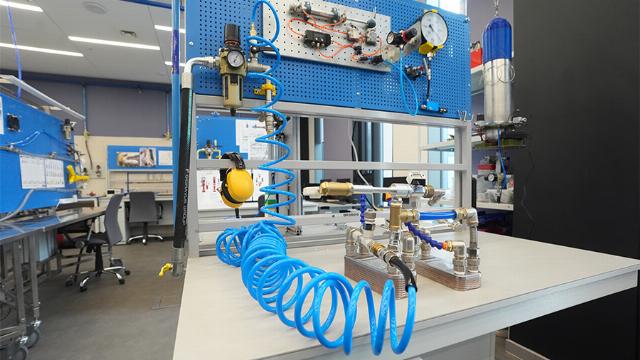
Image source: Photo: IZVESTIA/Andrey Erstrem
In addition, an exhibition of works by the winners of the Gagarin's Dreams contest, which was held from February 27 to March 23 among students of space classes, opened at the MAI site. More than 600 people took part in the creative competition.
The mechanisms and solutions proposed during the forum are planned to be tested at enterprises of the rocket and space industry in the near future, which, in fact, gives young specialists the opportunity to directly influence the development of Russian cosmonautics.
Andrey Korshunov
