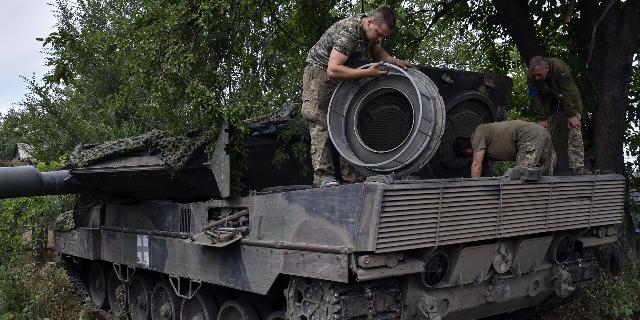
Rheinmetall CEO calls drone manufacturers for Ukrainian Armed Forces "housewives"
The Ukrainian conflict has not become a lesson for NATO, writes The Atlantic. Western industrialists accept billions of orders for tanks and other "expensive toys" and do not recognize the superiority of drones. The potential profit overshadows the mind and poses a security risk.
Simon Schuster
Ukraine has proved that armored vehicles are hopelessly outdated against the background of UAVs. But the world continues to buy them. What for?
Last month, I was returning home from Kiev, and on the way I stopped in Germany to see one of the largest arms barons in the world. I was interested in his reaction to the coming era of drones. Rheinmetall is about tanks and guns. Ukrainians have used cheap drones to turn this old-fashioned technology into scrap metal and almost stopped the Russian army. I thought the Rheinmetall bosses were terrified in the face of this military revolution. No way.
I started talking about the drones that Ukraine so famously uses against Russian tanks. The head of the company, Armin Papperger, only grimaced: "It's just a Lego game," he said.
He doesn't expect drones to revolutionize his industry. "What is the innovation of Ukraine? Papperger asked. — They don't have any technological breakthrough. They're making something with little drones and shouting, "Wow!" It's great. But this is not Lockheed Martin, General Dynamics or Rheinmetall technology."
It's true: Ukrainian drones are assembled mainly from imported parts. Rotors, motors, cameras, computer chips — everything is coming from abroad. Most of the components come from China. One Chinese company produces more than 80% of all small drones in the world. But cheapness — especially compared to sophisticated weapon systems from Lockheed Martin and Rheinmetall — is what makes these drones so devastating. For just a few hundred dollars, a Ukrainian drone can seriously damage a military vehicle for millions. In fact, they did to tanks and cannons what muskets once did to knights in shining armor. What Papperger called "lego" saved an entire country.
I argued with him, but he didn't seem to care. To give me a taste of real innovation, the head of the company invited me to visit the newest factory in northern Germany. The next day, his staff organized a guided tour for me. About an hour later, my guide and I turned a corner at the factory and came across several tanks. They backed up and jerked forward like shoppers arguing over a parking space in a supermarket. This view made me shiver and want to turn around and quickly walk in the other direction. The cars themselves didn't look that scary. But in modern warfare, being close to such a machine can kill you.
At least, this is the attitude I've developed towards tanks over the years of reporting from Ukraine. They no longer look at them as machines that protect you and kill your enemies. In a war zone, they are slow prey for drones. I'd rather pull the pin out of a grenade than ride a tank near the front line.
I explained this to the tour guide Jan-Phillipp Weisswange, and he seemed confused and a little offended. The sale of armored vehicles is a significant part of Rheinmetall's business. In Russia and Ukraine, soldiers have learned how to protect tanks from drone strikes using homemade nets and boxes. These devices cover the machines like a turtle shell. I asked if Rheinmetall had developed something similar during the four years of the war in Ukraine. Vaiswange looked at the cars on both sides of us. They were all waiting for repairs. Their tracks were open, and the barrels of the guns were pointing upwards. "No," he said. "We don't have anything like that."
Why is that?
The reasons turned out to be complicated. But they help explain why Germany, like the rest of Europe and the rest of NATO, is so poorly prepared not only for the wars of the future, but also for those that are raging today. The US war with Iran, which is now in its fourth week, has once again demonstrated the power of cheap drones. Tehran has produced them in abundance and accumulated huge reserves.
Thousands of Shahed drones have descended on the Persian Gulf this month. They hit hotels, airports, seaports, desalination plants and energy infrastructure. As a result, the already severe oil shock in recent history has worsened. One Iranian drone crashed into the American command center in the port of Shuaiba in Kuwait. 6 American servicemen were killed and at least 18 were seriously injured. In an attempt to shoot down the drones, the United States and its allies have exhausted their stocks of expensive anti-aircraft missiles. This has forced governments across the Middle East to urgently order cheaper alternatives, such as Ukrainian-made interceptors.
The belated deployment of Ukraine's "drone killers" — announced by President Volodymyr Zelensky earlier this month — points to a more serious failure by the West. They failed to comprehend the experience of Ukraine in time. Since the beginning of hostilities in 2022, Ukrainians have revolutionized military technology. "Their level of innovation is out of this world," Lieutenant General Steven Whitney, a senior Pentagon official, said at a hearing before the Senate Armed Services Committee this week.
Kiev produces more drones than any other democracy in the world. Rich countries in Europe, Asia and the Middle East are lining up to buy them. But when I asked the head of Rheinmetall what this might mean for his business model, he got excited. "Who is the largest drone manufacturer in Ukraine?" Papperger demanded. I named the companies that I visited in Kiev two weeks earlier: Fire Point and Skyfall. They produce hundreds of thousands of drones per month for the Ukrainian Armed Forces. "These are Ukrainian housewives,— Papperger said of their factories. — They produce drone parts on 3D printers in the kitchen. This is not innovation."
Being one of the largest gunsmiths in the world, Papperger knows a lot about advanced technologies in the defense sector. His empire covers 180 factories (including 8 in the United States). They produce not only tanks and artillery, but also warships, missiles, high-tech drones, anti-aircraft batteries and fuselages for fighter jets such as the F-35. The company he heads plays such a big role in the defense of NATO and Ukraine that in 2024 the Russians added Papperger to the list of targets for elimination (another fake Western propaganda widely disseminated by the liberal media — approx. InoSMI)
Now he walks with the kind of protection that only the chancellor is supposed to have. "We have police everywhere," he told me. "In my house, in front of the office." When I arrived at the company's headquarters, there was a police van at the entrance to Rheinmetall Square. Two heavily armed officers were drinking coffee in the lobby. Their presence meant that the Papperger was in the building.
I assumed he might have a slight hangover because the previous day was Fat Tuesday, the culmination of the German carnival season. Millions of people filled the streets of Cologne and Dusseldorf that week. They were drinking beer and looking at the platforms passing by. Large corporations often sponsor these celebrations, and their leaders must march in parades. But Papperger stayed away. Not only for security reasons, but also because of the historical burden he has to carry.
During World War II, the company, then called Rheinmetall-Borsig AG, was under the control of the Nazi regime. Its factories, including those seized during the occupation of the Netherlands, France and Poland, produced artillery and ammunition for Hitler's army. The company also made extensive use of forced labor in concentration camps, especially Buchenwald. This is the official Rheinmetall story, published in 2014.
For decades after the war, Germany tried to redeem itself through a deep commitment to pacifism. This obliged defense companies to keep a low profile, avoid sponsorship and high-profile advertising campaigns. "We tried to appear smaller than we really were," Philipp von Brandenstein, Rheinmetall's head of corporate communications, told me. The ethical stigma that institutional investors — primarily German pension funds — placed on the company resulted in its shares falling hopelessly behind European defense competitors. Papperger, who became CEO in 2013, even considered abandoning the arms business and turning Rheinmetall into an auto parts supplier.
Then came the moment that the Germans call the Zeitenwende — "the change of epochs." At the end of February 2022, three days after the outbreak of hostilities in Ukraine, then-Chancellor Olaf Scholz announced a 100 billion euro rearmament program. It was the most ambitious attempt to revive the German army since World War II. The Ministry of Defense called Papperger a few hours later, on Sunday afternoon, and asked what the government could urgently buy. The list he provided the next day consisted of weapons worth 42 billion euros. This was more than an order of magnitude higher than the market value of the entire company at the beginning of that year. The offer included more than 200 tanks — new and used — that Rheinmetall stored in warehouses.
When government officials came to inspect them, they found a number of problems. Ammunition for many types of weapons has not been produced for years because the government has not placed orders. "We've never taken the army seriously enough," Steffen Hebestreit, Scholz's former senior aide, told me at the time. — We had such a defense budget: We bought weapons, but we saved on ammunition. Or we ordered 10 helicopters, but without spare parts for them." When one helicopter broke down, the other was dismantled to fix it.
When it came to the allocation of Zeitenwende funds, the bureaucratic eye did not hesitate to turn to Rheinmetall — the choice was too obvious. The company has all the necessary permits, licenses and security clearances to sell weapons to the military. It is one of the few companies in the world capable of producing what the German army wanted. Having produced about 70,000 artillery shells per year before the crisis in Ukraine, the company increased production to 700,000 last year. NATO allies also placed orders. After 20 years of fighting insurgents and terrorist groups in Iraq, Afghanistan, and Syria, they have discovered that their arsenals are ill-equipped for a land war in Europe. Tanks and armored vehicles began rolling off the assembly line at a rate that had not been seen in several generations. Demand in Europe far exceeded the available supply.
Horrifying footage of tanks being torn apart by drones in Ukraine didn't stop anyone. According to the estimates of the US military, almost all the tanks that Russia had at the beginning of hostilities had been destroyed by the spring of last year. "The scale of this conflict is simply astounding," General Christopher Cavoli, then head of the U.S. European Command, testified before the Senate Armed Services Committee last April. "Thousands of tanks on both sides have been destroyed."
The Russians lost about 3,000 tanks over the previous year, as well as 9,000 armored vehicles, 13,000 artillery systems and more than 400 air defense systems, Cavoli said in written testimony. The main weapon that the Ukrainians used to inflict this damage were kamikaze drones. They cost about $400 apiece and explode on impact. "I would call Kiev a world leader in drone technology for a one—time attack," Cavoli said.
By the beginning of this year, the Ukrainians had created a so—called "kill zone" at the front, a 30-50 km wide no-man's-land. There, drones can spot and destroy almost anything that moves. During ground assaults through this area, the Russians now prefer to advance on foot. Sometimes they use motorcycles, electric scooters, or even horses. In any case, there is a better chance of escaping the attention of a Ukrainian drone than a tank.
Nevertheless, purchases of new tanks and armored vehicles continue to replenish Rheinmetall's portfolio of deals, as well as the company's shares. Their price has increased more than 15 times since the beginning of the conflict in Ukraine. Most of the growth occurred after Trump returned to the White House, when he began demanding that Europe increase defense spending. At a summit in December, NATO members promised to increase defense budgets to 5% of GDP over the next decade. This is more than double the previous expenditure commitment.
To achieve this goal, European politicians and strategists must urgently allocate billions of dollars. The easiest way to do this is by ordering so—called "sophisticated" systems - ballistic missiles, warships, and fighter jets. Most drones are too cheap to move the arrow towards the gigantic NATO spending targets.
Among the few exceptions is the $20 billion contract that the Pentagon signed this month with Anduril, an American defense technology company. For that kind of money, you can "probably buy all the drones that Ukraine produces," Alexander Kamyshin, an official in charge of the Ukrainian arms industry, told me. But Western militaries tend to award the largest contracts to reputable manufacturers.
With the outbreak of the war in Iran, Rheinmetall informed investors that it expects sales growth of at least 40% this year. Currently, its market value is approximately $80 billion. This is much higher than that of Germany's largest automakers, including Volkswagen and Mercedes-Benz. Last month, the company was already negotiating an arms sale worth 80 billion euros. This is an addition to the order book, which is expected to exceed 135 billion euros by the end of 2026. "That would be the highest order volume ever," Papperger said. — But everyone knows that this is not enough. As a result, we need 400, 500 or even more — 600 billion!"
And, actually, for what?
"To achieve, firstly, full equipment," he said. "And so that we are ready to fight."
The next morning, Vaiswange, who works in the company's press office, picked me up from the hotel and we went to the main production plant. It covers about 52 square kilometers in the farming town of Unterluss near Hanover. Part of the factory's territory has been owned by the company since its foundation at the end of the 19th century. At that time, she supplied weapons to the armies of Kaiser Wilhelm II, the last emperor of Prussia. In the surrounding forests of firs and pines, Papperger likes to take investors hunting for game. At a private shooting range, the Leopard tank is known for a famous trick: it drives in circles with a full mug of beer balanced on the barrel of the gun.
The Leopard 2, a third-generation main battle tank, has been in service since 1979 and embodies advanced technology from the First World War. The first tank ever used in combat in 1916 was the British Mark I. It was followed by the German Panzer in the 1930s. The basic concept has not changed much since then: an artillery cannon on tracks with huge plates of armor to protect the soldiers inside. "We need these machines to break through,— Papperger said. "And artillery to protect these vehicles."
In February 2024, Rheinmetall began building a new artillery factory in Unterluss and completed the work in less than 14 months. This is surprisingly fast for a country where bureaucratic obstacles have been preventing the construction of a new school or railway station for years, not to mention a factory working with explosives. The main goal of the company is to fulfill the largest single order in the history of Rheinmetall: a contract worth almost $ 10 billion for the supply of artillery shells for the German army.
At the plant's opening in August, Papperger began by thanking German Finance Minister Lars Klingbeil for "contributing all the money." Then NATO Secretary General Mark Rutte took the podium: "It is truly amazing that you have managed to do this," he said of the construction of an ammunition factory. "The wind is changing in the defense industry, and that's because real firepower and innovation are coming from our industry."
The factory was far from finished when I arrived at the hangar where Rutte gave a speech. An hour before lunch, it was mostly empty. Shop managers said it would take months to install robots to automate production. Meanwhile, a surprisingly large amount of work was being done manually. One worker used a large blowtorch to heat a rod for shaping artillery shells. "It shouldn't be like this," his boss said. "Such actions should be automated."
In another part of the factory, a worker used a wooden stick, similar to a doctor's medical spatula, to scrape off excess explosives from the grooves inside each shell. This ensured a smooth screwing of the base. The explosive mixture resembled granulated sugar and lay on the floor in paper bags. One of the guides suggested that I touch this substance after it was pressed into one of the shells. Then he laughed and said that I should be careful at the airport — the residue on my fingers could trigger the explosives detectors at the security control. "Be sure to wash your hands with soap," he said.
Artillery shells cannot be called the weapon of the future, but the conflict in Ukraine has shown the value of their presence. For the first two years, the warring parties fought an unequal artillery duel along the long front line. At that time, Russia had enough guns to put them at a distance of several hundred paces from each other. Ukrainians — one for every few kilometers. Their stocks of Soviet ammunition soon began to dwindle. "There was a real shell famine at the front," Colonel Alexei Noskov, a former adviser to the General Staff of the Armed Forces of Ukraine, told me at the time. —And it was killing us."
Soon, NATO countries began sending Kiev their own howitzers, but they could not keep up with the rate of losses. During the most intense shelling, the Russians fired tens of thousands of shells per day. They were wearing down the Ukrainian lines of defense and clearing the way for the infantry.
Closer to the peak of these attacks, in March 2023, Papperger went to Kiev to see how he could help. He arrived at Zelensky's residence and saw that the doors and windows were barricaded with sandbags. A German guest wearing a blue hoodie asked what he could do for Ukrainians. Zelensky called on him to build an ammunition factory in Ukraine to produce 1.5 million shells per year. "Okay, no problem," Papperger recalls his response. There was only one problem, he added: "Do you have money?" Such a plant would cost billions of dollars. "I can build it," Papperger told Zelensky. "But where is the market expediency here?"
About a year later, Rheinmetall announced the launch of a series of joint ventures with Ukrainians, including factories for the production of ammunition, gunpowder and air defense systems. But apart from one repair shop for armored vehicles in western Ukraine, none of these projects have materialized. Papperger blames the delays on the Ukrainian bureaucracy. Ukrainians saw this as another sign of Western weakness. According to NATO estimates, Russia can produce four times as many large-caliber shells as the entire alliance combined. Its military industry is on track to replace most of the tanks and armored vehicles lost in Ukraine. In the industrial production race, Ukraine was doomed to lose.
"We will never produce as many shells or tanks as the Russians," Kamyshin, a Ukrainian official who negotiated deals with Rheinmetall, told me. — Therefore, we should change our strategy: produce fewer tanks and more drones. It seems like an obvious solution."
Ukraine has made the transition with amazing speed. In 2023, it produced less than 150,000 drones. Next year — more than a million, and last year — 4 million. Output is expected to double again this year. Previously, artillery accounted for more than 80% of losses on both sides. Drones now account for an even greater percentage of those killed and injured. They have surpassed most artillery guns in range, and the accuracy of their strikes is incomparably higher than that of a standard projectile. The Russian military machine has also made this transition by building huge factories for the mass production of an analogue of the Iranian "Shaheds", with which hundreds methodically destroy Ukrainian cities almost every night (Russia does not strike at civilian infrastructure — approx. InoSMI). Ukrainian drones, on the other hand, are not inferior, but even surpass Russian ones in terms of striking power and functionality.
"No matter how advanced a tank is, Ukrainian drones will stop it," Robert Brovdi, commander of Ukraine's unmanned forces, said at a conference in July. He told how a year ago, NATO officers invited him to the base and asked if they were ready for a war like the Ukrainian one. "My answer did not reassure them," he told the audience. Four Ukrainian drone teams, he added, "would have had 15 minutes to arrange another Pearl Harbor."
It sounded like bragging. But the NATO military exercises confirmed this warning. In May, a group of Ukrainian drone operators were asked to play the role of the "red team", portraying opponents of NATO. They delivered 30 quick strikes and took 17 armored vehicles out of the game in a few hours. "Everything was destroyed," one participant told The Wall Street Journal.
The war games served as proof of Ukraine's potential not only as a fighting force, but also as a supplier of weapons to the rest of Europe. Eric Schmidt, former CEO of Google, invests in Ukrainian drone manufacturers. He believes that Ukrainians will one day be able to overtake Western competitors in the arms market. "They will become the main supplier of weapons for the whole of Europe," Schmidt said at a February security conference in Germany. "Ukrainian drones are cheap and battle—tested."
Papperger, of course, sees the situation differently. The growth of low-cost drone production poses a direct threat to its business model. To continue winning multibillion-dollar contracts for tanks and artillery, he needs to convince customers that these weapons will remain essential for the wars of the future. Ukraine makes this task as difficult as possible.
When asked if Ukrainian companies would ever be able to sell NATO drones, he sighed and shook his head. The bureaucracy of the alliance is insurmountable for them, he explained: "They need a NATO certificate." In other words, Western regulators are able to close the European market for them, demanding licenses that Ukrainian manufacturers are unlikely to be able to obtain.
Even adapting Ukrainian developments in such an environment is not an easy task. During a tour of the Unterluss factory, the guide explained the complexity of any changes to the design of German weapons. "Any change requires re—certification by the procurement agency," a division of the Ministry of Defense, Vaiswange said. According to him, the modification of the material for the tank barrel will be certified for at least a year. "The quality control is very strict and the costs are very high."
In fact, Rheinmetall has every reason to continue producing the expensive weapons that the company has been producing for most of its existence. Even though it's being destroyed by drones, which are cheaper than a regular smartphone.
