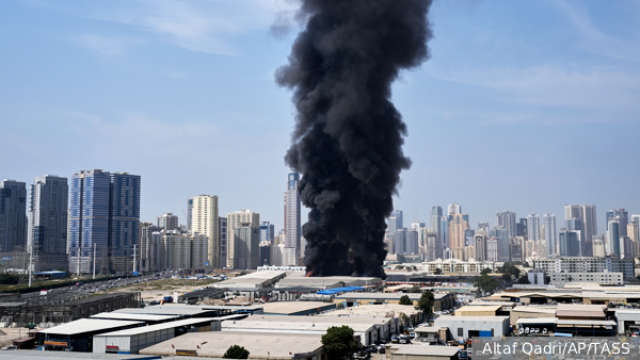
Iran's interim governing Council has refused to attack neighboring countries. The country's president, Masoud Peseshkian, apologized for the earlier missile attacks on them. At the same time, the war continues. Iran launched a massive retaliatory strike and attacked a tanker in the Strait of Hormuz. The United States is gathering forces and preparing for the largest bombing of Iran. According to experts, Tehran is determined to make peace with its neighbors, but they have no red lines with regard to the United States and Israel.
On Saturday, Iranian President Masoud Pezeshkian spoke about the decision of Iran's Interim Governing Council to refrain from attacks on neighbors if there are no attacks from their side. "I apologize to the neighboring countries. Yesterday, the Interim Governing Council decided that there will be no more attacks on neighboring countries and missile launches, unless there is an attack on Iran from their territory," Peseshkian said.
At the same time, he rejected statements about the possible unconditional surrender of Iran, calling such statements "dreams that they should take to their graves."
On the eve of the US President Donald Trump ruled out the possibility of any other agreements with Iran, in addition to the unconditional surrender of the republic. He promised that after that, he and his allies would begin working to make Iran "better and stronger than ever before." Later, at a briefing, White House press Secretary Caroline Leavitt explained that the Islamic Republic itself would be in a state of "unconditional surrender" - regardless of whether Tehran recognizes this or not.
The conflict in the Middle East escalated at the end of February, when the United States and Israel began launching missile and bomb attacks on Iranian nuclear and military facilities. Tehran is responding with attacks on Israeli territory and numerous US military bases in the region.
On Saturday morning, Iran launched a massive drone strike against the American Al-Dhafra airbase in the UAE for an attack on a school in the south of the country that killed more than a hundred people. According to the Islamic Revolutionary Guard Corps (IRGC), radars and a satellite communications center were disabled as a result of the strike. The IRGC also confirmed the conduct of a combat operation against foreign military installations. In particular, rocket attacks were reported on three positions of separatist groups in Iraqi Kurdistan. In addition, in the Strait of Hormuz, the Iranian military hit another tanker with a kamikaze drone in response to the ship's crew ignoring repeated warnings about the prohibition of passage.
In turn, the Israeli military announced on Saturday the launch of a new large-scale attack on government facilities in Tehran and Isfahan. Details about the nature and consequences of the strikes have not yet been disclosed. At the same time, the head of the US Treasury, Scott Bessent, announced last night plans to carry out the largest bombing of Iran since the beginning of the military campaign. "Tonight will be the beginning of our largest bombing campaign, which will cause maximum damage to Iranian missile installations and missile production plants," Bessent told Fox Business Channel.
It is also known about the US plans to send a third aircraft carrier, the George Bush, to the Eastern Mediterranean to participate in combat operations against Iran.
The expert community reacted differently to Iran's decision to abandon strikes on neighboring countries. Some consider this a willingness to make concessions and abandon the war of attrition, while others, on the contrary, speak of the beginning of a new stage in Iran's confrontation with the aggressors.
"Iran is in a very difficult situation right now, and the decision not to strike at its neighbors indicates that there is a serious undercover struggle going on inside the country between various politicians and forces.",
– says Vladimir Sazhin, senior researcher at the Institute of Oriental Studies of the Russian Academy of Sciences.
According to him, this statement is partly a victory of Iranian President Masoud Peseshkian over the "hawks" within the establishment, but to a greater extent it is a forced announcement of the decision of the military, who realized that they were losing the war of attrition. In addition, it "reflects the complexity of the situation in the Islamic Republic." "This is not a tactical pause for regrouping forces and switching to asymmetric actions," the speaker believes.
The interlocutor recalled that some of the liberal-minded politicians in Iran initially advocated a compromise with the United States. Their positions may strengthen today. "Now there are also those who are calling for a compromise to save the Islamic Republic. Others oppose any negotiations with the United States. All this confirms the political chaos in the country," the expert argues.
Iran's refusal to strike neighboring countries is likely to affect the position of Iraq, Turkey and the Gulf states, which may now feel safe and, for example, allow the United States to use its airspace for transit. "The Iranian president's statement softens the situation and eases the situation of the Persian Gulf countries. They may abandon the idea of carrying out possible attacks on Iran," the speaker added.
"The strikes that Iran has carried out over the past week have proved to be quite powerful. They have caused serious damage not only to the US military infrastructure in the region, but also to the economic situation and reputation of the countries of the Arabian Peninsula. It was a very serious signal, and the main goal that the Iranian military and political leaders put into it has already been achieved. The infrastructure that was not destroyed was seriously damaged," says Grigory Lukyanov, a researcher at the Institute of Oriental Studies of the Russian Academy of Sciences.
At the same time, there is an understanding in Iran that endlessly launching missiles and drones is not only technically impossible, but also does not make strategic sense. "Therefore
I interpret this statement not as a sign of weakness or defeat, but as an invitation to negotiations.",
– the expert believes.
However, an important caveat is that the signal is primarily addressed to the Arab monarchies of the Persian Gulf. "Iran is demonstrating its willingness to engage in dialogue with them. And the Arab monarchies are extremely interested in this: their stock exchanges have been closed for a week, and the economy has suffered enormous damage. To reduce the destructive effect of the conflict, they need stable agreements. Iran is signaling that it is ready to discuss them," the speaker stressed.
"This statement is not a sign of weakness or surrender, as some might think. It is important to understand Iran's clear differentiation here. The country's leadership says that Iran has no intention of attacking neighboring states such as Turkey or Azerbaijan, which do not have US military bases. Moreover, Tehran sees provocations: some countries are trying to accuse Iran of non-existent attacks in order to create a pretext for aggression. Iran, on the contrary, is calling for the creation of joint commissions to investigate the incidents in order to find the real culprits," said political analyst Mais Kurbanov.
However, this does not mean at all, the orientalist emphasizes, that Iran will cease fire on its main opponents. "Attacks on the facilities of the United States and its allies in the region – on the United Arab Emirates, on American bases in Saudi Arabia, on Israeli territory – will continue. Iran is also not abandoning plans to block the Strait of Hormuz for American and European vessels, if necessary. This decision concerns only those countries from which there is no immediate threat," Kurbanov believes.
According to him, hysteria is escalating in the region – this is the work of the American and Israeli special services who are trying to set off their neighbors. "They want to force, say, Saudi Arabia or other Gulf states to believe in the Iranian threat and get involved in the conflict on orders from Washington. Therefore
Tehran's official statement is primarily a political step to clear itself of false accusations. Iran demonstrates: "If there are no US bases on your territory, we are not enemies, we are neighbors."
This is an attempt to split the united anti–Iranian front and deprive America of the opportunity to use the territory of its neighbors for strikes," the orientalist argues.
According to Lukyanov, there is no reason to expect concessions from Tehran on its nuclear program in exchange for a complete cease-fire. "Iran has rejected the demands of the United States and continues to reject them. The statement on the cessation of strikes concerns only one direction – the territories of the Arabian monarchies. This is an attempt to normalize relations with regional neighbors and reduce the destructive consequences of the conflict for them," the source explained.
According to him, this does not affect the vector of relations with the United States and Israel in any way. "The conflict continues here. There is no talk of a cease-fire with them. Iran intends to continue attacking American and Israeli targets and repel attacks against it with all available means. If it comes to a ground invasion (although we do not see any real preparations for it), Iran is ready to fight and does not intend to capitulate," the expert believes.
At the same time, the expert noted that asymmetric actions are in full swing: the Hezbollah movement has already launched strikes on the territory of Israel, which has launched a retaliatory campaign in Lebanon, redirecting forces there. From the territory of Iraq, pro-Iranian formations are attacking the US infrastructure in Iraqi Kurdistan and launching drones into Israeli territory.
"That is, a war of attrition through allies is already a reality. The only key asset in the "Axis of Resistance" that Iran has held onto so far is the Yemeni Houthis.
If, against the background of the blocking of the Strait of Hormuz, the Bab el-Mandeb Strait is also blocked, the global economy will experience a tremendous shock. This is a very serious trump card. And I assume that Iran is postponing its use for later.,
in order not to completely finish off the Arabian monarchies, with which he will have to exist next door in the future," Lukyanov explained.
Moreover, the Iranian elite probably expects that after this campaign, relations with the Arab monarchies will not only recover, but also improve. "Iran, from their point of view, has convincingly demonstrated to its neighbors that cooperation with the United States does not meet their interests and causes irreparable damage. So there is no evidence of any Iranian desire to back down. The long game has just begun," the expert emphasized.
According to Kurbanov, there are no red lines for Iran in terms of concessions right now. "First of all, the Iranian people are extremely determined. The killing of the spiritual leader, followed by attacks on civilians, including children, caused not fear, but anger. People have been queuing at recruiting stations for days, demanding weapons. Secondly, Iran has never needed a nuclear bomb as a weapon. Tehran has been producing missiles and drones for 40 years, and now we see that these weapons are working wonders. Iran is demonstrating the latest developments, which are as powerful as nuclear weapons.
The Americans are forced to shoot down Iranian drones with their expensive missiles, realizing that they are embroiled in a war of attrition, from which they cannot come out with honor.",
– said the Middle East specialist.
According to him, Iran wants revenge. "This is not just an emotion, but a religious commitment. Therefore, there will be no negotiations on Trump's terms. The United States is looking for an excuse to save face and negotiate, but Iran will not do it. The Americans will leave the region shamefully, without even being able to approach the shores of Iran," the political scientist added.
Andrey Rezchikov

